
The board approved the shares. The documents were signed. The ownership records were updated.
For the company, the issuance may look finished.
For the recipient, a 30-day clock may already be running.
An 83(b) election allows an eligible taxpayer who receives substantially nonvested property in connection with services to elect to recognize the applicable compensation income based on the property’s value at the time of transfer, rather than waiting until it becomes substantially vested.
The election generally has to be filed with the IRS no later than 30 days after the property is transferred.
That deadline is one reason the 83(b) election matters beyond tax planning. It is also a good example of what happens after an equity issuance leaves the boardroom.
The company may have completed its approvals, documentation, and ownership records. The recipient may still need to determine whether an election applies, speak with a tax adviser, make a decision, file on time, and keep the supporting documentation.
One issuance. Several responsibilities. Different people holding each one.
What is an 83(b) election?
Section 83 of the Internal Revenue Code generally applies to property transferred in connection with the performance of services.
When the property is substantially nonvested, compensation income is recognized when the recipient’s rights become transferable or are no longer subject to a substantial risk of forfeiture.
An 83(b) election changes when that income is recognized.
If the election is made, the recipient includes in gross income for the year of transfer the difference, if any, between the property’s fair market value at the time of transfer and the amount paid for it.
If the property later increases in value before vesting, that appreciation is not treated as additional compensation under Section 83 simply because the property vests.
In practical terms, the election lets an eligible recipient choose to measure the applicable compensation income at transfer rather than waiting for vesting.
That can matter when the value of the property at transfer is close to what the recipient paid for it.
It can also work against the recipient if circumstances change.
Why can an 83(b) election matter?
Consider an employee who receives 100,000 shares of restricted stock subject to a four-year vesting schedule.
The employee pays $0.10 per share. The fair market value at the time of transfer is also $0.10 per share.
At that point, there may be little or no difference between the amount paid and the value used for purposes of Section 83.
Now assume the shares are worth $2.00 each when a portion of the stock later vests.
Without an 83(b) election, the normal Section 83 rules may result in compensation income being recognized as the substantially nonvested shares become vested, based on their value at that time.
With a timely 83(b) election, the applicable amount is instead determined at the time of the original transfer.
That difference in timing is the reason the election receives so much attention when restricted equity is transferred at a relatively low value.
There is a tradeoff.
If the recipient makes the election and later forfeits the shares, the tax rules do not simply reverse the election and return the tax previously paid on the elected amount. The regulations significantly limit the loss available following a forfeiture.
An election also cannot be revoked simply because the economics of the decision change. Section 83 provides that revocation requires the consent of the IRS.
This is why the decision belongs with the recipient and their tax adviser.
Does every equity grant require an 83(b) election?
No.
An 83(b) election is not a standard piece of paperwork that belongs with every equity award.
Restricted stock is one common situation in which the question can arise because the recipient has received property that remains subject to vesting or another substantial risk of forfeiture.
Options are different.
Most compensatory stock options do not have a readily ascertainable fair market value when granted. In those cases, the option grant itself is not eligible for an 83(b) election.
If substantially nonvested property is later received through the exercise of an option, however, an 83(b) election may apply to that property.
Statutory stock options, including incentive stock options, are subject to separate rules.
That makes blanket instructions particularly risky. “Everyone who receives options should file an 83(b)” is not a reliable rule.
The 30-day deadline is where administration gets involved
The filing period begins when the property is transferred.
That sounds straightforward until the documents and records surrounding the issuance are spread across several people.
Legal may have the executed agreement.
The board approval may sit with the corporate secretary.
Finance may update the ownership ledger a few days later.
The recipient may assume someone will tell them if there is anything else to do.
30 days is not much time when the approval is in one place, the signed agreement is in another, and nobody has written down who is responsible for the next step.
The company should not decide whether an 83(b) election is appropriate for the recipient.
But it should know when the transfer occurred. It should be able to retrieve the relevant documentation. The recipient should know that the issuance may have personal tax consequences and that those questions belong with their own adviser.
Those are administrative responsibilities, not tax advice.
Where does an 83(b) election sit in an equity issuance?
A restricted equity issuance might involve:
Approval → Documentation → Transfer → Ownership record update → 83(b) consideration, where applicable → Filing → Record retention
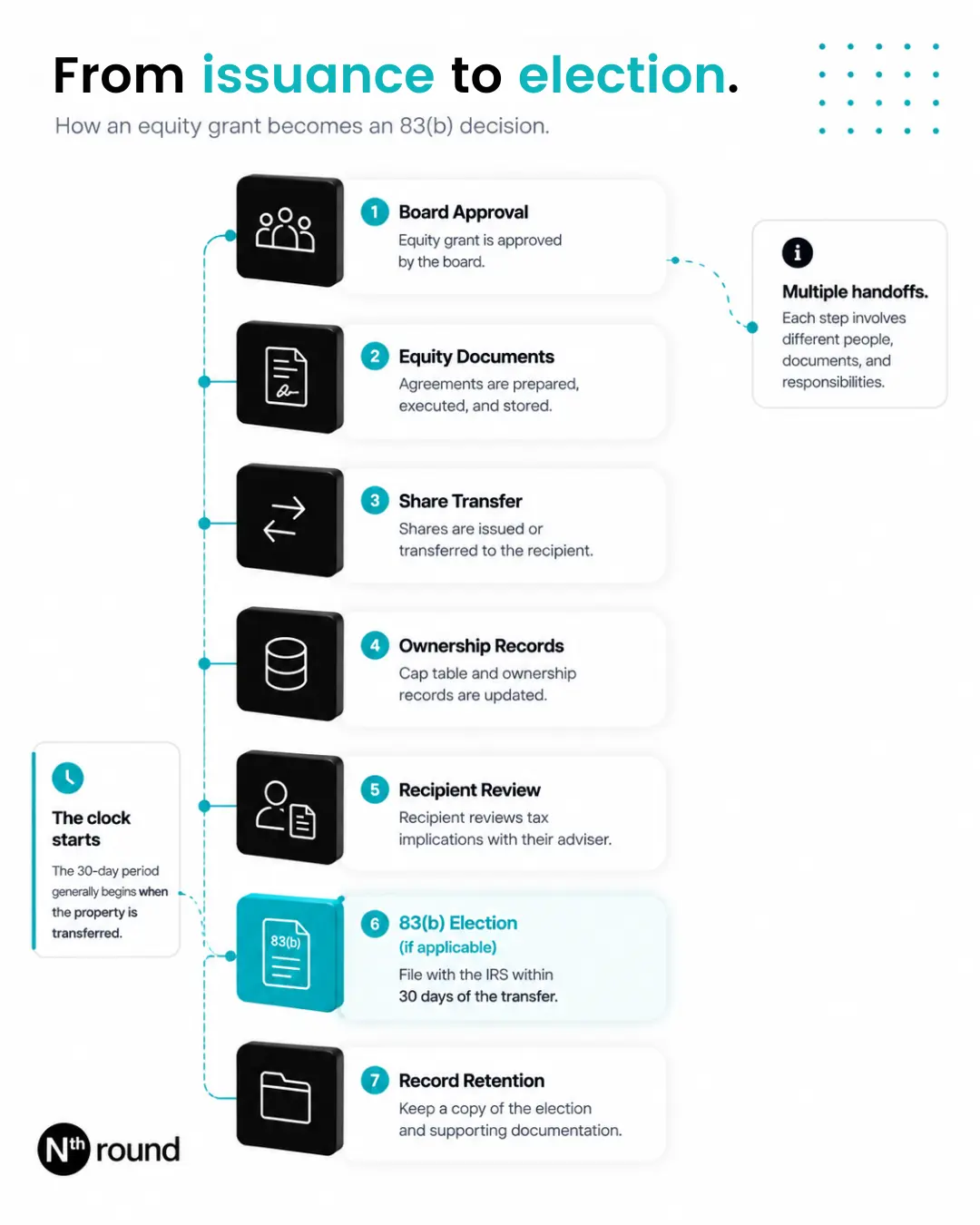
The sequence looks neat on paper. In practice, ownership changes hands between people at almost every step.
The board or an authorized committee approves the issuance.
Legal prepares or reviews the documents.
The recipient signs.
Finance, legal, or an equity administrator records the shares.
The recipient takes the tax question to an adviser.
If an election is made, the recipient files it.
No one person necessarily owns the whole process.
That is where companies tend to lose visibility. Each person completes a task, but nobody has a clear view of whether the entire issuance is complete.
A workflow is only as reliable as the handoff between one responsibility and the next.
For an 83(b) election, the consequences of a poor handoff are easier to see because the next step may have a statutory deadline attached to it.
What is the company responsible for?
The company is not responsible for deciding whether a recipient should make an 83(b) election.
It is responsible for running a clean issuance process.
At a minimum, that means the company should be able to answer some basic questions without reconstructing the transaction from email months later.
- When was the property transferred?
- Which documents governed the issuance?
- What vesting or forfeiture provisions applied?
- Was the issuance recorded correctly?
- Did the recipient receive the relevant documentation promptly?
- Was responsibility for any recipient-side follow-up clear?
If documentation was properly returned to the company, where was it stored?
None of those questions requires the company to give tax advice.
They do require the company to know what happened.
That distinction matters. Companies can respect the boundary around an individual tax decision while still running an issuance process that does not leave dates, records, and responsibilities open to interpretation.
How do you file an 83(b) election?
The IRS provides Form 15620, Section 83(b) Election, as a standardized form for making the election.
The form asks for information including the taxpayer’s identifying information, a description of the property, the transfer date, the restrictions that apply, the property’s fair market value at transfer, the amount paid, and the amount to be included in gross income.
According to the current IRS instructions, the completed and signed form is submitted by mail to the IRS office where the person performing the services files their federal income tax return.
The instructions also require the service provider to provide a copy to the person for whom the services were performed and, if different, the transferee of the property.
The 30-day deadline still applies.
Because filing procedures can change, recipients should use current IRS instructions and speak with a qualified tax adviser about their specific circumstances.
The bigger problem is often the space between systems
The 83(b) election is one tax issue. The administrative problem it exposes is much broader.
A private company may already have digital systems for every piece of the issuance.
The approval is digital.
The agreement is signed electronically.
The ownership ledger is online.
The recipient communicates through email.
The tax adviser has another system entirely.
Nothing is technically “manual” in the old sense.
The process still depends on one person remembering what comes next.
That is the weak point.
Digitizing individual steps does not create a complete ownership workflow when the handoffs still depend on memory.
This shows up far beyond 83(b) elections.
A shareholder onboarding can stall between signed documents and funding.
A transfer can be legally complete but not reflected in the ownership records.
A distribution can be approved while payment information is still missing.
A vote can close while the final governance record is sitting somewhere else.
The individual tasks may all have software behind them. What matters operationally is whether the company can see how those tasks connect.
What private companies should take away from the 83(b) process
An 83(b) election belongs to the taxpayer.
The company should not make that decision, recommend an outcome, or substitute its process for individual tax advice.
Its responsibility is narrower and more practical.
The issuance date should be clear.
The documents should be available.
The ownership records should match what actually happened.
The recipient should know when responsibility has passed to them.
And the company should be able to reconstruct the issuance later without relying on someone’s memory of an email thread.
That is the larger lesson from the 30-day deadline.
Private-company ownership rarely moves through one isolated transaction. An issuance sets off approvals, documents, signatures, record changes, communications, and sometimes actions that belong to people outside the company.
The work is not finished simply because each step exists somewhere.
It is finished when the people responsible for the next step know that the responsibility is theirs.
This article is provided for general informational purposes only and does not constitute legal, tax, or financial advice. The application of Section 83(b) depends on individual circumstances. Companies and equity recipients should consult qualified legal and tax advisers regarding their specific situations.