Stakeholder Communications

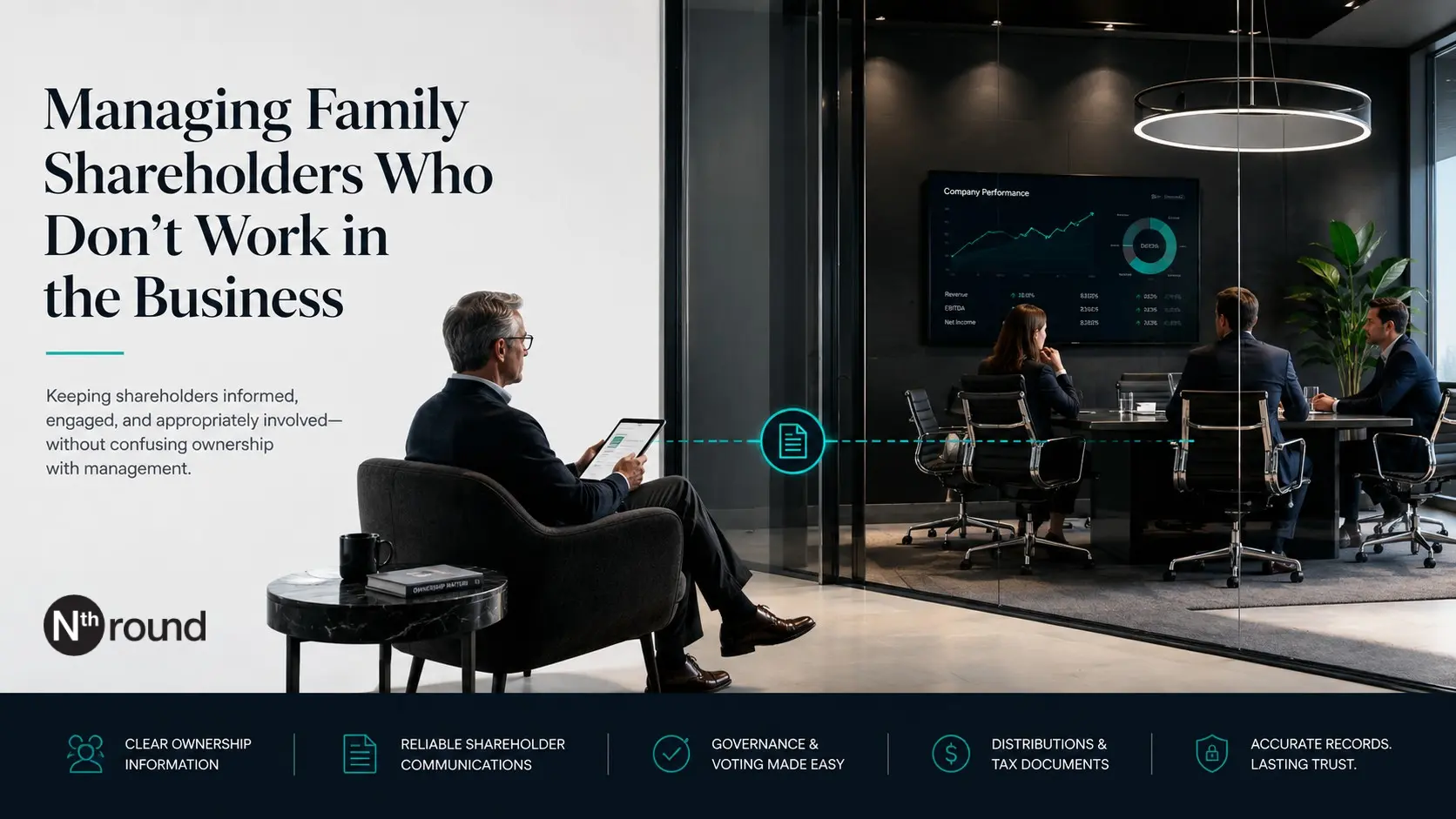
Managing Family Shareholders Who Don’t Work in the Business

Zohaib Khalid

I

August 20, 2026

As family ownership moves across generations, more shareholders may have no day-to-day role in the company. Keeping those owners informed, engaged, and appropriately involved requires a different approach to shareholder management.

In the early years of a family business, managing shareholders may not feel like a job at all.

The founder owns the company and runs it. A spouse may own shares. Perhaps a sibling or two is involved.

If an owner wants to know how the business is doing, they probably already know. They were in the meeting. They signed the agreement. They talked about the distribution over lunch.

Then ownership starts to spread.

One child joins the business. Another doesn't. Shares move to the next generation. Trusts become shareholders. Family branches develop. Some owners live nearby; others haven't worked for the company a day in their lives.

The business is still family-owned.

But the assumptions that worked when every shareholder was close to the business no longer work nearly as well.

A shareholder who doesn't work at the company still needs to understand their ownership. They may need information, documents, tax materials, distributions, voting opportunities, or a way to ask questions.

The challenge is providing that without confusing being informed as an owner with being involved as a manager.

For multi-generational family businesses, getting that distinction right becomes an important part of managing ownership.

Ownership and management eventually become different things

In the founder generation, the distinction between owning the business and running it can be almost invisible.

The founder may be the largest shareholder, CEO, board chair, and the person making most of the important decisions.

Then ownership spreads.

One child joins the company. Another becomes a doctor. A third builds a career somewhere else. Shares eventually pass to grandchildren or move into trusts.

All of them may have an economic interest in the same business.

They do not all have the same job.

That distinction matters.

Ownership does not automatically create a management role. And working in the business does not necessarily give someone greater rights as a shareholder.

Management is responsible for running the company. The board provides oversight and makes decisions within its authority. Shareholders have rights and responsibilities that come with their ownership and the company's governing structure.

In a family business, those lines can become blurry because the people involved aren't simply shareholders, directors, and executives. They're also parents, siblings, cousins, aunts, and uncles.

A family member may reasonably think, “I own part of this company. Why wasn't I involved in that decision?”

The answer may be that it wasn't a shareholder decision.

On the other side, someone running the company may think, “They don't work here. Why should they need to know?”

The answer may be that they're still an owner.

Neither side necessarily has bad intentions. They may simply be looking at the company through different roles.

That is why separating ownership from management doesn't mean keeping outside shareholders at arm's length.

It means being clearer about what belongs to each role.

A shareholder may need enough information to understand the performance of the business, participate in matters requiring shareholder action, understand their ownership, and make informed decisions when those decisions belong to them.

They don't need to participate in every operating decision to do that.

The goal is not to make every family shareholder a manager. It's to make it possible for them to be an informed owner.

The information gap grows when shareholders leave the building

Family members working inside the business absorb information almost without noticing it.

They hear how sales are going. They know the company is investing in a new facility. They understand why expenses increased. They know an acquisition is being considered or why management is being conservative with cash.

An outside shareholder doesn't have that context.

They may see an annual report, receive a distribution, attend a shareholder meeting, or hear about the company at a family gathering.

That creates an information gap that tends to widen as ownership spreads.

Consider a family member working in management who receives a smaller distribution than the year before.

They may already know that the company retained cash for a major capital investment.

Their cousin, who owns the same class of shares but works in another industry, simply sees less money arrive.

Same ownership event. Very different context.

That doesn't mean every shareholder needs the same information management has.

It does mean companies need to think deliberately about what shareholders should receive rather than assuming information will find its way through the family.

Keeping shareholders informed doesn't mean inviting them to run the company

This is where ownership and management can become tangled.

A family shareholder can have legitimate questions about the company without having a role in its daily operation.

How is the business performing?

How was my distribution calculated?

What am I being asked to vote on?

What restrictions apply to my shares?

Where can I find the shareholder agreement?

Who should I contact about my ownership?

Those are ownership questions.

Questions about which salesperson to hire, what a department should spend, or how management should execute its strategy belong somewhere else.

The distinction is easier to maintain when the company has established ways of communicating with shareholders.

Without them, information often travels through personal relationships.

One shareholder calls a sibling in management. Another calls the CFO. Someone asks a director at Thanksgiving. Different people hear different versions of the same story.

Over time, that can create a perception that the family members closest to the business have one level of access while everyone else has another.

Some difference in access may be entirely appropriate. A CEO obviously needs information that every shareholder does not.

The important part is making the difference intentional.

Good shareholder communication gives owners the information appropriate to their role without turning ownership into a seat on the management team.

The shareholder record becomes more important with every generation

The founder probably knows how to reach every shareholder.

That advantage doesn't last forever.

As a family expands, shareholder information becomes surprisingly easy to lose track of.

Someone moves.

Someone changes their last name.

A shareholder dies.

Shares move into a trust.

A trustee changes.

A family member changes banks.

An email address used for years stops working.

A shareholder moves overseas.

None of those changes is especially dramatic. Together, they determine whether the company can actually administer its owners.

A stale address can become a returned tax document.

An old email can become a missed shareholder notice.

Outdated banking information can delay a distribution.

An ownership record that doesn't reflect a trust correctly can create confusion when the company needs to determine who should receive information or act with respect to the shares.

This is why shareholder management becomes more than maintaining names and share counts.

The company's ownership records need to show not only who owns what, but also support the information required to administer those ownership relationships.

Shareholder communication needs somewhere to live

There is a point at which informal communication stops being enough.

That doesn't mean a family business needs to become impersonal.

Quite the opposite. Family ownership often benefits from communication that is more thoughtful and contextual than what a public-company shareholder would receive.

But important shareholder information shouldn't depend entirely on who happened to be copied on an email.

Companies may communicate financial updates, annual reports, shareholder letters, meeting materials, governance documents, distribution information, tax documents, or other ownership-related materials over the course of a year.

The question is whether shareholders know where to find those materials later.

An email from three years ago may technically still exist. That doesn't make it a good ownership record.

This becomes particularly important for outside shareholders because they don't have the fallback of walking into the finance office and asking for another copy.

Giving shareholders a reliable place to access the information and documents relevant to their ownership reduces that dependence on individual employees and old inboxes.

It also gives the company a more consistent way to manage shareholder communications across family branches and generations.

Governance feels different from outside the business

A shareholder vote is another moment when the difference between inside and outside shareholders becomes visible.

Someone working in the company may have heard a proposal discussed for months.

An outside shareholder may encounter it for the first time when voting materials arrive.

If the company needs shareholder approval, the shareholder needs enough information to understand what they are being asked to decide.

They also need the practical ability to participate.

Were the materials delivered?

Who is entitled to vote?

How much voting power does each shareholder have?

How do shareholders submit their votes?

Was the required approval threshold reached?

Where is the final result recorded?

For a small ownership group, companies can sometimes manage this manually without much trouble.

The process changes when ownership is spread across dozens of family members, trusts, family branches, and different classes of stock.

A vote is no longer simply a conversation among the people running the company.

It becomes a shareholder governance process.

And for the family member outside the business, these moments may be one of the few times each year when their role as an owner becomes particularly visible.

The experience matters.

Distributions are more than a payment

For many outside shareholders, distributions are the most tangible connection they have to the family business.

That can make them deceptively important.

From the company's perspective, a distribution involves much more than sending money.

The company needs to know who is entitled to receive it, calculate the appropriate amounts, maintain current payment information, execute the payments, reconcile them, and maintain the resulting records.

Depending on the company and payment, tax reporting may follow.

From the shareholder's perspective, another question matters:

Why this amount?

A shareholder working inside the business may understand the company's approach to retained earnings and distributions because they see the underlying economics.

Outside shareholders may need more context.

That doesn't mean management needs to defend every capital-allocation decision individually. It does mean families benefit when shareholders understand how distributions fit into the company's broader ownership philosophy.

Otherwise, a process that the company views as routine can become a recurring source of confusion.

Tax season exposes weak shareholder information quickly

Tax documents are another recurring test.

Depending on the company's structure and the nature of the shareholder's interest, an owner may receive documents such as a K-1 or 1099-DIV.

The company may prepare everything correctly and still have a bad shareholder experience if the document goes to an old address or disappears into an email inbox.

And unlike a shareholder who works in finance, an outside owner may not know who inside the company is responsible for fixing the problem.

This is the less glamorous side of family ownership.

Nobody builds a succession plan around the question of where a cousin will find a tax document in February.

But once ownership spreads, these small administrative interactions make up a meaningful part of how shareholders experience the company.

Good ownership administration is often noticed most when it isn't there.

Trusts and family branches add another layer

As family businesses move through generations, the shareholder list may stop being a list of individual family members.

Shares may be held in trusts or other entities. Different family branches may hold different amounts. Trustees or other fiduciaries may become part of the ownership structure.

Now a simple question such as “Who is the shareholder?” can have several layers.

Who legally holds the shares?

Who should receive communications?

Who has authority to vote?

Who receives economic benefits?

Who should have access to particular documents?

The answers depend on the ownership arrangement and applicable governing documents, and companies should work with their legal and tax advisers on the specifics.

Operationally, though, the lesson is straightforward:

The company needs records capable of reflecting the ownership structure it actually has.

A spreadsheet designed when five individuals owned the company may become increasingly awkward when the shareholder base includes trusts, representatives, multiple family branches, and different relationships to the business.

The complexity isn't theoretical. It appears every time the company needs to communicate, vote, pay, transfer, or report.

Liquidity becomes a shareholder-management issue too

Outside shareholders may also think about liquidity differently from family members working in the business.

An executive whose career and ownership are both tied to the company may have one perspective on holding shares for another 20 years.

A cousin who has never worked there may have another.

As ownership spreads, financial circumstances also diverge.

One shareholder may want to keep every share they inherit.

Another may want money for a home, education, retirement, or an investment outside the family company.

The company may have transfer restrictions, redemption provisions, buy-sell arrangements, periodic liquidity programs, or other mechanisms governing what happens when an owner wants to sell.

Whatever the structure, shareholders benefit from understanding it before they need liquidity.

Otherwise, the company can find itself explaining decades-old ownership rules at the exact moment a shareholder wants an outcome those rules don't allow.

That is not just a legal-document issue.

It's a shareholder relationship issue.

Family ownership can remain personal without remaining informal

There is a temptation to view more structured shareholder administration as something that makes a family company feel corporate.

It doesn't have to.

The goal isn't to replace relationships with systems.

It's to stop relying on relationships to perform jobs they weren't designed to perform.

A cousin shouldn't need to know which person in accounting maintains the distribution spreadsheet.

A trustee shouldn't have to search an old email chain to find the latest shareholder document.

A family member shouldn't need an uncle on the board to explain how to participate in a vote.

And the company shouldn't depend on one longtime employee remembering the history behind every ownership record.

Structure can actually protect the personal side of family ownership.

When the administrative basics work, conversations between family members can spend less time locating documents, correcting records, and chasing routine information.

The company has to prepare for the next generation too

We often talk about succession as preparation.

Prepare the next CEO.

Prepare the board.

Prepare the next generation.

Preparing the next generation for ownership matters enormously. Future family shareholders should understand the business they're going to own, their rights and responsibilities, the family's approach to governance, and what ownership will—and won't—mean for them.

But preparation runs in both directions.

If ten members of the next generation will eventually own shares, the company needs to be ready for ten shareholder relationships.

If some shares will move into trusts, the ownership records need to accommodate trusts.

If future owners live across the country, shareholder communication cannot depend on everyone being in the same room.

If more shareholders will sit outside the business, information can no longer depend on what people happen to hear at work.

And if those shareholders will eventually vote, receive distributions, access documents, consider liquidity, and pass their shares to another generation, the ownership workflows behind those events need to work for them too.

The family can prepare people for ownership.

The business has to prepare for the ownership structure they're about to create.

In the early years of a family business, managing shareholders may not feel like a job at all.

The founder owns the company and runs it. A spouse may own shares. Perhaps a sibling or two is involved.

If an owner wants to know how the business is doing, they probably already know. They were in the meeting. They signed the agreement. They talked about the distribution over lunch.

Then ownership starts to spread.

One child joins the business. Another doesn't. Shares move to the next generation. Trusts become shareholders. Family branches develop. Some owners live nearby; others haven't worked for the company a day in their lives.

The business is still family-owned.

But the assumptions that worked when every shareholder was close to the business no longer work nearly as well.

A shareholder who doesn't work at the company still needs to understand their ownership. They may need information, documents, tax materials, distributions, voting opportunities, or a way to ask questions.

The challenge is providing that without confusing being informed as an owner with being involved as a manager.

For multi-generational family businesses, getting that distinction right becomes an important part of managing ownership.

Ownership and management eventually become different things

In the founder generation, the distinction between owning the business and running it can be almost invisible.

The founder may be the largest shareholder, CEO, board chair, and the person making most of the important decisions.

Then ownership spreads.

One child joins the company. Another becomes a doctor. A third builds a career somewhere else. Shares eventually pass to grandchildren or move into trusts.

All of them may have an economic interest in the same business.

They do not all have the same job.

That distinction matters.

Ownership does not automatically create a management role. And working in the business does not necessarily give someone greater rights as a shareholder.

Management is responsible for running the company. The board provides oversight and makes decisions within its authority. Shareholders have rights and responsibilities that come with their ownership and the company's governing structure.

In a family business, those lines can become blurry because the people involved aren't simply shareholders, directors, and executives. They're also parents, siblings, cousins, aunts, and uncles.

A family member may reasonably think, “I own part of this company. Why wasn't I involved in that decision?”

The answer may be that it wasn't a shareholder decision.

On the other side, someone running the company may think, “They don't work here. Why should they need to know?”

The answer may be that they're still an owner.

Neither side necessarily has bad intentions. They may simply be looking at the company through different roles.

That is why separating ownership from management doesn't mean keeping outside shareholders at arm's length.

It means being clearer about what belongs to each role.

A shareholder may need enough information to understand the performance of the business, participate in matters requiring shareholder action, understand their ownership, and make informed decisions when those decisions belong to them.

They don't need to participate in every operating decision to do that.

The goal is not to make every family shareholder a manager. It's to make it possible for them to be an informed owner.

The information gap grows when shareholders leave the building

Family members working inside the business absorb information almost without noticing it.

They hear how sales are going. They know the company is investing in a new facility. They understand why expenses increased. They know an acquisition is being considered or why management is being conservative with cash.

An outside shareholder doesn't have that context.

They may see an annual report, receive a distribution, attend a shareholder meeting, or hear about the company at a family gathering.

That creates an information gap that tends to widen as ownership spreads.

Consider a family member working in management who receives a smaller distribution than the year before.

They may already know that the company retained cash for a major capital investment.

Their cousin, who owns the same class of shares but works in another industry, simply sees less money arrive.

Same ownership event. Very different context.

That doesn't mean every shareholder needs the same information management has.

It does mean companies need to think deliberately about what shareholders should receive rather than assuming information will find its way through the family.

Keeping shareholders informed doesn't mean inviting them to run the company

This is where ownership and management can become tangled.

A family shareholder can have legitimate questions about the company without having a role in its daily operation.

How is the business performing?

How was my distribution calculated?

What am I being asked to vote on?

What restrictions apply to my shares?

Where can I find the shareholder agreement?

Who should I contact about my ownership?

Those are ownership questions.

Questions about which salesperson to hire, what a department should spend, or how management should execute its strategy belong somewhere else.

The distinction is easier to maintain when the company has established ways of communicating with shareholders.

Without them, information often travels through personal relationships.

One shareholder calls a sibling in management. Another calls the CFO. Someone asks a director at Thanksgiving. Different people hear different versions of the same story.

Over time, that can create a perception that the family members closest to the business have one level of access while everyone else has another.

Some difference in access may be entirely appropriate. A CEO obviously needs information that every shareholder does not.

The important part is making the difference intentional.

Good shareholder communication gives owners the information appropriate to their role without turning ownership into a seat on the management team.

The shareholder record becomes more important with every generation

The founder probably knows how to reach every shareholder.

That advantage doesn't last forever.

As a family expands, shareholder information becomes surprisingly easy to lose track of.

Someone moves.

Someone changes their last name.

A shareholder dies.

Shares move into a trust.

A trustee changes.

A family member changes banks.

An email address used for years stops working.

A shareholder moves overseas.

None of those changes is especially dramatic. Together, they determine whether the company can actually administer its owners.

A stale address can become a returned tax document.

An old email can become a missed shareholder notice.

Outdated banking information can delay a distribution.

An ownership record that doesn't reflect a trust correctly can create confusion when the company needs to determine who should receive information or act with respect to the shares.

This is why shareholder management becomes more than maintaining names and share counts.

The company's ownership records need to show not only who owns what, but also support the information required to administer those ownership relationships.

Shareholder communication needs somewhere to live

There is a point at which informal communication stops being enough.

That doesn't mean a family business needs to become impersonal.

Quite the opposite. Family ownership often benefits from communication that is more thoughtful and contextual than what a public-company shareholder would receive.

But important shareholder information shouldn't depend entirely on who happened to be copied on an email.

Companies may communicate financial updates, annual reports, shareholder letters, meeting materials, governance documents, distribution information, tax documents, or other ownership-related materials over the course of a year.

The question is whether shareholders know where to find those materials later.

An email from three years ago may technically still exist. That doesn't make it a good ownership record.

This becomes particularly important for outside shareholders because they don't have the fallback of walking into the finance office and asking for another copy.

Giving shareholders a reliable place to access the information and documents relevant to their ownership reduces that dependence on individual employees and old inboxes.

It also gives the company a more consistent way to manage shareholder communications across family branches and generations.

Governance feels different from outside the business

A shareholder vote is another moment when the difference between inside and outside shareholders becomes visible.

Someone working in the company may have heard a proposal discussed for months.

An outside shareholder may encounter it for the first time when voting materials arrive.

If the company needs shareholder approval, the shareholder needs enough information to understand what they are being asked to decide.

They also need the practical ability to participate.

Were the materials delivered?

Who is entitled to vote?

How much voting power does each shareholder have?

How do shareholders submit their votes?

Was the required approval threshold reached?

Where is the final result recorded?

For a small ownership group, companies can sometimes manage this manually without much trouble.

The process changes when ownership is spread across dozens of family members, trusts, family branches, and different classes of stock.

A vote is no longer simply a conversation among the people running the company.

It becomes a shareholder governance process.

And for the family member outside the business, these moments may be one of the few times each year when their role as an owner becomes particularly visible.

The experience matters.

Distributions are more than a payment

For many outside shareholders, distributions are the most tangible connection they have to the family business.

That can make them deceptively important.

From the company's perspective, a distribution involves much more than sending money.

The company needs to know who is entitled to receive it, calculate the appropriate amounts, maintain current payment information, execute the payments, reconcile them, and maintain the resulting records.

Depending on the company and payment, tax reporting may follow.

From the shareholder's perspective, another question matters:

Why this amount?

A shareholder working inside the business may understand the company's approach to retained earnings and distributions because they see the underlying economics.

Outside shareholders may need more context.

That doesn't mean management needs to defend every capital-allocation decision individually. It does mean families benefit when shareholders understand how distributions fit into the company's broader ownership philosophy.

Otherwise, a process that the company views as routine can become a recurring source of confusion.

Tax season exposes weak shareholder information quickly

Tax documents are another recurring test.

Depending on the company's structure and the nature of the shareholder's interest, an owner may receive documents such as a K-1 or 1099-DIV.

The company may prepare everything correctly and still have a bad shareholder experience if the document goes to an old address or disappears into an email inbox.

And unlike a shareholder who works in finance, an outside owner may not know who inside the company is responsible for fixing the problem.

This is the less glamorous side of family ownership.

Nobody builds a succession plan around the question of where a cousin will find a tax document in February.

But once ownership spreads, these small administrative interactions make up a meaningful part of how shareholders experience the company.

Good ownership administration is often noticed most when it isn't there.

Trusts and family branches add another layer

As family businesses move through generations, the shareholder list may stop being a list of individual family members.

Shares may be held in trusts or other entities. Different family branches may hold different amounts. Trustees or other fiduciaries may become part of the ownership structure.

Now a simple question such as “Who is the shareholder?” can have several layers.

Who legally holds the shares?

Who should receive communications?

Who has authority to vote?

Who receives economic benefits?

Who should have access to particular documents?

The answers depend on the ownership arrangement and applicable governing documents, and companies should work with their legal and tax advisers on the specifics.

Operationally, though, the lesson is straightforward:

The company needs records capable of reflecting the ownership structure it actually has.

A spreadsheet designed when five individuals owned the company may become increasingly awkward when the shareholder base includes trusts, representatives, multiple family branches, and different relationships to the business.

The complexity isn't theoretical. It appears every time the company needs to communicate, vote, pay, transfer, or report.

Liquidity becomes a shareholder-management issue too

Outside shareholders may also think about liquidity differently from family members working in the business.

An executive whose career and ownership are both tied to the company may have one perspective on holding shares for another 20 years.

A cousin who has never worked there may have another.

As ownership spreads, financial circumstances also diverge.

One shareholder may want to keep every share they inherit.

Another may want money for a home, education, retirement, or an investment outside the family company.

The company may have transfer restrictions, redemption provisions, buy-sell arrangements, periodic liquidity programs, or other mechanisms governing what happens when an owner wants to sell.

Whatever the structure, shareholders benefit from understanding it before they need liquidity.

Otherwise, the company can find itself explaining decades-old ownership rules at the exact moment a shareholder wants an outcome those rules don't allow.

That is not just a legal-document issue.

It's a shareholder relationship issue.

Family ownership can remain personal without remaining informal

There is a temptation to view more structured shareholder administration as something that makes a family company feel corporate.

It doesn't have to.

The goal isn't to replace relationships with systems.

It's to stop relying on relationships to perform jobs they weren't designed to perform.

A cousin shouldn't need to know which person in accounting maintains the distribution spreadsheet.

A trustee shouldn't have to search an old email chain to find the latest shareholder document.

A family member shouldn't need an uncle on the board to explain how to participate in a vote.

And the company shouldn't depend on one longtime employee remembering the history behind every ownership record.

Structure can actually protect the personal side of family ownership.

When the administrative basics work, conversations between family members can spend less time locating documents, correcting records, and chasing routine information.

The company has to prepare for the next generation too

We often talk about succession as preparation.

Prepare the next CEO.

Prepare the board.

Prepare the next generation.

Preparing the next generation for ownership matters enormously. Future family shareholders should understand the business they're going to own, their rights and responsibilities, the family's approach to governance, and what ownership will—and won't—mean for them.

But preparation runs in both directions.

If ten members of the next generation will eventually own shares, the company needs to be ready for ten shareholder relationships.

If some shares will move into trusts, the ownership records need to accommodate trusts.

If future owners live across the country, shareholder communication cannot depend on everyone being in the same room.

If more shareholders will sit outside the business, information can no longer depend on what people happen to hear at work.

And if those shareholders will eventually vote, receive distributions, access documents, consider liquidity, and pass their shares to another generation, the ownership workflows behind those events need to work for them too.

The family can prepare people for ownership.

The business has to prepare for the ownership structure they're about to create.

Frequently Asked Questions

Can a family member own shares without working in the family business?

Yes. Family-company ownership and employment are separate roles. A family member may own shares without serving as an employee, executive, or director. As family ownership spreads across generations, it is common for shareholders to have different levels of involvement with the operating business.

What information should family shareholders receive?

The appropriate information depends on the company, its governing documents, applicable law, and the shareholder's role. Family businesses commonly provide shareholder communications, financial or company updates, governance materials, ownership information, tax documents, and other information relevant to the shareholder relationship.

How should a family business communicate with shareholders who don't work there?

The specific approach varies, but consistency matters. Companies may use shareholder meetings, periodic updates, shareholder letters, secure document access, and other communication methods to ensure outside shareholders receive appropriate information without relying on informal family or employee channels.

How can family businesses keep shareholder records current?

Companies need a reliable process for maintaining ownership information as shareholders move, change contact or banking information, transfer shares, establish trusts, or experience other ownership changes. The ownership record should be updated as those events occur rather than reconstructed only when the information is needed.

How do trusts affect shareholder management in a family business?

Trust ownership can introduce additional parties and relationships into the shareholder record, including trustees, beneficiaries, and other representatives. Voting authority, communications, distributions, information access, and other matters depend on the trust arrangement, company documents, and applicable law.

Why is liquidity important for family shareholders?

Private-company shares generally do not offer the same ready market as publicly traded securities. As family ownership expands, different shareholders may have different financial needs and time horizons. Clear expectations around transfers, redemptions, buy-sell arrangements, or other liquidity mechanisms can help shareholders understand their options before a liquidity need arises.