A shareholder buys into the company.
A board approves a new equity grant.
Shareholders are asked to vote.
A distribution goes out.
An employee retires and sells shares back to the business.
Each can look like a single event on the ownership record. None of them is particularly simple once the work behind the record is considered.
A new shareholder may require documents, approvals, funding, an ownership update, access to company information, and ongoing communications.
A shareholder vote requires a record date, an eligible voting population, voting materials, responses, tabulation, and a final record of the outcome.
A distribution starts with an approved amount but eventually depends on accurate ownership data, payment information, calculations, payments, and reporting.
Different people may handle each part. Different systems often hold the information.
That is the reality behind private-company ownership.
The transaction may be what appears on the cap table. The workflow is everything required to make that transaction happen and administer what comes next.
What is an ownership workflow?
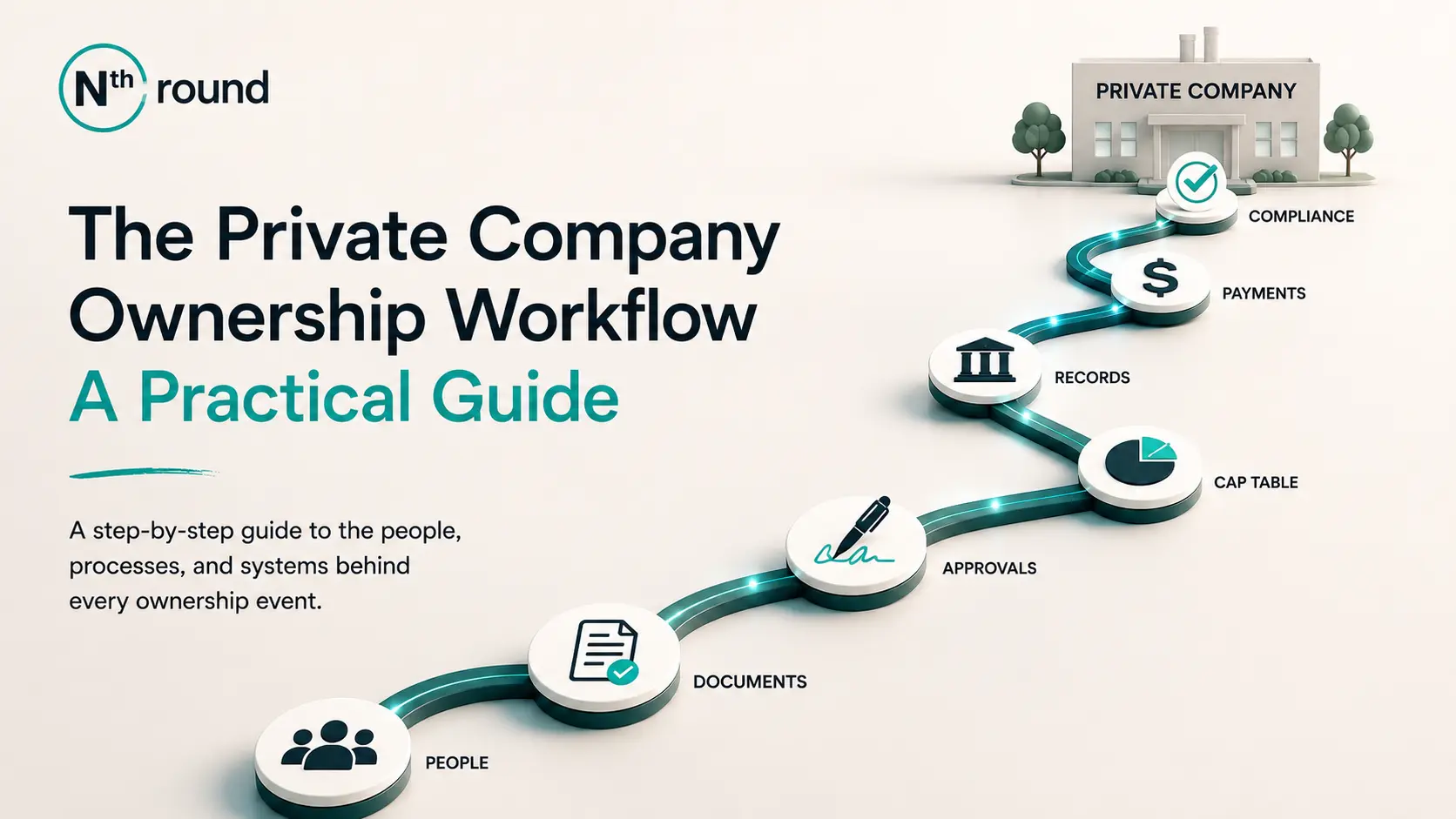
An ownership workflow is the sequence of information, documents, decisions, approvals, actions, records, and communications required to carry an ownership event from beginning to end.
That definition is intentionally broader than automation.
A workflow can be entirely manual. It can also be almost entirely digital and still require substantial manual coordination.
Consider a company issuing shares to a new investor.
The investor information is collected through an online form.
The subscription agreement is signed electronically.
The board approval is stored digitally.
Funds arrive by electronic transfer.
The cap table is maintained online.
The new shareholder receives documents through email.
Every individual step is digital.
Someone may still need to check the bank account, tell legal the funds arrived, confirm the issuance can close, ask finance to update the ownership record, send the shareholder their information, and make sure the right documents were retained.
The software changed.
The coordination did not.
Digitizing individual steps is not the same as digitizing the workflow.
For private companies, these workflows tend to fall into three broad areas: Equity Issuance, Governance, and Ownership Operations.
They overlap more often than the categories suggest.
1. Equity issuance workflows
Equity issuance is where ownership begins, but an issuance rarely begins or ends with a cap table entry.
Depending on the transaction, the process can involve collecting information, preparing agreements, obtaining corporate approvals, satisfying closing conditions, receiving funds, issuing the equity, updating ownership records, and communicating with the new owner.
A new investor might move through something like:
Investor information → Qualification, where applicable → Subscription documents → Approval → Funding → Issuance → Ownership records → Shareholder access
An employee receiving restricted equity will follow a different path.
A family member receiving shares through a transfer will follow another.
The point is not to create one universal issuance checklist. There isn't one.
The company needs to know which path applies to the ownership event in front of it.
New shareholder and investor onboarding
Adding a shareholder is one of the clearest examples.
The cap table needs a name, security, quantity, and transaction date. But those data points are the result of work that happened before the record changed.
Was the issuance approved?
Were the necessary agreements signed?
If money was required, was it received?
Did the transaction require the new shareholder to join an existing shareholder agreement?
When did the ownership actually transfer?
Once the transaction closed, was the shareholder given the appropriate access and information?
We covered those steps in more detail in our guide to onboarding a new shareholder in a private company.
The important connection is what happens next. The information established during onboarding becomes the starting point for future distributions, votes, tax reporting, transfers, redemptions, and communications.
Poor onboarding rarely stays an onboarding problem.
Equity grants and post-issuance responsibilities
Employee and service-provider equity creates its own set of dependencies.
Approval and documentation may be followed by vesting administration, ownership-record updates, valuation considerations, and other responsibilities depending on the type of equity.
Some responsibilities also sit with the recipient.
An 83(b) election, for example, may become relevant when substantially nonvested property is transferred in connection with services. The taxpayer generally has only 30 days from the transfer to make the election.
The company should not make that tax decision for the recipient. But a well-run issuance should not leave basic facts such as the transfer date buried in an agreement or unclear between departments.
This is a recurring characteristic of ownership workflows: the next step may belong to someone else, but the information needed to take that step often comes from the one before it.
2. Governance workflows
Ownership creates rights as well as records.
Depending on the company, its governing documents, and the matter at hand, shareholders may need to receive information, provide consent, vote, execute documents, or participate in other governance events.
Consider a shareholder vote.
The visible event is the result: approved or not approved.
Getting to that result can require considerably more work.
The company needs to determine who is entitled to vote and the voting power associated with those shares. Materials need to be prepared and distributed. Shareholders need a way to respond. Votes need to be collected and tabulated correctly. The result needs to be documented and retained.
A simplified process might look like:
Proposal → Eligibility and voting power → Materials → Distribution → Voting → Tabulation → Outcome → Governance record
That process can become complicated quickly when a private company has multiple share classes, trusts, family branches, employee owners, or other ownership structures with different rights.
And unlike a public company, a closely held business may be managing relationships among shareholders who expect to own the company together for decades.
The governance record has to survive longer than the email thread.
Approvals and consents
Not every governance event requires a formal voting campaign.
Companies regularly need board or shareholder approvals, written consents, signatures, resolutions, and records showing that a particular action was authorized.
The paperwork itself is rarely the hardest part.
The harder questions come later.
Who needed to approve it?
Who actually approved it?
Were the applicable thresholds met?
Which version was executed?
Where is the final document?
Was the resulting ownership action reflected in the company’s records?
These questions become particularly uncomfortable when they are first asked during an audit, transaction, shareholder dispute, or diligence process.
Good governance is partly about making the decision correctly. It is also about being able to show, years later, how that decision was made.
3. Ownership operations workflows
Issuing the shares establishes ownership. Governance defines how some ownership rights are exercised.
Then there is everything involved in shareholder management over time: keeping information current, communicating with owners, distributing documents, making payments, and maintaining the records those activities depend on.
For many established private companies, this is where a large share of the recurring work lives.
Distributions.
Tax documents.
Transfers.
Redemptions.
Payments.
Shareholder information.
Document delivery.
Ownership changes involving trusts or estates.
These events happen against an ownership structure that may have been accumulating complexity for years.
Distributions
A distribution can look simple from the shareholder’s perspective: money arrives.
Inside the company, the process starts much earlier.
The distribution needs to be authorized. The company needs an accurate record of who owns what. The appropriate amount needs to be calculated for each recipient. Payment information has to be current. Payments need to be executed and reconciled. The transaction needs to be recorded. Depending on the circumstances, tax reporting may follow.
Something closer to this is happening behind the payment:
Approval → Ownership record → Calculation → Payment information → Distribution → Reconciliation → Reporting
An error early in that sequence travels.
If the ownership data is wrong, the calculation can be wrong.
If the shareholder information is stale, payment can fail.
If the transaction record is incomplete, reporting and reconciliation become harder later.
The payment is only one step.
Tax document delivery
The same pattern appears during tax season.
A company may need to distribute documents such as 1099-DIV forms or K-1s, depending on its structure and the nature of the payments or allocations involved.
Generating the document is part of the job.
The company also needs accurate shareholder information, correct tax data, a reliable way to deliver the document, and a record of what was sent.
If a shareholder changed addresses three years ago and nobody updated the ownership records, that small onboarding problem has now become a tax-document problem.
Ownership workflows have a long memory.
Transfers and redemptions
Transfers and redemptions make that especially clear.
A shareholder wants to transfer shares. An employee-owner retires. A family member moves shares into a trust. The company repurchases an ownership interest.
Each event changes the ownership record, but the record should be the result of the process rather than the starting point.
Transfer restrictions may need to be reviewed.
Approvals may be required.
Valuation or pricing provisions may apply.
Documents need to be executed.
Payment may need to occur.
Certificates or other ownership evidence may need to be canceled or reissued.
Only then can the company be confident that its ownership records reflect what actually happened.
At a company with hundreds of shareholders or a steady stream of employee buy-ins and redemptions, these are not occasional administrative events.
They are recurring operating processes.
The cap table sits underneath all three
Equity issuance, governance, and ownership operations look like different categories of work.
They share one dependency: the ownership record.
A vote depends on knowing who is entitled to vote.
A distribution depends on knowing who owns what.
A redemption changes who owns what.
A new issuance changes everyone’s relative ownership.
A transfer changes the parties associated with an existing interest.
The cap table is therefore more than a report produced after these events. It is infrastructure used by the next event.
That creates a difficult cycle when ownership records are maintained separately from the processes changing them.
A transaction happens.
Someone updates a spreadsheet.
A document stays with legal.
Finance maintains another record.
A shareholder's information changes in an email.
Months later, the next ownership event begins using whichever version someone believes is current.
This can work for a surprisingly long time.
Then something forces the records to reconcile.
Where private-company ownership workflows tend to break
Most workflow problems are not dramatic.
They are gaps.
A document was signed, but nobody updated the ownership record.
A transfer was approved, but the final document stayed with outside counsel.
A shareholder changed their banking information, but the distribution file still has the old account.
A new owner was added to the cap table, but nobody added them to shareholder communications.
A vote was completed, but the final record is difficult to reconstruct.
A departing employee's redemption is waiting because nobody is quite sure which valuation applies.
Individually, these look like administrative mistakes.
At scale, they become an operating model.
The company compensates with people who know where things are. Someone maintains a spreadsheet. Someone else keeps a checklist. Legal knows which agreements matter. Finance knows which report is actually current. The corporate secretary knows where the signed version lives.
Eventually, the process becomes dependent on institutional memory.
That is usually when a seemingly simple request starts taking days.
More software does not necessarily solve the problem
Private companies have no shortage of digital tools.
Electronic signatures can solve signatures.
Cloud storage can solve document access.
Online banking can move money.
Cap table software can maintain ownership records.
Email can distribute information.
Tax software can produce tax forms.
Each may do its individual job well.
But ownership events move across those boundaries.
A signature can trigger an ownership change.
An ownership change can affect a vote.
A distribution relies on the ownership record and shareholder payment information.
A redemption requires documents, ownership data, approvals, payment, and a resulting cap table change.
If the connection between those steps is still managed through email, spreadsheets, reminders, and institutional knowledge, the workflow itself has not really been digitized.
The fragmentation has simply moved online.
What does a well-managed ownership workflow look like?
It does not mean eliminating people from the process.
Private-company ownership involves judgment. Lawyers need to interpret agreements. Boards need to make decisions. Finance needs to verify information. Shareholders sometimes need individual attention.
The objective is not automation for its own sake.
A well-managed workflow makes a few things much easier to establish:
What happened?
The company can see the ownership event and the actions that produced it.
What happens next?
A completed step does not leave the next responsibility sitting invisibly in someone's inbox.
Who owns the next action?
Responsibility is clear even when work moves between finance, legal, executives, shareholders, and outside advisers.
Which information controls the process?
The workflow operates from reliable ownership and shareholder data rather than competing versions.
Where is the record?
Approvals, documents, transactions, communications, and outcomes can be found later without reconstructing the event from memory.
Those questions sound simple.
Answering them consistently becomes harder as the shareholder base grows, ownership structures become more complicated, and the number of ownership events increases.
Ownership complexity compounds
A private company does not start every year with a clean ownership structure.
It carries its history forward.
The investor onboarded five years ago is part of today's distribution.
The employee granted shares three years ago may be part of tomorrow's redemption.
The trust created during a family transfer may participate in the next shareholder vote.
The agreement signed during an earlier transaction may determine whether shares can be transferred today.
Every ownership event becomes part of the starting point for another.
This is especially visible in family-owned businesses, where ownership may move across generations, trusts, family branches, and different shareholder roles while the company continues operating under the same ownership structure.
That is why disconnected administration tends to become harder over time, even when the number of shareholders grows slowly.
The problem is not simply more data.
It is more relationships between the data, documents, people, rights, responsibilities, and events surrounding ownership.
Private-company ownership happens through workflows
A cap table can tell a company who owns what today.
It cannot, by itself, run everything that ownership requires.
Shares have to be issued.
New owners have to be onboarded.
Approvals have to be obtained.
Votes have to be run.
Distributions have to be paid.
Tax documents have to be delivered.
Transfers and redemptions have to be completed.
Records have to remain accurate after each one.
These are not separate administrative chores that happen to involve the same shareholders.
They are connected parts of managing private-company ownership.
Equity Issuance. Governance. Ownership Operations.
For companies managing these processes across a growing or complex shareholder base, see how Nth Round supports private companies with ownership management, governance, shareholder communications, and administration.
Different workflows. One ownership structure underneath them.
The companies that manage this well are not necessarily the ones with the most software.
They are the ones that can move an ownership event from one responsibility to the next without losing the information, the record, or the person who needs to act.