Your CFO knows why margins were down last quarter.
Your CEO knows why the company held back cash instead of making a larger distribution.
Your cousin who inherited shares two years ago probably does not.
Neither does the investor who backed the company five years ago and now hears from management a few times a year.
That gap matters.
Private-company shareholders can own the same business and have completely different views of what is happening inside it.
One shareholder may sit in management meetings every week. Another may live three states away. One may understand the financial statements immediately. Another may be looking at a distribution notice and wondering why the check is smaller than last year.
If the company does not provide enough context, people fill in the blanks themselves.
That is usually where communication problems begin.
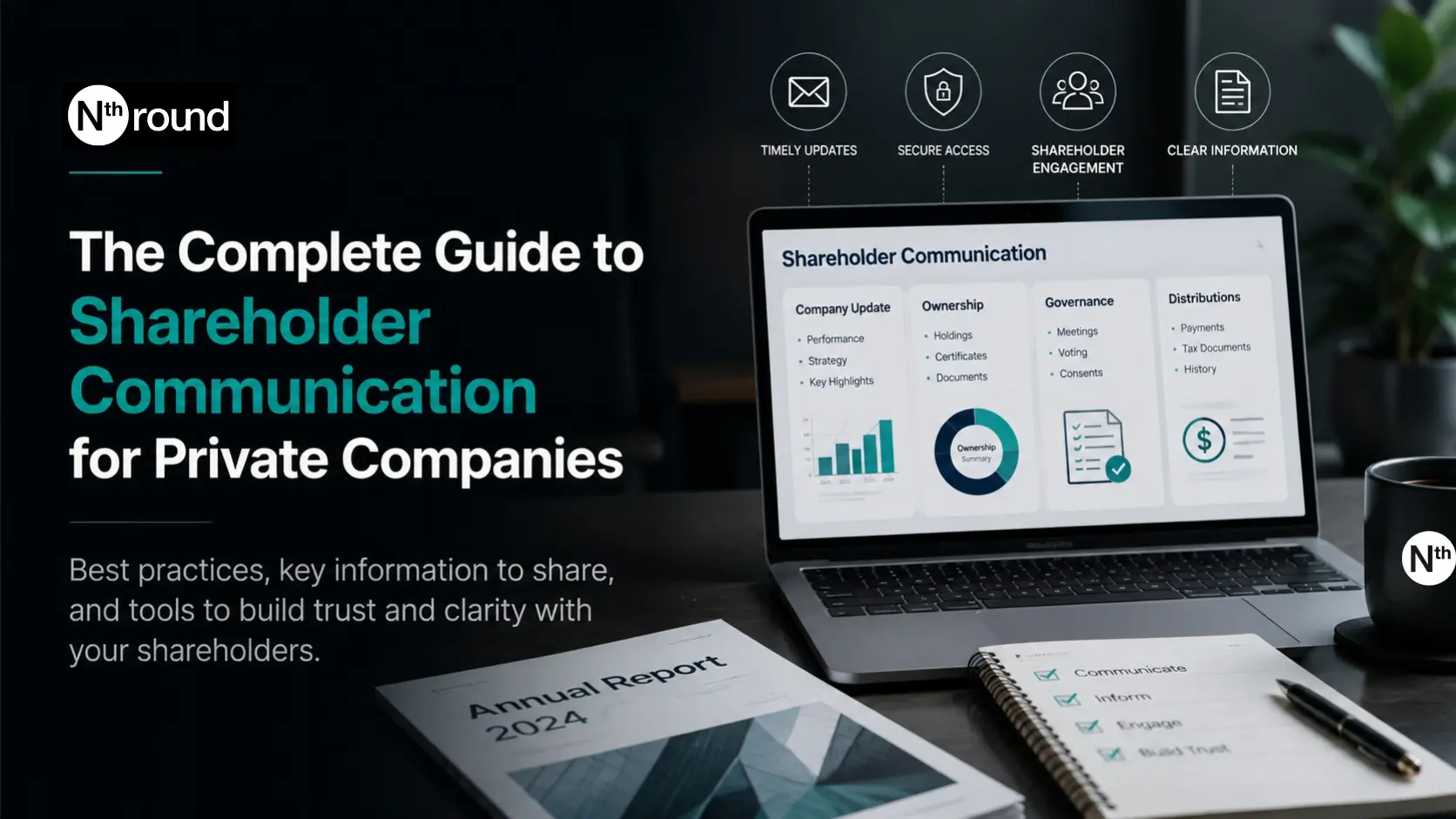
Shareholder communication is not about sending more emails. It is about making sure owners understand what they need to know, can find the information that belongs to them, and know what to do when the company needs something back.
What is shareholder communication?
Shareholder communication is simply how a company keeps its owners informed.
Sometimes that means talking about the business.
How did the year go?
What is management focused on?
Why did profitability move?
What is the company investing in?
Sometimes it is more personal to the shareholder.
How many shares do I own?
Where is my stock certificate?
When is the distribution going out?
Where can I find last year's K-1?
And sometimes the company needs something from the shareholder.
Please vote.
Please sign this consent.
Please update your banking information.
Please review these meeting materials before Friday.
Those are all shareholder communications, but they are not the same kind of interaction.
That is one reason email alone can become difficult as ownership gets more complicated.
The numbers usually need a story
Imagine sending shareholders a spreadsheet showing that earnings declined 15%.
Management knows exactly why.
The company hired ahead of growth. It invested in a new facility. A large customer delayed an order. Whatever the explanation is, the people running the business have been living with it for months.
A shareholder outside the company sees one thing:
Earnings down 15%.
Now they are left to come up with their own explanation.
Maybe the company is struggling.
Maybe management made a bad decision.
Maybe the smaller distribution they received is connected to it.
A good shareholder update does not need to read like an earnings call.
But it should help owners understand what changed and why.
Numbers tell people what happened.
Context tells them what it means.
That is especially important in a private company because shareholders cannot simply pull up public filings, analyst reports, and an investor-relations website to fill in the gaps.
If management has important context, somebody has to share it.
Your shareholders are not all starting from the same place
This becomes obvious in a family business.
Say three cousins each own part of the company.
One works there.
One sits on the board but has a career somewhere else.
The third inherited shares last year and has never worked in the business.
Send all three the exact same financial package and they will not get the same thing out of it.
The first cousin may already know why the numbers look the way they do.
The second has some context.
The third may still be trying to understand what retained earnings are.
That does not mean every shareholder needs their own custom newsletter.
It does mean companies should stop assuming that information management finds obvious will also be obvious to owners.
We wrote about this recently in our piece on preparing the next generation for ownership in a family business.
Someone can inherit shares much faster than they can inherit thirty years of context about the company.
They may not know why shares cannot simply be sold.
They may not understand how distributions are decided.
They may not know which decisions belong to management and which decisions belong to shareholders.
Communication is one way families close that gap before it turns into frustration.
The stakes get higher when communication goes wrong, which is something we have also explored in The Impact of Poor Shareholder Communication on Family Businesses.
Shareholders mostly want reasonable answers to reasonable questions
A lot of shareholder communication comes down to questions that are not particularly complicated.
How is the company doing?
What do I own?
Why did my distribution change?
Where is my tax document?
What am I being asked to vote on?
Can I see the shareholder agreement?
What happens if I want to sell my shares?
Who do I contact if my address changes?
The problem is not that shareholders ask these questions.
They should.
The problem is when every question starts a scavenger hunt inside the company.
Someone checks an inbox.
Someone else looks through a shared drive.
Finance opens a spreadsheet.
Legal has another version of the document.
A former employee might know where the historical record came from.
Eventually, someone finds the answer.
That is communication too, just an inefficient version of it.
We have written separately about why shareholder communication breaks down. Often, nothing dramatic went wrong. The company simply outgrew a process built around a handful of people who all knew one another.
Email is useful. It is not a shareholder record.
Email gets blamed for too much.
It is still one of the easiest ways to tell shareholders something.
Need to announce a meeting?
Send an email.
Need to remind everyone that voting closes Friday?
Email works.
Need to explain a complicated transaction to a major shareholder?
Maybe call them.
Need to talk through a difficult year with family owners?
That may deserve a meeting.
The problem starts when email is asked to do everything else too.
You email a shareholder their stock certificate.
Three years later, they ask for another copy.
You email a K-1.
Their accountant needs it six months later.
You email meeting materials.
A new shareholder wants to look back at last year's documents.
Now somebody inside the company has to find and resend information that already went out once.
One request is not a big deal.
Neither are five.
At fifty, the process starts looking different.
Email is good at delivering information. It is not particularly good at being the permanent home for that information.
Tax season exposes this quickly
Tax season is probably one of the easiest ways to see whether your shareholder communication process actually works.
The company sends the documents.
Then the requests start.
“I can't find my K-1.”
“Can you resend my 1099?”
“Do you have last year's form too?”
“Can you send it to my accountant?”
Sometimes the shareholder changed email addresses. Sometimes they deleted the message. Sometimes the document is sitting right there in their inbox and they still cannot find it.
That is normal human behavior.
The answer cannot always be, “Please search your email more carefully.”
The company may have communicated correctly when it sent the document.
The shareholder still has an access problem.
That distinction matters.
Sending something and making it accessible are different jobs
Think about a stock certificate.
If you email it to the shareholder, you have delivered it.
What happens two years later?
Or think about an annual meeting.
You send materials before the meeting. Everyone reviews them. The meeting happens.
Eighteen months later, one shareholder wants to revisit something.
Where do they go?
For a lot of private companies, the answer is:
Ask somebody.
That works when there are ten shareholders and everybody knows who that somebody is.
It gets harder when there are seventy-five owners spread across different states, family branches, trusts, and careers.
At that point, it helps to separate two ideas.
Communication is what the company sends.
Access is what the shareholder can find later without asking the company to send it again.
You need both.
What should private companies actually communicate?
There is no universal list.
What a company shares depends on its structure, governing documents, shareholder agreements, legal obligations, and what is actually happening in the business.
But there are a few areas that come up again and again.
Company performance
Shareholders should have enough information, where appropriate, to understand how the business is doing.
That may include financial results, strategic priorities, large investments, leadership changes, or important developments.
The useful part is often the explanation.
If the company retained more cash this year, say why.
If margins declined because the business deliberately invested ahead of growth, explain that.
If management is worried about something, shareholders should not always have to discover it after the fact.
Ownership information
People also want to understand their own position.
How many shares do I have?
What class are they?
Where is my certificate?
Did a recent transfer change anything?
This is where shareholder communication starts touching the company's cap table and ownership records.
The company needs the record for its own administration.
The shareholder may need an appropriate view of that record to understand what they own.
Votes, meetings, and consents
These are different because the shareholder has to act.
Do not bury the action in the fifth paragraph of a long email.
What are we deciding?
Why does it matter?
Who can vote?
What do I need to do?
When is the deadline?
Where can I read the supporting materials?
Clear communication makes the shareholder's job easier.
It also makes the company's job easier when Friday arrives and half the responses are still missing.
Distributions
Shareholders notice when money moves.
If the distribution is different from what they expected, explain enough to help them understand why.
If banking information needs to be updated, make the process clear.
If tax documents will follow later, tell them what to expect.
A payment may happen once.
Questions about it can last for months.
How often should you communicate?
There is no magic answer.
Quarterly is not automatically better than twice a year.
Monthly is not automatically better than quarterly.
If you have nothing useful to say, twelve emails are not a communication strategy.
What matters is that shareholders have some idea what to expect.
A company might provide quarterly updates and then communicate separately when there is a vote, distribution, transaction, or major change.
Another business may communicate twice a year.
A family company might anchor much of its communication around the annual shareholder meeting.
The exact cadence matters less than the habit.
Long silence followed by an urgent request tends to make shareholders feel like the company only remembers them when it needs something.
Some of the most useful communication happens before a shareholder has to ask. In an earlier edition of Governance Insights, we looked at questions shareholders regularly bring to private companies - from cost basis and liquidity to finding the right outside advisers - and why staying ahead of those questions can make the relationship easier on both sides.
At the same time, filling their inboxes with low-value updates makes the important messages easier to ignore.
Be predictable. Be useful.
That is a better rule than “communicate more.”
Give shareholders an easy way to ask questions
Communication cannot only run downhill from management.
Sometimes a shareholder does not understand something.
Sometimes the company's explanation raises another question.
Sometimes a family member sees the business differently from the people running it.
Make it easy to ask.
That can be as simple as ending an update with:
If you have questions about the quarter or anything related to your ownership, contact us at...
The point is not to invite shareholders into every operating decision.
It is to avoid creating a culture where owners feel that asking a reasonable question is an inconvenience.
In closely held companies, that matters.
Relationships often last for decades.
A shareholder who feels ignored for five years does not suddenly become engaged because a vote needs their attention.
When does a shareholder portal start making sense?
Usually, nobody buys a shareholder portal because they are excited about shareholder portals.
They buy one because something else has become annoying.
Shareholders keep asking for documents they already received.
Tax season creates the same requests every year.
Stock certificates are scattered across folders.
The company has several versions of shareholder contact information.
One person knows where everything lives.
Outside shareholders have no obvious place to see what belongs to them.
A shareholder portal gives owners a secure place to access information the company has made available to them.
That might include ownership information, stock certificates, tax documents, company materials, distribution information, meeting documents, or other records.
The important part is not that these things are “digital.”
Most companies already have digital documents.
The difference is that the information is organized around the shareholder instead of around whoever happened to save the file.
We'll cover this more fully in What Is a Shareholder Portal and When Does a Private Company Need One?
But there is an important limit worth stating here:
A portal does not fix bad communication.
If management refuses to explain what is happening, putting financial statements behind a password does not create transparency.
Technology can make access easier.
It cannot supply judgment, context, or trust.
The process usually breaks before anyone admits it has broken
This part is familiar.
There are eight shareholders.
Everything works.
Then there are eighteen.
Still fine.
Then somebody transfers shares.
A founder dies.
Three children inherit ownership.
A trust changes trustees.
One shareholder moves.
Another changes banks.
Tax season comes around.
There is a distribution.
Then a vote.
Nobody announces, “Our shareholder communication process has officially stopped scaling.”
Instead, one person keeps holding it together.
They know which spreadsheet is current.
They know where last year's meeting materials are saved.
They know that one shareholder uses a different email address.
They remember that another still has not updated their banking information.
They can tell you which folder has the certificates.
As long as that person is there, the system looks functional.
That is often the problem.
If the process depends on one person's memory, the company has more risk than it realizes.
Shareholder communication is part of the ownership work itself
A vote needs communication.
So does a distribution.
So does a transfer.
So does bringing in a new shareholder.
Communication does not happen after these events. It runs through them.
Take a vote.
First, you need to know who can vote.
Then materials need to go out.
Shareholders may ask questions.
Votes come back.
Someone tracks who responded.
The result gets recorded.
The company may need to tell shareholders what happened afterward.
That is not one email.
It is an ownership process with communication running through it.
The same is true of distributions, redemptions, tax reporting, and other private-company ownership workflows.
This is where fragmented systems create unnecessary work.
The cap table is in one place.
Documents are somewhere else.
Emails live in individual inboxes.
Voting happens through another process.
A spreadsheet tracks who responded.
Someone inside the company keeps everything aligned.
Until they miss something.
A better shareholder communication process starts with a few basic questions
You do not need to begin with a giant policy document.
Start with reality.
Do we know how to reach every shareholder?
Not last year's email address. Today.
What do shareholders regularly ask us for?
Those requests tell you where information is hard to find.
What do we send repeatedly?
Tax documents? Certificates? Meeting materials? Distribution information?
What requires action?
Votes, signatures, information updates, deadlines.
Make those communications impossible to misunderstand.
What should shareholders be able to find themselves?
If the company has already provided a document, does an employee really need to resend it every time?
What happens if the person managing all of this leaves?
That question is worth asking while they still work there.
Good communication should make ownership easier to understand
The goal is not to turn every shareholder into an executive.
It is not to tell owners everything management knows.
It is not to eliminate every question.
Good shareholder communication does something simpler.
It helps owners understand the company they own.
It gives them context when something changes.
It tells them clearly when they need to act.
It makes important information easier to find.
And it gives them somewhere to go when they have a legitimate question.
The best test is not how many shareholder updates you sent last year.
Ask instead:
- Can our shareholders find what they need?
- Do they understand why important things are happening?
- Do they know when we need something from them?
- Can we communicate consistently without somebody rebuilding the list every time?
- Can the process keep working if ownership doubles?
If those answers depend on old emails, scattered spreadsheets, and one person who knows where everything is, the company probably does not have a communication problem.
It has a shareholder-management problem.
Where Nth Round fits
Nth Round does not decide what you should tell your shareholders.
You do.
What Nth Round can do is make the work around those conversations easier.
Companies can give shareholders secure access to appropriate ownership information, stock certificates, documents, company updates, and other materials through a private shareholder portal connected to the broader ownership record.
That means fewer requests to resend something that already went out.
It means ownership information does not have to live separately from the documents associated with it.
And it gives shareholders a consistent place to go when they need something related to their ownership.
You should still send the shareholder letter.
You should still call someone when the conversation deserves a call.
And if the business had a difficult year, somebody still has to explain why.
The portal is not the relationship.
It is the infrastructure that helps you manage it.
Learn more about Nth Round's Shareholder Portal.