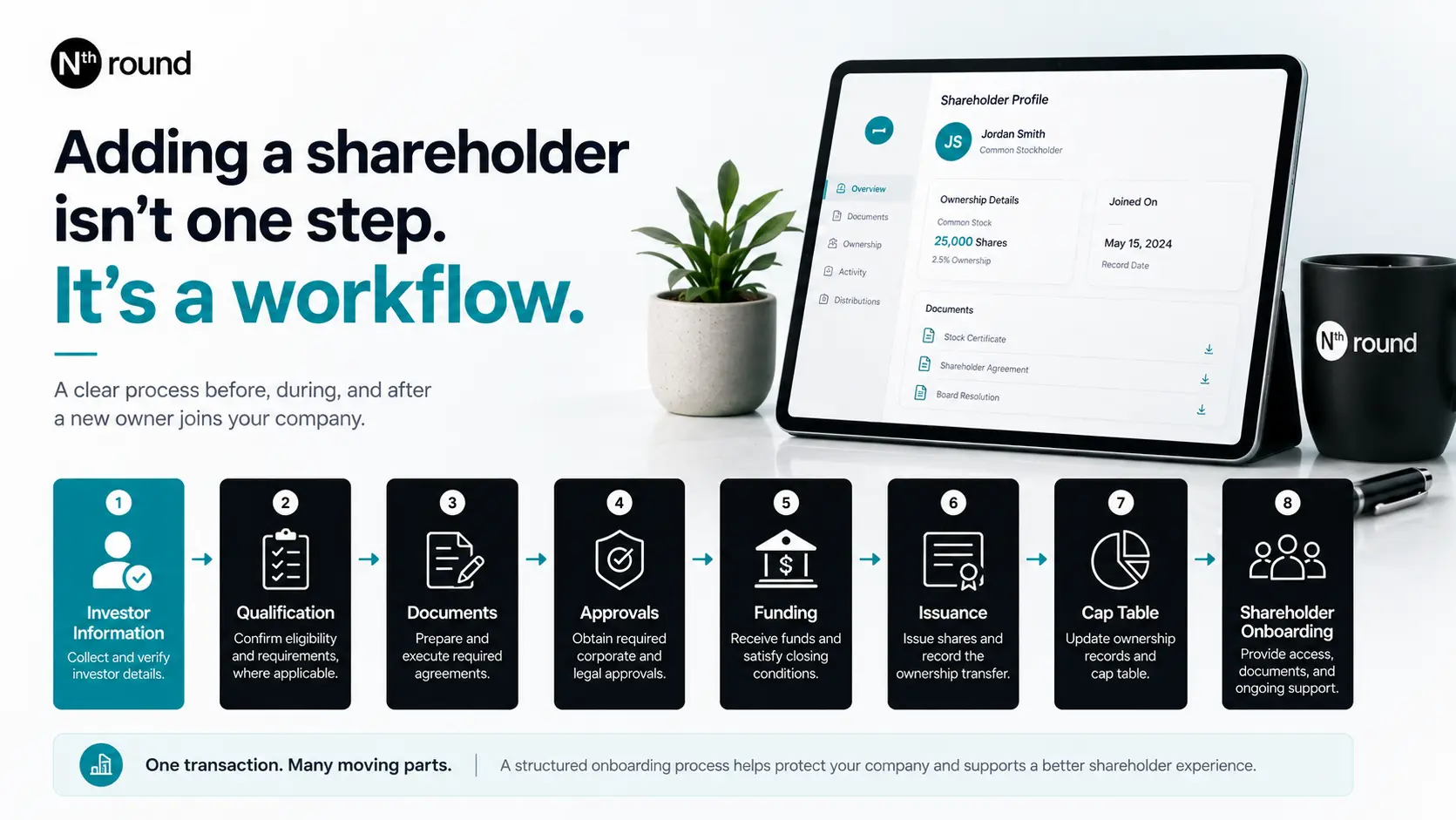
A new shareholder has completed the paperwork. The shares have been issued. Someone updates the cap table.
Done?
Not necessarily.
Depending on how the shareholder acquired their equity, there may have been approvals to obtain, agreements to sign, funds to collect, or eligibility requirements to confirm before the issuance. Afterward, the new owner may need access to shareholder information, company documents, tax materials, voting communications, or future distributions.
None of those steps is particularly unusual on its own. The difficulty is making sure they happen in the right order, with the right information, and with a clear record of what was completed.
That makes shareholder onboarding a useful example of a broader reality in private-company ownership:
Adding someone to the cap table is a transaction. Bringing them into the ownership structure is a process.
What does shareholder onboarding involve?
Shareholder onboarding is the process of bringing a new owner into a company’s ownership records and, where appropriate, the administrative processes that come with being a shareholder.
There is no universal onboarding checklist.
A new investor purchasing shares directly from the company will not necessarily follow the same process as an employee acquiring equity, a family member receiving shares through a gift, or a new partner buying into a closely held business.
But the questions companies need to answer tend to be similar.
- Who is acquiring the interest?
- What are they acquiring?
- What approvals are required?
- Which agreements need to be completed?
- Does money need to change hands?
- When does ownership actually transfer?
- Has that transaction been reflected correctly in the company’s ownership records?
- And once the person becomes a shareholder, what information and access should they receive?
The answers depend on the transaction.
Start with the transaction
One reason shareholder onboarding gets messy is that companies sometimes start at the end.
A name needs to be added to the cap table, so the company collects the new shareholder’s contact information
But the new cap table entry should reflect a transaction that has already been properly documented.
Before changing the ownership record, the company needs to understand how the person is becoming an owner.
- Are they purchasing newly issued shares?
- Buying shares from an existing shareholder?
- Receiving an equity award?
- Receiving shares through a gift, trust, estate, or other transfer?
- Joining an existing ownership group as part of a transaction?
That distinction can change almost everything that comes after.
A direct investment may involve subscription documents and funding. A transfer from an existing shareholder may be governed by transfer restrictions or require company approval. An employee equity issuance may involve vesting terms and additional considerations, including whether an 83(b) election may be relevant when substantially nonvested property is transferred. A family transfer may introduce trusts, fiduciaries, or additional ownership relationships that need to be reflected accurately.
There is no reason to force those events through the same checklist.
The onboarding process should follow the ownership event.
What might happen before a new shareholder is added?
For some transactions, a substantial amount of work happens before the ownership record changes.
Take a new investor purchasing shares directly from a private company.
Depending on the offering and circumstances, the process might include:
Investor information → Qualification, where applicable → Subscription documents → Corporate approval → Funding → Issuance
However, not every investment requires every one of those steps.
For example, a company relying on a securities-law exemption that depends on an investor’s accredited status may need to collect information relevant to that status. Other offerings may operate under different requirements.
A subscription agreement may document the investor’s commitment to purchase shares, the number or amount of securities being purchased, representations made by the parties, and other terms of the investment.
Corporate approvals may also be required before the shares can be issued.
Then there is funding.
A signed agreement does not necessarily mean the transaction has closed. If the investment requires payment, the company needs to know whether the funds were received and whether any other closing conditions were satisfied before treating the issuance as complete.
These details are easy to separate when legal documents, payment information, approvals, and ownership records live in different places.
They are much harder to separate when someone needs to answer a simple question six months later:
When did this person actually become a shareholder?
Where does a joinder agreement fit?
A joinder agreement is another document that may appear during shareholder onboarding, particularly when an existing agreement already governs the company’s shareholders.
Suppose the company has a shareholder agreement that covers matters such as transfer restrictions, voting rights, buy-sell provisions, or other obligations among the owners.
When a new shareholder enters the ownership group, the existing agreement may require that person to become a party to it.
A joinder can provide a way for the new shareholder to agree to be bound by the existing agreement without requiring every existing shareholder to execute the entire agreement again.
But a joinder is not automatically required every time a private company adds a shareholder.
Whether one is needed depends on the company’s existing agreements, the type of transaction, and the applicable legal requirements.
Operationally, the important question is simpler:
Are there agreements the new shareholder must join before, or as a condition of, becoming an owner?
If there are, that step needs to happen at the appropriate point in the transaction rather than being discovered after the cap table has already changed.
The cap table update is a checkpoint
Once the transaction is complete, the company needs to reflect it accurately in its ownership records.
That sounds obvious, but it is also where small discrepancies can become long-term problems.
The record should accurately reflect the shareholder, the security type or share class, the number of shares or units acquired, the relevant transaction date, and other information the company maintains as part of its ownership ledger.
For a transfer between existing and new shareholders, both sides of the transaction need to reconcile.
For a new issuance, the company needs to make sure the ownership record matches the approved and executed transaction.
If certificates are used, certificate records may also need to be created, canceled, or updated.
This is one reason a cap table should not be treated as an isolated spreadsheet exercise.
The numbers on the cap table are the result of actual ownership events. The supporting approvals, agreements, and transaction records are what explain how those numbers got there.
When the two drift apart, someone eventually has to reconstruct the history.
That usually happens at the least convenient time: during an audit, a transaction, a shareholder question, a redemption, or another ownership event.
What happens after the shareholder is added?
This is the part of onboarding that is easiest to overlook.
The transaction closes. The cap table is correct. The new shareholder exists in the company’s official records.
Now the company has an ongoing relationship to administer.
What that relationship looks like depends heavily on the company and the shareholder.
A new owner may need access to a shareholder portal or another approved source of company information.
They may need historical or governing documents.
The company may need banking or payment information before making future distributions.
Tax information may need to be collected and tax documents delivered later.
The shareholder may become eligible to receive company updates, notices, voting materials, or other communications.
Their access may also need to reflect their role. A shareholder, trustee, employee-owner, board member, and accountant may not all have the same information rights or administrative permissions.
This is where “shareholder onboarding” becomes more than transaction processing.
The company is setting up a relationship that may last for years or, in a family-owned business, generations.
A wrong email address is annoying on day one. Years later, bad contact information can mean missed notices, returned tax documents, delayed signatures, or another round of detective work before a distribution.
The quality of the ownership record matters long after the initial transaction is finished.
Why shareholder onboarding becomes fragmented
Consider a fairly ordinary new investment.
Counsel sends the subscription agreement.
The investor returns a signed copy through an electronic signature platform.
An approval sits in the company’s board records.
Funds arrive in the company’s bank account.
Someone tells finance that the investment closed.
The cap table gets updated.
The investor receives documents by email.
Later, another person creates their shareholder access.
Every step can be digital.
The process can still be fragmented.
The question is not whether the company uses software. The question is whether someone can tell, without searching across inboxes and systems, which steps are complete and what still needs attention.
That distinction matters because ownership administration is full of handoffs.
Legal may finish its work before finance starts.
Finance may update the ownership record before the person responsible for shareholder communications knows the transaction closed.
The person managing distributions months later may have no idea that banking information was never collected.
Nothing necessarily failed at any individual step.
The connection between the steps failed.
What does a good shareholder onboarding process look like?
A good process starts by recognizing that different transactions need different paths.
It does not force an employee equity issuance, a family transfer, and a new investment through identical paperwork.
Instead, the company should be able to determine what the particular ownership event requires and follow it through to completion.
For a new investor, that might look like:
Investor information → Qualification, where applicable → Subscription documentation → Approval → Funding → Issuance → Ownership records → Shareholder access
For a transfer involving an existing shareholder, it could look quite different:
Transfer request → Restrictions reviewed → Required approvals → Transfer documents → Joinder, where applicable → Ownership records → Shareholder access
The exact sequence matters less than the visibility around it.
At any point, the company should be able to tell what has happened, what has not, and who owns the next step.
That sounds basic until ownership administration is spread across finance, legal, outside counsel, executives, shareholders, and several different systems.
Then it becomes infrastructure.
A new shareholder creates an ongoing ownership relationship
Private companies tend to accumulate complexity rather than shed it.
A shareholder added today may later participate in a vote, receive a distribution, transfer shares to a trust, sell shares back to the company, receive tax documents, or become part of a broader succession plan.
The information captured during onboarding follows that shareholder into those later events.
That is why getting a new shareholder onto the cap table is important, but insufficient.
The transaction needs a reliable record.
The shareholder needs the right information and access.
The company needs to know which agreements govern the relationship.
And the next person responsible for that shareholder should not have to reconstruct the onboarding process from an old email thread.
Private company ownership does not happen through isolated transactions. It happens through connected workflows.