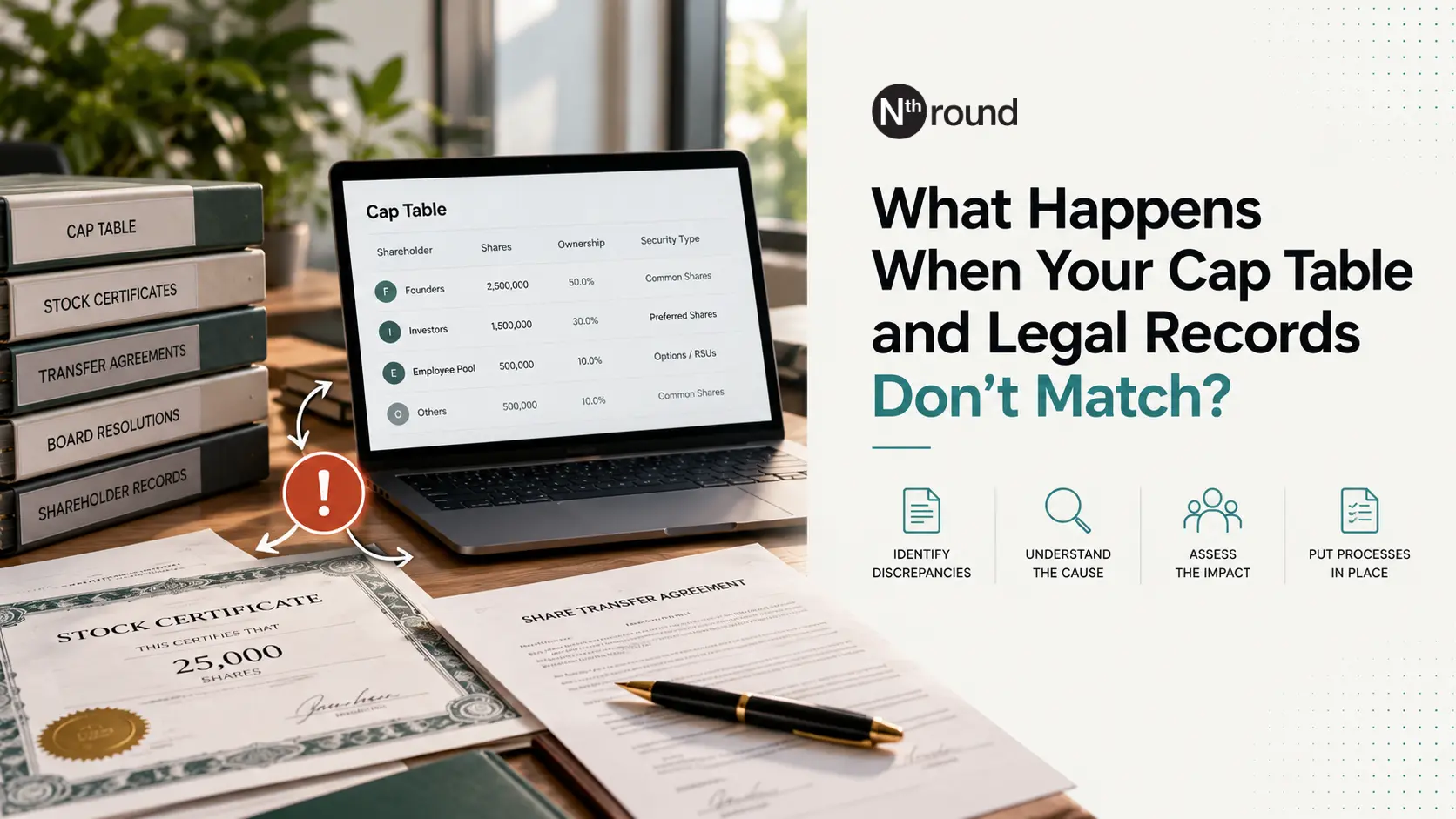
Your cap table says one thing. A stock certificate says another. Somewhere in the files, there’s a signed transfer agreement that may explain the difference. Now someone has to figure out which record reflects what actually happened.
This is not an unusual way for a private company to discover an ownership problem.
The cap table may have been updated after a transaction, while the supporting documents weren't. Or the documents were signed, but nobody made the corresponding change to the cap table. A certificate was cancelled, but the cancellation wasn't properly recorded. Someone created a new version of a spreadsheet, and both versions kept circulating.
For years, nothing happens.
Then there’s a shareholder question, an audit, a financing, a redemption, a sale, or another event that forces someone to look closely.
And suddenly a small discrepancy isn't small anymore.
The real problem isn't simply that two records disagree. It's that the company has to reconstruct what happened before it can confidently say who owns what.
Which record controls when your cap table and legal documents disagree?
There isn't a universal answer.
A cap table is an important administrative record, but it does not by itself determine the legal validity of every ownership transaction. Stock certificates, executed agreements, board approvals, governing documents, the company's stock ledger, and applicable law may all be relevant depending on the circumstances.
That's why a discrepancy shouldn't be “fixed” by choosing whichever number looks right and updating everything else to match it.
The first job is to understand what actually happened.
What transaction was intended?
What was authorized?
What was signed?
What was issued or transferred?
What was recorded afterward?
And do those pieces tell the same story?
If they don't, legal counsel may need to help determine the appropriate correction.
From an operational perspective, though, there's a lesson worth taking seriously: the cap table should not live separately from the records that explain it.
How do ownership records end up disagreeing?
Usually, nobody sets out to create conflicting records.
It happens one transaction at a time.
Imagine a shareholder transfers 5,000 shares.
The transfer agreement is signed and saved by legal. Finance updates its spreadsheet. Someone else needs to cancel an existing certificate and issue a replacement. The shareholder's information needs to be updated. Perhaps an approval needs to be retained with the transaction.
If every step happens, everything is fine.
If one doesn't, you now have two versions of the same ownership event.
And that may not become obvious until much later.
This is why we think of private-company ownership as a series of connected workflows, rather than isolated transactions.
The transaction isn't really finished just because the document was signed.
The spreadsheet can look perfectly fine
This is what makes ownership discrepancies uncomfortable.
Your cap table can balance.
Every row can add up.
The percentages can equal 100%.
And the underlying records can still contain a problem.
Suppose the cap table shows:
Shareholder A: 20,000 shares
Simple enough.
But the company's files contain a certificate for 25,000 shares and a transfer agreement showing that 5,000 shares were transferred several years ago.
Was the transfer completed?
Was the original certificate cancelled?
Was a new certificate issued for the remaining 20,000 shares?
Did the recipient get recorded properly?
The 20,000 on the spreadsheet may be correct.
But until the company can answer those other questions, it doesn't have a clean ownership history. It has a number that appears to be correct.
Those are not quite the same thing.
Our Ultimate Guide to Cap Table Management goes deeper into maintaining the cap table itself. But as ownership becomes more complicated, the information behind those numbers becomes just as important.
Where do cap table discrepancies usually show up?
There are a few places worth looking when something doesn't add up.
Stock certificates
Certificates are an obvious source of trouble because they represent ownership but have their own lifecycle.
A certificate gets issued.
Then shares are transferred.
The old certificate should be dealt with appropriately and, where applicable, a new one issued.
Years later, someone finds the original certificate.
Now you have a document showing one amount and a cap table showing another.
This doesn't necessarily mean the cap table is wrong. It means the company needs to understand what happened to the certificate and the shares it represented.
That's why issuing certificates is only the beginning. In Stock Certificates Are Easy to Issue. Managing Them Is the Hard Part, we look at what happens after issuance: assignments, transfers, cancellations, replacements, and preserving the history behind them.
Transfer documents
Transfers can create discrepancies when the paperwork and administrative record move at different speeds.
Maybe the agreement was signed but the cap table wasn't updated.
Maybe the cap table was updated in anticipation of closing, but the transaction never actually closed.
Maybe part of a shareholder's position moved into a trust or another entity and one system reflects the new owner while another still shows the old one.
A signed document sitting in a folder and an updated row in a spreadsheet are both pieces of information.
Neither should exist in isolation from the transaction they represent.
Board and shareholder approvals
Some ownership events may require approval under applicable law or the company's governing documents.
If an ownership change appears on the cap table but the company can't locate the corresponding approval, that's a different problem from a simple spreadsheet typo.
Likewise, having an approval doesn't necessarily mean every subsequent step was completed.
Governance creates decisions. Ownership administration has to carry those decisions through.
That's part of why we've argued that private-company governance is a process, not simply what happens during a board meeting.
Option and equity award records
Employee equity creates its own opportunities for records to drift.
Grants are approved. Vesting occurs. Options are exercised. Employees leave. Awards expire or are cancelled.
The current cap table may capture the end result, but the supporting records need to explain how that result was reached.
This becomes especially important when someone is trying to reconstruct an individual's equity history several years later.
Multiple versions of the cap table
And then there's the simplest problem of all.
Cap Table FINAL.xlsx
Cap Table FINAL v2.xlsx
Cap Table FINAL v2 UPDATED.xlsx
We've all met this filing system.
The danger isn't that spreadsheets are inherently bad. It's that copies are easy to create, send, download, and continue editing.
Finance has one version.
Legal has another.
The CEO has the version attached to an email six months ago.
Nobody intentionally created three sources of truth.
They just slowly appeared.
What should you do when the records don't match?
Don't start by making the discrepancy disappear.
Start by reconstructing it.
Take the ownership position in question and work backward through the available history.
You may need to review the current cap table or stock ledger, prior versions of the ownership record, certificates, signed transaction documents, approvals, equity award records, correspondence, and other relevant materials.
You're trying to build a timeline.
What did the shareholder own before the event?
What event was supposed to occur?
What documentation exists?
Was the transaction completed?
What changed afterward?
Where did the records stop agreeing?
Sometimes the answer will be painfully ordinary.
Someone forgot an update.
Other times, the issue may require legal analysis or corrective action. That's where qualified counsel should get involved rather than trying to solve a legal ownership question through spreadsheet archaeology.
The point is not to assume every mismatch represents a serious legal defect.
The point is to know enough about your ownership history to tell the difference.
Don't “clean up” the history you need to preserve
There's another temptation when companies find messy records.
Make everything neat.
Update the current spreadsheet. Rename the documents. Delete the obsolete files. Get rid of the old certificate. Move on.
Some cleanup is obviously useful.
But be careful about erasing the very history that explains the discrepancy.
If a record was corrected, you may need to know what it said before the correction.
If a certificate was cancelled, the fact that it once existed can still matter.
If a transaction changed ownership, the previous position doesn't become irrelevant simply because the current position is correct.
A good ownership record doesn't pretend the past never happened.
It preserves enough of the past to explain the present.
That's the principle behind good shareholder recordkeeping: the cap table tells you where ownership stands, while the records around it help explain how it got there.
The real test is whether you can reconstruct the ownership history
Pick one shareholder.
Not the founder whose shares haven't moved since the company was formed.
Pick someone with some history.
Maybe they acquired shares in multiple transactions. Transferred some into a trust. Participated in a redemption. Received a replacement certificate.
Now try to reconstruct their position.
Can you see what they originally acquired?
Can you see each event that changed their ownership?
Can you find the documents behind those events?
Can you identify which certificates are active and which were cancelled?
Can you explain why today's balance is what it is?
And could somebody who wasn't involved in those transactions do the same thing?
That last question matters.
A recordkeeping system shouldn't depend on one person's memory.
Why these problems get harder as ownership grows
More shareholders create more records.
But headcount isn't the only source of complexity.
A company with 50 shareholders spread across individuals, trusts, family entities, employee owners, and multiple share classes may have more administrative complexity than a company with several hundred straightforward holders.
Ownership also accumulates history.
A shareholder who has been with the company for 15 years may have gone through several transactions, address changes, distributions, votes, and certificate events.
A family shareholder may transfer shares into a trust.
One generation becomes two.
Then three.
The current ownership position is just the latest frame in a much longer movie.
This is where shareholder management becomes broader than maintaining a capitalization spreadsheet. The ownership record has to stay connected to the people, documents, transactions, communications, and governance activity surrounding it.
An audit trail makes the cap table more useful
An accurate cap table tells you where things stand.
An audit trail helps you understand how they changed.
Those are different jobs.
If a shareholder owns 12,500 shares today, the current balance is useful.
If they owned 20,000 shares two years ago, the ability to see the transactions that moved them from 20,000 to 12,500 is useful in a different way.
That history can help teams investigate discrepancies without starting from scratch.
It can also make handoffs easier.
People leave companies. Outside counsel changes. Finance teams turn over. Family offices move responsibilities between generations.
The ownership history needs to survive all of them.
Software won't prevent every recordkeeping mistake. It certainly won't fix a transaction that wasn't properly completed.
What it can do is reduce the number of disconnected places where the story of that transaction has to live.
Your shareholders may have records of their own
There's another reason not to assume the company's current spreadsheet settles every question.
Shareholders keep things.
Certificates.
Agreements.
Old statements.
Tax documents.
Emails.
Sometimes very old emails.
If what the shareholder has doesn't match what the company has, the company needs to be able to explain why.
That doesn't mean every old document a shareholder produces reflects their current ownership.
It means the company should have enough history to understand what the document represents.
Giving shareholders secure access to appropriate current ownership information and documents can help reduce some of that ambiguity. A shareholder portal won't replace the underlying records, but it gives shareholders a reliable place to access the information the company makes available to them.
The best time to find a discrepancy is before you need the answer
Ownership problems have terrible timing.
They tend to become visible when something else is already happening.
A financing.
An audit.
A shareholder vote.
A distribution.
A redemption.
A liquidity event.
A shareholder dies and an estate needs information.
Someone wants to transfer shares.
Now the company isn't investigating its records because it has a quiet afternoon.
It's investigating because somebody needs an answer.
That's why recordkeeping is fundamentally an ongoing operational discipline.
You don't maintain the history because you know exactly when you'll need it.
You maintain it because you probably won't get to choose.
Your cap table and legal records should tell the same ownership story
Perfect records are an appealing idea.
Real private companies have history.
People make corrections. Documents get replaced. Transactions become more complicated than expected. Shareholders change. Teams change.
The goal isn't to create an ownership record that has never required a correction.
It's to maintain one that can explain the corrections and changes that occurred.
So if your cap table says 10,000 shares and a certificate says 12,000, don't just change one until they match.
Find out why they don't.
Follow the transaction.
Find the supporting records.
Preserve what happened.
Correct what needs correcting with the appropriate professional guidance.
Because the number on today's cap table matters.
But when somebody asks where that number came from, “that's what the spreadsheet says” isn't much of an answer.