Equity Operations

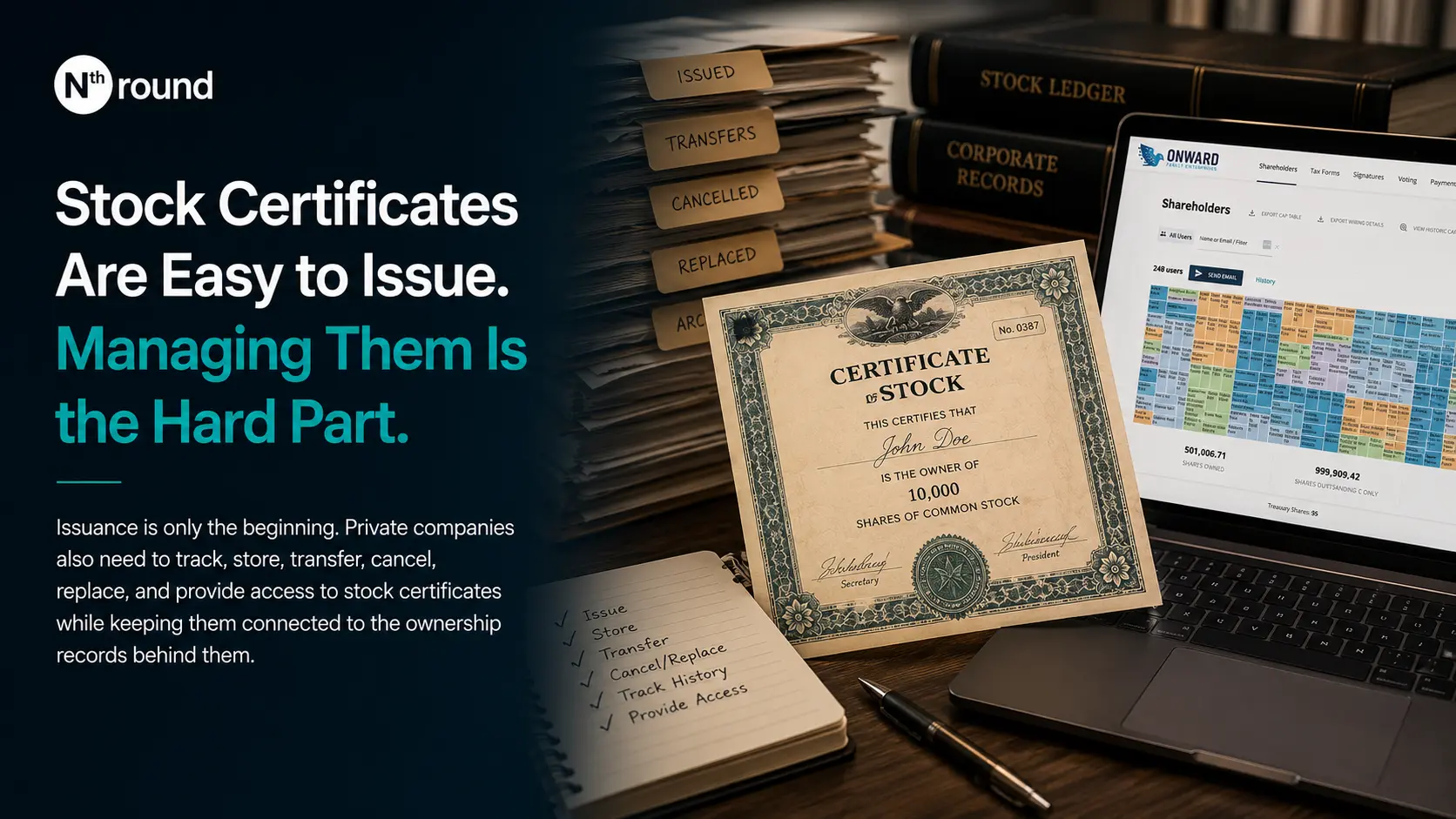
Stock Certificates Are Easy to Issue. Managing Them Is the Hard Part.

Zohaib Khalid

I

August 27, 2026

Issuance is only the beginning. Private companies also need to track, store, transfer, cancel, replace, and provide access to stock certificates while keeping them connected to the ownership records behind them.

Issuing a stock certificate is the easy part.

The harder question is what happens afterward.

The certificate needs to remain connected to the shareholder and the shares it represents. Certificate numbers need to be tracked. If shares transfer, an existing certificate may need to be cancelled and another issued. If a certificate is replaced, the company needs to preserve that history. And when a shareholder wants to see their certificate, someone needs to be able to find the right one.

None of this sounds particularly difficult when you're managing one certificate.

Multiply it across dozens, hundreds, or thousands of ownership positions, and across years of transfers, redemptions, replacements, and other ownership changes - and the job looks very different.

That's when stock certificate management stops being about generating documents.

It becomes part of maintaining an accurate ownership record.

The certificate has a lifecycle

A certificate might be issued today and remain outstanding for the next twenty years.

Or the shares it represents might transfer next year.

The certificate could be cancelled. It could be replaced. The shareholder could change their name. The company could move from paper-based administration to a digital system.

The point is that issuance is a moment. Certificate management continues for as long as the certificate remains part of the company's ownership history.

A simple way to think about that lifecycle is:

Generate → Assign → Issue → Store → Access → Transfer → Cancel or reissue → Preserve the history

Not every certificate will pass through every step.

But looking only at certificates that are outstanding today gives you part of the picture. A well-maintained record should also help explain how the company arrived at today's ownership.

That's why certificates belong alongside the cap table, stock ledger, transaction documents, and shareholder records, not in a separate filing system that only gets opened when somebody needs a copy.

If you're looking for the fundamentals first, our Complete Guide to Stock Certificates for Private Companies covers what certificates represent, certificated versus uncertificated shares, transfer restrictions, lost certificates, and other core concepts.

Start with the ownership record

A stock certificate should reflect ownership that has already been properly authorized and issued.

Generating the certificate doesn't create the underlying equity. The certificate represents shares issued pursuant to the company's applicable approvals, governing documents, transaction terms, and legal requirements.

That means certificate creation should start with accurate ownership information.

Who is the registered shareholder?

How many shares were issued?

What class or series are they?

When were they issued?

Are there restrictions or other information that needs to appear on the certificate?

The more often an administrator has to take that information from one system and manually enter it into another, the more opportunities there are for the records to diverge.

A shareholder name is entered differently.

A share count is transposed.

The certificate is generated, but the certificate register isn't updated.

The certificate itself isn't the problem. The handoff between records is.

Ideally, certificate generation should remain connected to the information the company already maintains about its ownership.

Certificate numbers need a history

A certificate number might seem like a small administrative detail.

Over time, it becomes a useful way to follow what happened.

Consider a simple example.

Certificate #38 is issued to a shareholder for 25,000 shares.

Years later, those shares are transferred. Certificate #38 is cancelled and a new certificate is issued to the new shareholder.

Later still, that certificate is reported lost and replaced.

If those events are properly recorded, an administrator can follow the history from one ownership position to the next.

If they're not, the company may eventually find several certificate numbers associated with the same shares and have to work backward to understand which certificate is actually outstanding.

The problem becomes harder when certificate numbers are tracked separately from the rest of the ownership record; perhaps in a spreadsheet, document folder, or certificate register that isn't updated every time the cap table changes.

Certificate numbers aren't the ownership record themselves.

But they can provide an important trail through it.

The certificate and cap table should tell the same story

Suppose a certificate says a shareholder owns 10,000 shares.

The cap table says 7,500.

Now what?

Perhaps 2,500 shares were transferred and the old certificate was never cancelled. Perhaps the cap table was changed incorrectly. Perhaps a replacement certificate exists. Perhaps there's a transaction in the company's history that explains the difference.

The discrepancy itself doesn't tell you which record is right.

Someone has to investigate.

This is why certificates shouldn't become a parallel ownership system.

The company's cap table provides a broader picture of its capitalization and ownership. Certificate records provide information about the instruments representing certificated positions.

As ownership changes, those records need to remain connected.

Otherwise, every transfer, redemption, replacement, or correction creates another opportunity for one record to move while another stays behind.

Digital storage doesn't automatically solve the problem

Paper certificates have obvious limitations.

They can be misplaced, damaged, or left in a filing cabinet that only one person knows exists.

But replacing the filing cabinet with a folder full of PDFs doesn't necessarily solve the administrative problem.

Imagine the company's certificates are now digital, but some live in a shared drive, others are attached to emails, older certificates are stored with transaction documents, and the certificate register lives in a spreadsheet.

The paper is gone.

The fragmentation isn't.

Someone still needs to know where everything lives and how the pieces relate to one another.

Centralizing certificates makes the record more useful because the certificate can be maintained alongside information about the shareholder and ownership position it represents.

The question then becomes more useful than:

Where is the file?

Instead, an administrator can ask:

What does this certificate represent, is it still outstanding, and what has happened to it since it was issued?

That's the difference between digitizing the document and improving the administration around it.

We've covered the paper-to-digital transition itself in The Benefits and Implementation of Digital Stock Certificates.

Shareholders need access too

There's another person involved in certificate management who can get overlooked: the shareholder.

With traditional paper certificates, the shareholder might have received an original document and been responsible for storing it indefinitely.

In a disconnected digital process, that experience can become:

"Can you send me another copy of my certificate?"

Someone inside the company then needs to locate the right document, make sure it's the current certificate, and send it.

Multiply those requests across a larger shareholder base, and another administrative process emerges.

A secure shareholder portal changes that relationship.

Rather than relying on email requests and one-off document delivery, shareholders can have appropriate access to certificates and ownership information in a private environment.

That matters because a shareholder may need information years after the original issuance.

Access shouldn't depend on whether the employee who originally sent the certificate still works at the company.

Transfers show why lifecycle management matters

Issuance gets plenty of attention because it's the beginning of an ownership position.

Transfers are where the value of good certificate management becomes more obvious.

Private-company shares may be subject to rights of first refusal, consent requirements, shareholder agreements, or other restrictions. Companies should work with counsel to determine what applies before registering a transfer.

Once an appropriate transfer occurs, the certificate record may need to change too.

Depending on the circumstances, the process might look something like:

Existing certificate → Cancellation → Ownership record update → New certificate or ownership position → Updated shareholder record

The certificate is one part of the transaction.

The cap table is another.

The stock ledger, supporting documents, approvals, and shareholder information may also be affected.

This is a good example of the broader principle we've discussed in our guide to private-company ownership workflows:

An ownership event is rarely one event.

If each part of the transfer is administered separately, someone has to make sure every system and document reflects the same result.

That's manageable… until one step gets missed.

Cancellation shouldn't erase the history

Companies naturally pay attention when certificates are issued.

Cancelled certificates can receive less attention.

But cancellation tells you something important: why a certificate that once represented outstanding shares no longer does.

Perhaps the shares were transferred.

Perhaps they were redeemed.

Perhaps the certificate was replaced.

Whatever happened, an administrator reviewing the records later should be able to distinguish between:

Outstanding

Cancelled

and, where relevant:

Replaced

Deleting an old certificate from the current view isn't the same thing as maintaining a clean record.

Imagine reviewing the company's ownership history several years later.

Certificate #74 appears for a shareholder, but you also find Certificate #29 for what looks like the same shares.

If the history clearly shows that #29 was cancelled when #74 was issued, there's little mystery.

If it doesn't, somebody has another reconciliation project.

Good certificate management keeps the current record clear without erasing the path that led there.

Lost certificates create the same historical challenge

Physical certificates disappear.

The shareholder may still be reflected in the company's records. The shares may still exist. But the document itself is nowhere to be found.

The appropriate replacement process depends on applicable law, the company's governing arrangements, and the circumstances.

For example, Section 167 of the Delaware General Corporation Law permits a corporation to issue a new certificate or uncertificated shares in place of a certificate alleged to have been lost, stolen, or destroyed. It also permits the corporation to require a bond sufficient to protect against claims arising from the missing certificate or replacement.

Companies should work with counsel on the appropriate procedure rather than simply generating another copy.

But there's an administrative issue here too.

If Certificate #81 replaces lost Certificate #46, someone reviewing the records later should be able to understand why both numbers appear.

A replacement solves today's problem.

The record needs to make sure it doesn't create tomorrow's.

The warning signs usually appear gradually

There isn't a magic number of shareholders at which a certificate process suddenly stops working.

Usually, the warning signs accumulate.

Certificate numbers are tracked in a spreadsheet.

The cap table lives somewhere else.

Certificates are stored across several folders.

Someone has to manually update multiple records after an ownership change.

Shareholders regularly email the company for copies.

Cancelled certificates are difficult to trace.

A transfer means updating several disconnected systems.

Historical certificates don't quite agree with the current cap table.

And perhaps the most telling sign:

One person understands how everything fits together.

That process can work for years.

Then that person leaves.

Or the company enters a transaction.

Or a shareholder dies.

Or ownership passes to another generation.

Or someone needs an answer quickly.

Suddenly, what looked like a perfectly workable administrative process has become an ownership-record problem.

The issue isn't that the company used spreadsheets, paper certificates, or shared folders.

It's that the history became dependent on someone manually keeping all of them aligned.

Better certificate management isn't just about going digital

Moving from paper to digital can remove a lot of unnecessary handling.

But it isn't the end goal.

Scanning a paper certificate creates a digital copy.

Creating a PDF instead of printing a certificate eliminates paper.

Neither one, by itself, connects the certificate to the shareholder, cap table, transaction history, or events that happen later.

A better certificate-management process should make it easier to answer:

  • Which certificates are currently outstanding?
  • Which shareholder and ownership position does each represent?
  • What certificate numbers have been assigned?
  • Which certificates have been cancelled or replaced?
  • What happened when ownership transferred?
  • Does the certificate record correspond to the current cap table?
  • Can the appropriate shareholder securely access their certificate?
  • Can an administrator follow the history without reconstructing it manually?

If those questions still require searching through several systems, the certificates may be digital while the administration remains manual.

The real improvement comes when the certificate becomes part of the ownership system around it.

What better stock certificate management looks like

A well-managed certificate process doesn't need to make certificates more complicated.

It should make their history easier to understand.

When shares are issued, the certificate reflects the appropriate ownership information.

Certificate numbers are assigned and tracked.

The certificate is securely maintained.

The shareholder can access the appropriate information.

When ownership changes, the certificate record changes with it.

When a certificate is cancelled or replaced, that history remains available.

And throughout those events, the certificate remains connected to the cap table and broader shareholder record.

That's the difference between managing certificates as individual documents and managing them as part of the company's ownership.

How Nth Round approaches stock certificate management

Nth Round brings stock certificates into the same environment companies use to maintain their ownership records.

Administrators can generate digital stock certificates using their company's certificate templates, assign and track unique certificate numbers, maintain certificates securely, and make them available to stakeholders through a private portal.

When ownership changes, certificates can be cancelled and reissued while preserving the history behind the transaction.

The point isn't simply to turn paper certificates into digital files.

It's to make certificates easier to administer because they remain connected to the ownership information they represent.

Learn more about stock certificate management with Nth Round.

Issuing a stock certificate is the easy part.

The harder question is what happens afterward.

The certificate needs to remain connected to the shareholder and the shares it represents. Certificate numbers need to be tracked. If shares transfer, an existing certificate may need to be cancelled and another issued. If a certificate is replaced, the company needs to preserve that history. And when a shareholder wants to see their certificate, someone needs to be able to find the right one.

None of this sounds particularly difficult when you're managing one certificate.

Multiply it across dozens, hundreds, or thousands of ownership positions, and across years of transfers, redemptions, replacements, and other ownership changes - and the job looks very different.

That's when stock certificate management stops being about generating documents.

It becomes part of maintaining an accurate ownership record.

The certificate has a lifecycle

A certificate might be issued today and remain outstanding for the next twenty years.

Or the shares it represents might transfer next year.

The certificate could be cancelled. It could be replaced. The shareholder could change their name. The company could move from paper-based administration to a digital system.

The point is that issuance is a moment. Certificate management continues for as long as the certificate remains part of the company's ownership history.

A simple way to think about that lifecycle is:

Generate → Assign → Issue → Store → Access → Transfer → Cancel or reissue → Preserve the history

Not every certificate will pass through every step.

But looking only at certificates that are outstanding today gives you part of the picture. A well-maintained record should also help explain how the company arrived at today's ownership.

That's why certificates belong alongside the cap table, stock ledger, transaction documents, and shareholder records, not in a separate filing system that only gets opened when somebody needs a copy.

If you're looking for the fundamentals first, our Complete Guide to Stock Certificates for Private Companies covers what certificates represent, certificated versus uncertificated shares, transfer restrictions, lost certificates, and other core concepts.

Start with the ownership record

A stock certificate should reflect ownership that has already been properly authorized and issued.

Generating the certificate doesn't create the underlying equity. The certificate represents shares issued pursuant to the company's applicable approvals, governing documents, transaction terms, and legal requirements.

That means certificate creation should start with accurate ownership information.

Who is the registered shareholder?

How many shares were issued?

What class or series are they?

When were they issued?

Are there restrictions or other information that needs to appear on the certificate?

The more often an administrator has to take that information from one system and manually enter it into another, the more opportunities there are for the records to diverge.

A shareholder name is entered differently.

A share count is transposed.

The certificate is generated, but the certificate register isn't updated.

The certificate itself isn't the problem. The handoff between records is.

Ideally, certificate generation should remain connected to the information the company already maintains about its ownership.

Certificate numbers need a history

A certificate number might seem like a small administrative detail.

Over time, it becomes a useful way to follow what happened.

Consider a simple example.

Certificate #38 is issued to a shareholder for 25,000 shares.

Years later, those shares are transferred. Certificate #38 is cancelled and a new certificate is issued to the new shareholder.

Later still, that certificate is reported lost and replaced.

If those events are properly recorded, an administrator can follow the history from one ownership position to the next.

If they're not, the company may eventually find several certificate numbers associated with the same shares and have to work backward to understand which certificate is actually outstanding.

The problem becomes harder when certificate numbers are tracked separately from the rest of the ownership record; perhaps in a spreadsheet, document folder, or certificate register that isn't updated every time the cap table changes.

Certificate numbers aren't the ownership record themselves.

But they can provide an important trail through it.

The certificate and cap table should tell the same story

Suppose a certificate says a shareholder owns 10,000 shares.

The cap table says 7,500.

Now what?

Perhaps 2,500 shares were transferred and the old certificate was never cancelled. Perhaps the cap table was changed incorrectly. Perhaps a replacement certificate exists. Perhaps there's a transaction in the company's history that explains the difference.

The discrepancy itself doesn't tell you which record is right.

Someone has to investigate.

This is why certificates shouldn't become a parallel ownership system.

The company's cap table provides a broader picture of its capitalization and ownership. Certificate records provide information about the instruments representing certificated positions.

As ownership changes, those records need to remain connected.

Otherwise, every transfer, redemption, replacement, or correction creates another opportunity for one record to move while another stays behind.

Digital storage doesn't automatically solve the problem

Paper certificates have obvious limitations.

They can be misplaced, damaged, or left in a filing cabinet that only one person knows exists.

But replacing the filing cabinet with a folder full of PDFs doesn't necessarily solve the administrative problem.

Imagine the company's certificates are now digital, but some live in a shared drive, others are attached to emails, older certificates are stored with transaction documents, and the certificate register lives in a spreadsheet.

The paper is gone.

The fragmentation isn't.

Someone still needs to know where everything lives and how the pieces relate to one another.

Centralizing certificates makes the record more useful because the certificate can be maintained alongside information about the shareholder and ownership position it represents.

The question then becomes more useful than:

Where is the file?

Instead, an administrator can ask:

What does this certificate represent, is it still outstanding, and what has happened to it since it was issued?

That's the difference between digitizing the document and improving the administration around it.

We've covered the paper-to-digital transition itself in The Benefits and Implementation of Digital Stock Certificates.

Shareholders need access too

There's another person involved in certificate management who can get overlooked: the shareholder.

With traditional paper certificates, the shareholder might have received an original document and been responsible for storing it indefinitely.

In a disconnected digital process, that experience can become:

"Can you send me another copy of my certificate?"

Someone inside the company then needs to locate the right document, make sure it's the current certificate, and send it.

Multiply those requests across a larger shareholder base, and another administrative process emerges.

A secure shareholder portal changes that relationship.

Rather than relying on email requests and one-off document delivery, shareholders can have appropriate access to certificates and ownership information in a private environment.

That matters because a shareholder may need information years after the original issuance.

Access shouldn't depend on whether the employee who originally sent the certificate still works at the company.

Transfers show why lifecycle management matters

Issuance gets plenty of attention because it's the beginning of an ownership position.

Transfers are where the value of good certificate management becomes more obvious.

Private-company shares may be subject to rights of first refusal, consent requirements, shareholder agreements, or other restrictions. Companies should work with counsel to determine what applies before registering a transfer.

Once an appropriate transfer occurs, the certificate record may need to change too.

Depending on the circumstances, the process might look something like:

Existing certificate → Cancellation → Ownership record update → New certificate or ownership position → Updated shareholder record

The certificate is one part of the transaction.

The cap table is another.

The stock ledger, supporting documents, approvals, and shareholder information may also be affected.

This is a good example of the broader principle we've discussed in our guide to private-company ownership workflows:

An ownership event is rarely one event.

If each part of the transfer is administered separately, someone has to make sure every system and document reflects the same result.

That's manageable… until one step gets missed.

Cancellation shouldn't erase the history

Companies naturally pay attention when certificates are issued.

Cancelled certificates can receive less attention.

But cancellation tells you something important: why a certificate that once represented outstanding shares no longer does.

Perhaps the shares were transferred.

Perhaps they were redeemed.

Perhaps the certificate was replaced.

Whatever happened, an administrator reviewing the records later should be able to distinguish between:

Outstanding

Cancelled

and, where relevant:

Replaced

Deleting an old certificate from the current view isn't the same thing as maintaining a clean record.

Imagine reviewing the company's ownership history several years later.

Certificate #74 appears for a shareholder, but you also find Certificate #29 for what looks like the same shares.

If the history clearly shows that #29 was cancelled when #74 was issued, there's little mystery.

If it doesn't, somebody has another reconciliation project.

Good certificate management keeps the current record clear without erasing the path that led there.

Lost certificates create the same historical challenge

Physical certificates disappear.

The shareholder may still be reflected in the company's records. The shares may still exist. But the document itself is nowhere to be found.

The appropriate replacement process depends on applicable law, the company's governing arrangements, and the circumstances.

For example, Section 167 of the Delaware General Corporation Law permits a corporation to issue a new certificate or uncertificated shares in place of a certificate alleged to have been lost, stolen, or destroyed. It also permits the corporation to require a bond sufficient to protect against claims arising from the missing certificate or replacement.

Companies should work with counsel on the appropriate procedure rather than simply generating another copy.

But there's an administrative issue here too.

If Certificate #81 replaces lost Certificate #46, someone reviewing the records later should be able to understand why both numbers appear.

A replacement solves today's problem.

The record needs to make sure it doesn't create tomorrow's.

The warning signs usually appear gradually

There isn't a magic number of shareholders at which a certificate process suddenly stops working.

Usually, the warning signs accumulate.

Certificate numbers are tracked in a spreadsheet.

The cap table lives somewhere else.

Certificates are stored across several folders.

Someone has to manually update multiple records after an ownership change.

Shareholders regularly email the company for copies.

Cancelled certificates are difficult to trace.

A transfer means updating several disconnected systems.

Historical certificates don't quite agree with the current cap table.

And perhaps the most telling sign:

One person understands how everything fits together.

That process can work for years.

Then that person leaves.

Or the company enters a transaction.

Or a shareholder dies.

Or ownership passes to another generation.

Or someone needs an answer quickly.

Suddenly, what looked like a perfectly workable administrative process has become an ownership-record problem.

The issue isn't that the company used spreadsheets, paper certificates, or shared folders.

It's that the history became dependent on someone manually keeping all of them aligned.

Better certificate management isn't just about going digital

Moving from paper to digital can remove a lot of unnecessary handling.

But it isn't the end goal.

Scanning a paper certificate creates a digital copy.

Creating a PDF instead of printing a certificate eliminates paper.

Neither one, by itself, connects the certificate to the shareholder, cap table, transaction history, or events that happen later.

A better certificate-management process should make it easier to answer:

If those questions still require searching through several systems, the certificates may be digital while the administration remains manual.

The real improvement comes when the certificate becomes part of the ownership system around it.

What better stock certificate management looks like

A well-managed certificate process doesn't need to make certificates more complicated.

It should make their history easier to understand.

When shares are issued, the certificate reflects the appropriate ownership information.

Certificate numbers are assigned and tracked.

The certificate is securely maintained.

The shareholder can access the appropriate information.

When ownership changes, the certificate record changes with it.

When a certificate is cancelled or replaced, that history remains available.

And throughout those events, the certificate remains connected to the cap table and broader shareholder record.

That's the difference between managing certificates as individual documents and managing them as part of the company's ownership.

How Nth Round approaches stock certificate management

Nth Round brings stock certificates into the same environment companies use to maintain their ownership records.

Administrators can generate digital stock certificates using their company's certificate templates, assign and track unique certificate numbers, maintain certificates securely, and make them available to stakeholders through a private portal.

When ownership changes, certificates can be cancelled and reissued while preserving the history behind the transaction.

The point isn't simply to turn paper certificates into digital files.

It's to make certificates easier to administer because they remain connected to the ownership information they represent.

Learn more about stock certificate management with Nth Round.

Frequently Asked Questions

What is stock certificate management?

Stock certificate management is the process of creating, issuing, tracking, storing, cancelling, replacing, and maintaining records of stock certificates throughout their lifecycle. Good certificate management keeps those records connected to the company's broader ownership information.

How should private companies track stock certificates?

Companies should maintain a reliable record of certificates issued, the shareholders and shares they represent, certificate numbers, current status, and relevant cancellation or replacement history. Certificate records should remain consistent with the company's cap table and stock ledger.

Can stock certificates be managed digitally?

Yes, subject to applicable law and the company's governing arrangements. Digital systems can be used to generate, maintain, and provide access to stock certificates. Companies should distinguish between electronically administered certificates and uncertificated shares, which are not represented by a certificate.

What happens to a stock certificate when shares are transferred?

The exact process depends on the transaction, applicable law, and company requirements. Where certificated shares are transferred, an existing certificate may need to be surrendered and cancelled and another certificate or ownership position established. The company's ownership records should also be updated to reflect the transaction.

Should cancelled stock certificates be kept?

Companies should maintain sufficient historical records to understand certificates that were previously issued and subsequently cancelled, replaced, or otherwise ceased to be outstanding. Appropriate record-retention practices should be determined with company counsel and other advisers.

What's the difference between a digital stock certificate and an uncertificated share?

A digital or electronic certificate can still represent certificated shares. An uncertificated share, by definition, is not represented by a certificate. Companies should understand how their shares are legally structured rather than treating "digital" and "uncertificated" as interchangeable terms.