Cap Table Management

Stock Certificates for Private Companies: A Complete Guide

Zohaib Khalid

I

August 25, 2026

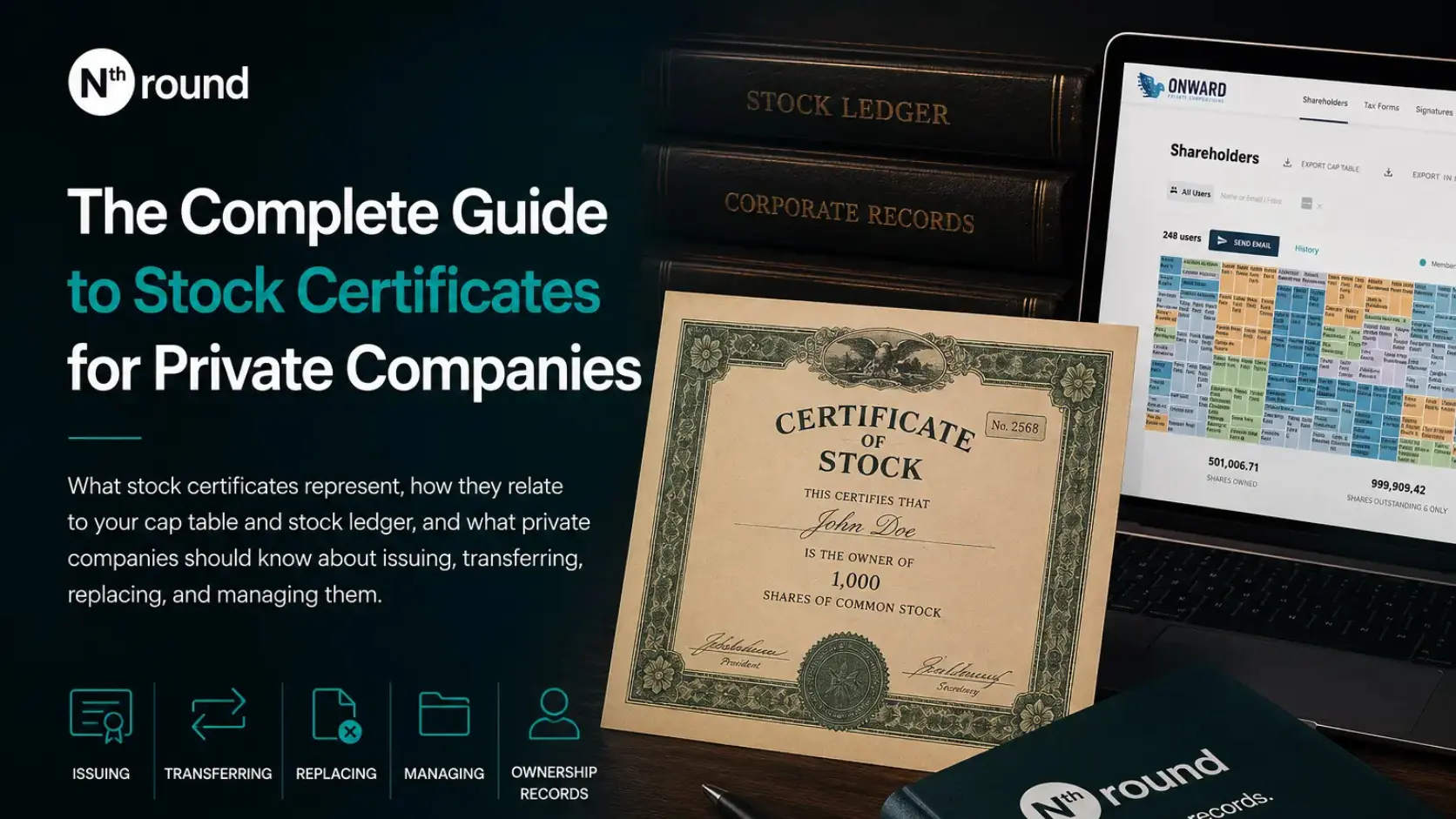
What stock certificates represent, how they relate to your cap table and stock ledger, and what private companies should know about issuing, transferring, replacing, and managing them.

There was a time when owning shares in a private company often came with something tangible: a stock certificate.

It might have been signed by corporate officers, stamped with a certificate number, and placed in a safe, filing cabinet, or safe-deposit box. Years later, when the shares needed to move, somebody had to find it.

Private-company ownership doesn't have to work that way anymore.

Ownership records can be maintained electronically. Shareholders can access information online. Companies can issue and administer equity without relying on pieces of paper moving between shareholders, lawyers, and corporate offices.

But stock certificates haven't simply disappeared.

A stock certificate is a document issued by a corporation representing a shareholder's ownership of a specified number of shares. Certificates can still be physical, but private companies can also administer certificated shares electronically or, where permitted, maintain uncertificated shares.

Many private companies still have paper certificates outstanding. Family businesses may have certificates that have been in circulation for decades. Companies moving from paper records to digital systems first have to understand what was issued in the past. And even companies administering ownership electronically need to understand whether their shares are certificated or uncertificated.

The distinction that matters most is this:

A stock certificate represents an ownership position. It is not, by itself, the company's entire ownership record.

That becomes important the moment shares are issued, transferred, lost, replaced, or cancelled.

What is a stock certificate?

A stock certificate is a document issued by a corporation representing a specified number of shares registered to a shareholder.

Traditionally, that meant a physical document. The certificate identified the company and shareholder, the shares represented, and other information relevant to that ownership.

Today, the first question isn't necessarily whether a certificate is paper or digital.

It's whether the shares are certificated or uncertificated.

Those terms have specific legal meaning. Under Delaware's version of UCC Article 8, for example, a certificated security is a security represented by a certificate. An uncertificated security is not represented by one. Delaware UCC Article 8

That distinction is more precise than assuming every electronically administered share is simply a "digital certificate."

A company can maintain ownership information electronically while still having certificated shares. Another company may maintain uncertificated shares, meaning no certificate represents the shares at all.

Either way, the company still needs an accurate record of the underlying ownership.

Are stock certificates still required?

Not necessarily.

The answer depends on where the company is incorporated, its governing documents, and how its shares have been structured.

Delaware is a useful example because of its prominence as a state of incorporation.

Under Section 158 of the Delaware General Corporation Law, shares are represented by certificates unless the board provides by resolution that some or all shares of a class or series will be uncertificated. Holders of certificated shares are entitled to certificates representing the shares registered in certificate form.

There is an important detail for companies moving away from paper.

A board resolution providing for uncertificated shares does not automatically convert an existing certificated share. Under Delaware law, it does not apply to shares already represented by a certificate until that certificate is surrendered to the corporation.

So a company can't necessarily decide on Monday that it has "gone digital" and assume every certificate issued during the previous 30 years has ceased to matter.

The old ownership history still has to be dealt with.

Companies should work with counsel to determine what their jurisdiction and governing documents require rather than applying Delaware's rules—or another company's practices—to their own situation.

What's actually on a stock certificate?

A certificate generally identifies the corporation, registered shareholder, number of shares, and class or series represented. Certificates may also include a certificate number, authorized signatures, and notices or legends required by applicable law or the company's governing arrangements.

The details can matter.

Suppose a company has common and preferred stock with different rights. Or its shares are subject to restrictions on transfer.

Those aren't details you want disconnected from the instrument representing the shares.

Delaware law, for example, contains requirements concerning how rights associated with different classes or series are addressed on certificates or made available to shareholders. For uncertificated stock, required information is instead provided through written or electronic notice.

Transfer restrictions are another good example.

Under Section 202 of the Delaware General Corporation Law, certain restrictions can be imposed through a certificate of incorporation, bylaws, or agreements among security holders or between holders and the corporation. The statute also makes the way a restriction is communicated important: generally, a permitted restriction must be conspicuously noted on the certificate—or included in the required notice for uncertificated shares—to be enforceable against a person without actual knowledge of it.

This is one reason a stock certificate isn't just a decorative receipt.

It sits inside a broader legal and ownership record.

Stock certificate, cap table, and stock ledger: what's the difference?

These terms often get used in the same conversation, especially when a company is cleaning up old ownership records.

They aren't interchangeable.

A stock certificate represents a particular certificated ownership position.

A cap table gives the company a broader view of its capitalization and ownership. It may track shareholders, security classes, share counts, ownership percentages, options, and other rights to acquire equity, depending on how the company maintains it.

The stock ledger is part of the corporation's formal ownership record.

The practical issue isn't memorizing three definitions.

It's making sure they tell the same story.

Imagine finding an old certificate showing that a shareholder owns 10,000 shares.

The current cap table says 7,500.

Now what?

Maybe 2,500 shares were transferred years ago and the certificate was never properly cancelled.

Maybe the cap table was changed incorrectly.

Maybe a replacement certificate exists.

Maybe there's a transaction document somewhere that explains everything.

The certificate alone doesn't resolve the discrepancy. Neither does blindly trusting the spreadsheet.

Someone has to understand what happened.

That's why stock certificate administration should remain connected to the company's broader cap table and ownership records.

Certificated vs. uncertificated shares

For a company that has always used paper certificates, uncertificated shares can initially sound less formal.

No physical certificate. No ornate border. Nothing for the shareholder to put in a safe.

But the absence of a certificate doesn't mean the absence of an ownership record.

Delaware law expressly provides that, except where otherwise provided by law, holders of uncertificated stock have the same rights and obligations as holders of certificates representing stock of the same class and series. It also requires registered owners of uncertificated stock to receive specified information in writing or electronically within a reasonable time following issuance or transfer.

What changes is the way the shares are represented and administered.

That can remove a great deal of physical handling from the process.

What it doesn't remove is the need to properly authorize the shares, issue them, maintain the shareholder record, communicate applicable information, and track what happens later.

Paper was never the thing making the ownership valid.

The underlying corporate action and ownership record matter.

Where do digital stock certificates fit?

This is where terminology gets messy.

"Digital stock certificate," "electronic stock certificate," "book-entry shares," and "uncertificated shares" are sometimes used as though they all describe the same thing.

They don't necessarily.

A certificate can be maintained electronically and still represent certificated shares. Uncertificated shares, by definition, aren't represented by a certificate.

For administrators, both approaches can eliminate much of the physical handling associated with traditional paper certificates. But the company should understand what it has actually issued rather than treating digital as the legal classification.

We've covered the transition from paper in more depth in The Benefits and Implementation of Digital Stock Certificates.

The more important point here is what happens behind the certificate.

If the certificate exists electronically but the administrator still has to update a separate spreadsheet, email the shareholder, save a PDF somewhere else, and manually reconcile the ownership record, the company has digitized the document.

It hasn't necessarily improved the process around it.

Issuing a stock certificate is not the same as issuing stock

This distinction is easy to miss because the certificate is the thing a shareholder sees.

A company cannot create valid equity simply by generating an impressive-looking certificate with someone's name on it.

The underlying shares first need to be properly authorized and issued in accordance with applicable law, the company's governing documents, and the transaction.

The exact process varies, but an issuance can touch several steps:

Authorization → Approvals → Transaction documents → Consideration → Issuance → Certificate or uncertificated position → Ownership records → Shareholder access

Not every transaction will follow that exact sequence.

The point is that the certificate sits inside the issuance process; it doesn't replace it.

This is one example of a broader ownership workflow: the certificate may be one output, while the ownership event itself moves through approvals, documents, records, and shareholder administration.

And once a new owner has been added, the work can extend into shareholder onboarding, including access to ownership information and relevant company materials.

That distinction becomes especially important when companies reconstruct old cap tables.

Finding a certificate is useful evidence.

You may still need to understand the corporate action and transaction behind it.

What happens when certificated shares are transferred?

Private-company shares generally shouldn't be treated like a piece of property that changes ownership merely because someone physically hands over a certificate.

A proposed transfer may need to be checked against the company's governing documents and agreements. Rights of first refusal, consent requirements, eligibility restrictions, or other transfer provisions may apply.

Delaware law expressly recognizes several types of permitted transfer restrictions, including rights that give the corporation or other holders an opportunity to acquire the shares and provisions requiring consent to a proposed transfer.

The transfer itself also affects more than the certificate.

Depending on the circumstances, the existing certificate may need to be surrendered and cancelled. The transfer has to be registered appropriately. A new certificate or uncertificated position may need to be established. The stock ledger and cap table need to reflect the new ownership.

In Delaware, transfers of stock, stock certificates, and uncertificated stock are generally governed by Article 8 of the state's UCC, subject to the Delaware General Corporation Law.

From an administrative perspective, there's a simpler principle:

The certificates and the ownership record should not tell different stories after the transfer is complete.

Years later, somebody may need to understand exactly how Shareholder B came to own shares previously held by Shareholder A.

The record should make that answer easier, not harder.

When a stock certificate goes missing

Anyone who has administered a company with decades of paper records knows this situation.

The shareholder is still there.

The shares are still on the books.

The certificate isn't.

Maybe it was lost during a move. Maybe it belonged to a parent who died. Maybe it was damaged. Maybe nobody remembers receiving it in the first place.

A missing certificate doesn't automatically mean the underlying ownership vanished.

But the company also can't safely pretend the old certificate never existed and print another one.

For Delaware corporations, Section 167 of the Delaware General Corporation Law allows a corporation to issue a new certificate or uncertificated shares in place of a certificate alleged to have been lost, stolen, or destroyed. The corporation may require the owner or legal representative to provide a bond sufficient to protect the corporation against claims arising from the missing certificate or replacement.

Other jurisdictions and individual companies may have different requirements or procedures.

From a recordkeeping perspective, the replacement should also preserve the history.

If Certificate #27 is replaced by Certificate #104, somebody reviewing the records five years later should be able to understand why both numbers exist.

Otherwise, a replacement intended to solve one problem creates a new one.

Cancellation is part of the history

Companies tend to pay attention when certificates are issued.

Cancelled certificates can receive less attention.

That's a mistake.

A certificate might be cancelled because shares were transferred, redeemed, exchanged, or replaced. Whatever the reason, cancellation explains why a certificate that once represented outstanding shares no longer does.

Deleting it from the current view isn't the same as preserving that history.

A useful certificate record should let an administrator follow the lifecycle:

Certificate issued.

Certificate outstanding.

Certificate surrendered or otherwise addressed.

Certificate cancelled.

Replacement or new ownership position created, where applicable.

This becomes increasingly important as the people administering the cap table change.

The employee who remembers why Certificate #42 disappeared may not work at the company ten years from now.

The record needs to remember for them.

Why certificate numbers still matter

Certificate numbers can feel like another artifact from the paper era.

But they provide something useful: an identifier for following a certificate through its life.

Suppose Certificate #12 was issued to one shareholder.

Those shares were later transferred and #12 was cancelled.

Certificate #43 was issued to the new holder.

Years later, #43 was reported lost and Certificate #86 replaced it.

The numbers aren't what establish the economic ownership.

They help administrators follow what happened to the instruments representing it.

That's particularly useful when a company has a long history of paper certificates, transfers, and replacements.

Without that trail, an administrator may have to reconstruct events from board minutes, legal documents, old spreadsheets, scanned certificates, and email.

When the certificate register and cap table don't agree

This is where stock certificate administration stops feeling theoretical.

In ownership-record migrations, one of the first jobs is often reconciling what the company believes it owns today with the history that produced that record. Old certificates, cancellation records, transaction documents, and the current cap table don't always line up neatly.

A company preparing for a financing, sale, redemption, or ownership transition can encounter the same problem.

The current cap table looks fine.

Then somebody opens the certificate register.

There are certificates marked outstanding for people who no longer appear on the cap table. Certificate numbers are duplicated. A shareholder has a certificate for a different number of shares than the current record shows. A replacement certificate appears without a clear reference to what it replaced.

Now the company has a reconciliation project.

This is why a stock certificate audit can be useful, particularly before migrating old paper records into a digital system.

The basic question is:

What certificates have we issued, which remain outstanding, what shares do they represent, and does that history agree with our current ownership records?

The exercise may involve comparing certificates and certificate registers against the stock ledger, cap table, transaction documents, and historical transfer records.

It's tempting to treat digitization as the solution.

But uploading an incorrect certificate register into a modern system only gives you a digital version of the same problem.

Clean the ownership history before relying on the new system to preserve it.

The problems are usually small—until they aren't

Most certificate problems don't begin as crises.

Someone forgot to mark a certificate cancelled.

A shareholder changed their name.

A replacement wasn't linked clearly to the original.

A certificate contains the wrong share count.

The cap table was updated but the certificate register wasn't.

A paper certificate is still marked outstanding even though everyone assumed the company converted its records years ago.

Each one is easy to postpone.

Then the company needs to complete a transaction.

Or a shareholder dies.

Or shares need to transfer.

Or counsel begins diligence for a sale.

Suddenly, the company isn't cleaning up an old administrative detail. It's trying to establish what happened to its ownership under a deadline.

That is why certificate management is really a recordkeeping discipline.

The goal isn't perfect paperwork for its own sake.

The goal is being able to answer a basic question with confidence:

Who owns the company, and how did the ownership get here?

Moving from paper certificates to digital records

For companies with years of paper history, modernization shouldn't begin with scanning.

It should begin with reconciliation.

Before deciding how future shares will be represented, understand the existing ones.

Which certificates were issued?

Which are still outstanding?

Which were cancelled?

Are any missing?

Who is the registered holder of each outstanding position?

How many shares does each certificate represent?

Does that history agree with the current stock ledger and cap table?

Only after those questions are resolved does the technology decision become much easier.

Depending on the company's legal structure and governing documents, it may move toward electronically administered certificates, uncertificated shares, or another approach determined with counsel.

Whatever the method, the objective should be more ambitious than getting rid of paper.

The company should come out of the process with greater confidence in its ownership record.

For a closer look at what happens after a certificate is issued, see our guide Managing stock certificates throughout their lifecycle, including certificate numbers, shareholder access, transfers, cancellations, and replacements.

A certificate is one part of a much larger ownership system

Stock certificates are easy to think about as documents.

For private companies, they're better understood as part of an ownership history.

A share gets authorized and issued.

A shareholder receives an ownership position.

That ownership may later be transferred, redeemed, replaced, or passed to another generation.

The cap table changes.

The stock ledger changes.

The shareholder record changes.

The certificate, where one exists, needs to remain connected to those events.

That's why moving from paper to digital can be valuable—but not simply because electronic records are easier to store than pieces of paper.

The real improvement comes when the company no longer has separate records telling separate versions of the same ownership story.

When shares are issued, the ownership record reflects it.

When shares move, the history follows them.

When a certificate is cancelled or replaced, the old record doesn't disappear.

And when somebody needs to understand the company's ownership ten or twenty years later, they aren't starting with a filing cabinet and a guess.

Modern stock certificate management isn't really about the certificate. It's about maintaining an ownership record you can trust.

There was a time when owning shares in a private company often came with something tangible: a stock certificate.

It might have been signed by corporate officers, stamped with a certificate number, and placed in a safe, filing cabinet, or safe-deposit box. Years later, when the shares needed to move, somebody had to find it.

Private-company ownership doesn't have to work that way anymore.

Ownership records can be maintained electronically. Shareholders can access information online. Companies can issue and administer equity without relying on pieces of paper moving between shareholders, lawyers, and corporate offices.

But stock certificates haven't simply disappeared.

A stock certificate is a document issued by a corporation representing a shareholder's ownership of a specified number of shares. Certificates can still be physical, but private companies can also administer certificated shares electronically or, where permitted, maintain uncertificated shares.

Many private companies still have paper certificates outstanding. Family businesses may have certificates that have been in circulation for decades. Companies moving from paper records to digital systems first have to understand what was issued in the past. And even companies administering ownership electronically need to understand whether their shares are certificated or uncertificated.

The distinction that matters most is this:

A stock certificate represents an ownership position. It is not, by itself, the company's entire ownership record.

That becomes important the moment shares are issued, transferred, lost, replaced, or cancelled.

What is a stock certificate?

A stock certificate is a document issued by a corporation representing a specified number of shares registered to a shareholder.

Traditionally, that meant a physical document. The certificate identified the company and shareholder, the shares represented, and other information relevant to that ownership.

Today, the first question isn't necessarily whether a certificate is paper or digital.

It's whether the shares are certificated or uncertificated.

Those terms have specific legal meaning. Under Delaware's version of UCC Article 8, for example, a certificated security is a security represented by a certificate. An uncertificated security is not represented by one. Delaware UCC Article 8

That distinction is more precise than assuming every electronically administered share is simply a "digital certificate."

A company can maintain ownership information electronically while still having certificated shares. Another company may maintain uncertificated shares, meaning no certificate represents the shares at all.

Either way, the company still needs an accurate record of the underlying ownership.

Are stock certificates still required?

Not necessarily.

The answer depends on where the company is incorporated, its governing documents, and how its shares have been structured.

Delaware is a useful example because of its prominence as a state of incorporation.

Under Section 158 of the Delaware General Corporation Law, shares are represented by certificates unless the board provides by resolution that some or all shares of a class or series will be uncertificated. Holders of certificated shares are entitled to certificates representing the shares registered in certificate form.

There is an important detail for companies moving away from paper.

A board resolution providing for uncertificated shares does not automatically convert an existing certificated share. Under Delaware law, it does not apply to shares already represented by a certificate until that certificate is surrendered to the corporation.

So a company can't necessarily decide on Monday that it has "gone digital" and assume every certificate issued during the previous 30 years has ceased to matter.

The old ownership history still has to be dealt with.

Companies should work with counsel to determine what their jurisdiction and governing documents require rather than applying Delaware's rules—or another company's practices—to their own situation.

What's actually on a stock certificate?

A certificate generally identifies the corporation, registered shareholder, number of shares, and class or series represented. Certificates may also include a certificate number, authorized signatures, and notices or legends required by applicable law or the company's governing arrangements.

The details can matter.

Suppose a company has common and preferred stock with different rights. Or its shares are subject to restrictions on transfer.

Those aren't details you want disconnected from the instrument representing the shares.

Delaware law, for example, contains requirements concerning how rights associated with different classes or series are addressed on certificates or made available to shareholders. For uncertificated stock, required information is instead provided through written or electronic notice.

Transfer restrictions are another good example.

Under Section 202 of the Delaware General Corporation Law, certain restrictions can be imposed through a certificate of incorporation, bylaws, or agreements among security holders or between holders and the corporation. The statute also makes the way a restriction is communicated important: generally, a permitted restriction must be conspicuously noted on the certificate—or included in the required notice for uncertificated shares—to be enforceable against a person without actual knowledge of it.

This is one reason a stock certificate isn't just a decorative receipt.

It sits inside a broader legal and ownership record.

Stock certificate, cap table, and stock ledger: what's the difference?

These terms often get used in the same conversation, especially when a company is cleaning up old ownership records.

They aren't interchangeable.

A stock certificate represents a particular certificated ownership position.

A cap table gives the company a broader view of its capitalization and ownership. It may track shareholders, security classes, share counts, ownership percentages, options, and other rights to acquire equity, depending on how the company maintains it.

The stock ledger is part of the corporation's formal ownership record.

The practical issue isn't memorizing three definitions.

It's making sure they tell the same story.

Imagine finding an old certificate showing that a shareholder owns 10,000 shares.

The current cap table says 7,500.

Now what?

Maybe 2,500 shares were transferred years ago and the certificate was never properly cancelled.

Maybe the cap table was changed incorrectly.

Maybe a replacement certificate exists.

Maybe there's a transaction document somewhere that explains everything.

The certificate alone doesn't resolve the discrepancy. Neither does blindly trusting the spreadsheet.

Someone has to understand what happened.

That's why stock certificate administration should remain connected to the company's broader cap table and ownership records.

Certificated vs. uncertificated shares

For a company that has always used paper certificates, uncertificated shares can initially sound less formal.

No physical certificate. No ornate border. Nothing for the shareholder to put in a safe.

But the absence of a certificate doesn't mean the absence of an ownership record.

Delaware law expressly provides that, except where otherwise provided by law, holders of uncertificated stock have the same rights and obligations as holders of certificates representing stock of the same class and series. It also requires registered owners of uncertificated stock to receive specified information in writing or electronically within a reasonable time following issuance or transfer.

What changes is the way the shares are represented and administered.

That can remove a great deal of physical handling from the process.

What it doesn't remove is the need to properly authorize the shares, issue them, maintain the shareholder record, communicate applicable information, and track what happens later.

Paper was never the thing making the ownership valid.

The underlying corporate action and ownership record matter.

Where do digital stock certificates fit?

This is where terminology gets messy.

"Digital stock certificate," "electronic stock certificate," "book-entry shares," and "uncertificated shares" are sometimes used as though they all describe the same thing.

They don't necessarily.

A certificate can be maintained electronically and still represent certificated shares. Uncertificated shares, by definition, aren't represented by a certificate.

For administrators, both approaches can eliminate much of the physical handling associated with traditional paper certificates. But the company should understand what it has actually issued rather than treating digital as the legal classification.

We've covered the transition from paper in more depth in The Benefits and Implementation of Digital Stock Certificates.

The more important point here is what happens behind the certificate.

If the certificate exists electronically but the administrator still has to update a separate spreadsheet, email the shareholder, save a PDF somewhere else, and manually reconcile the ownership record, the company has digitized the document.

It hasn't necessarily improved the process around it.

Issuing a stock certificate is not the same as issuing stock

This distinction is easy to miss because the certificate is the thing a shareholder sees.

A company cannot create valid equity simply by generating an impressive-looking certificate with someone's name on it.

The underlying shares first need to be properly authorized and issued in accordance with applicable law, the company's governing documents, and the transaction.

The exact process varies, but an issuance can touch several steps:

Authorization → Approvals → Transaction documents → Consideration → Issuance → Certificate or uncertificated position → Ownership records → Shareholder access

Not every transaction will follow that exact sequence.

The point is that the certificate sits inside the issuance process; it doesn't replace it.

This is one example of a broader ownership workflow: the certificate may be one output, while the ownership event itself moves through approvals, documents, records, and shareholder administration.

And once a new owner has been added, the work can extend into shareholder onboarding, including access to ownership information and relevant company materials.

That distinction becomes especially important when companies reconstruct old cap tables.

Finding a certificate is useful evidence.

You may still need to understand the corporate action and transaction behind it.

What happens when certificated shares are transferred?

Private-company shares generally shouldn't be treated like a piece of property that changes ownership merely because someone physically hands over a certificate.

A proposed transfer may need to be checked against the company's governing documents and agreements. Rights of first refusal, consent requirements, eligibility restrictions, or other transfer provisions may apply.

Delaware law expressly recognizes several types of permitted transfer restrictions, including rights that give the corporation or other holders an opportunity to acquire the shares and provisions requiring consent to a proposed transfer.

The transfer itself also affects more than the certificate.

Depending on the circumstances, the existing certificate may need to be surrendered and cancelled. The transfer has to be registered appropriately. A new certificate or uncertificated position may need to be established. The stock ledger and cap table need to reflect the new ownership.

In Delaware, transfers of stock, stock certificates, and uncertificated stock are generally governed by Article 8 of the state's UCC, subject to the Delaware General Corporation Law.

From an administrative perspective, there's a simpler principle:

The certificates and the ownership record should not tell different stories after the transfer is complete.

Years later, somebody may need to understand exactly how Shareholder B came to own shares previously held by Shareholder A.

The record should make that answer easier, not harder.

When a stock certificate goes missing

Anyone who has administered a company with decades of paper records knows this situation.

The shareholder is still there.

The shares are still on the books.

The certificate isn't.

Maybe it was lost during a move. Maybe it belonged to a parent who died. Maybe it was damaged. Maybe nobody remembers receiving it in the first place.

A missing certificate doesn't automatically mean the underlying ownership vanished.

But the company also can't safely pretend the old certificate never existed and print another one.

For Delaware corporations, Section 167 of the Delaware General Corporation Law allows a corporation to issue a new certificate or uncertificated shares in place of a certificate alleged to have been lost, stolen, or destroyed. The corporation may require the owner or legal representative to provide a bond sufficient to protect the corporation against claims arising from the missing certificate or replacement.

Other jurisdictions and individual companies may have different requirements or procedures.

From a recordkeeping perspective, the replacement should also preserve the history.

If Certificate #27 is replaced by Certificate #104, somebody reviewing the records five years later should be able to understand why both numbers exist.

Otherwise, a replacement intended to solve one problem creates a new one.

Cancellation is part of the history

Companies tend to pay attention when certificates are issued.

Cancelled certificates can receive less attention.

That's a mistake.

A certificate might be cancelled because shares were transferred, redeemed, exchanged, or replaced. Whatever the reason, cancellation explains why a certificate that once represented outstanding shares no longer does.

Deleting it from the current view isn't the same as preserving that history.

A useful certificate record should let an administrator follow the lifecycle:

Certificate issued.

Certificate outstanding.

Certificate surrendered or otherwise addressed.

Certificate cancelled.

Replacement or new ownership position created, where applicable.

This becomes increasingly important as the people administering the cap table change.

The employee who remembers why Certificate #42 disappeared may not work at the company ten years from now.

The record needs to remember for them.

Why certificate numbers still matter

Certificate numbers can feel like another artifact from the paper era.

But they provide something useful: an identifier for following a certificate through its life.

Suppose Certificate #12 was issued to one shareholder.

Those shares were later transferred and #12 was cancelled.

Certificate #43 was issued to the new holder.

Years later, #43 was reported lost and Certificate #86 replaced it.

The numbers aren't what establish the economic ownership.

They help administrators follow what happened to the instruments representing it.

That's particularly useful when a company has a long history of paper certificates, transfers, and replacements.

Without that trail, an administrator may have to reconstruct events from board minutes, legal documents, old spreadsheets, scanned certificates, and email.

When the certificate register and cap table don't agree

This is where stock certificate administration stops feeling theoretical.

In ownership-record migrations, one of the first jobs is often reconciling what the company believes it owns today with the history that produced that record. Old certificates, cancellation records, transaction documents, and the current cap table don't always line up neatly.

A company preparing for a financing, sale, redemption, or ownership transition can encounter the same problem.

The current cap table looks fine.

Then somebody opens the certificate register.

There are certificates marked outstanding for people who no longer appear on the cap table. Certificate numbers are duplicated. A shareholder has a certificate for a different number of shares than the current record shows. A replacement certificate appears without a clear reference to what it replaced.

Now the company has a reconciliation project.

This is why a stock certificate audit can be useful, particularly before migrating old paper records into a digital system.

The basic question is:

What certificates have we issued, which remain outstanding, what shares do they represent, and does that history agree with our current ownership records?

The exercise may involve comparing certificates and certificate registers against the stock ledger, cap table, transaction documents, and historical transfer records.

It's tempting to treat digitization as the solution.

But uploading an incorrect certificate register into a modern system only gives you a digital version of the same problem.

Clean the ownership history before relying on the new system to preserve it.

The problems are usually small—until they aren't

Most certificate problems don't begin as crises.

Someone forgot to mark a certificate cancelled.

A shareholder changed their name.

A replacement wasn't linked clearly to the original.

A certificate contains the wrong share count.

The cap table was updated but the certificate register wasn't.

A paper certificate is still marked outstanding even though everyone assumed the company converted its records years ago.

Each one is easy to postpone.

Then the company needs to complete a transaction.

Or a shareholder dies.

Or shares need to transfer.

Or counsel begins diligence for a sale.

Suddenly, the company isn't cleaning up an old administrative detail. It's trying to establish what happened to its ownership under a deadline.

That is why certificate management is really a recordkeeping discipline.

The goal isn't perfect paperwork for its own sake.

The goal is being able to answer a basic question with confidence:

Who owns the company, and how did the ownership get here?

Moving from paper certificates to digital records

For companies with years of paper history, modernization shouldn't begin with scanning.

It should begin with reconciliation.

Before deciding how future shares will be represented, understand the existing ones.

Which certificates were issued?

Which are still outstanding?

Which were cancelled?

Are any missing?

Who is the registered holder of each outstanding position?

How many shares does each certificate represent?

Does that history agree with the current stock ledger and cap table?

Only after those questions are resolved does the technology decision become much easier.

Depending on the company's legal structure and governing documents, it may move toward electronically administered certificates, uncertificated shares, or another approach determined with counsel.

Whatever the method, the objective should be more ambitious than getting rid of paper.

The company should come out of the process with greater confidence in its ownership record.

For a closer look at what happens after a certificate is issued, see our guide Managing stock certificates throughout their lifecycle, including certificate numbers, shareholder access, transfers, cancellations, and replacements.

A certificate is one part of a much larger ownership system

Stock certificates are easy to think about as documents.

For private companies, they're better understood as part of an ownership history.

A share gets authorized and issued.

A shareholder receives an ownership position.

That ownership may later be transferred, redeemed, replaced, or passed to another generation.

The cap table changes.

The stock ledger changes.

The shareholder record changes.

The certificate, where one exists, needs to remain connected to those events.

That's why moving from paper to digital can be valuable—but not simply because electronic records are easier to store than pieces of paper.

The real improvement comes when the company no longer has separate records telling separate versions of the same ownership story.

When shares are issued, the ownership record reflects it.

When shares move, the history follows them.

When a certificate is cancelled or replaced, the old record doesn't disappear.

And when somebody needs to understand the company's ownership ten or twenty years later, they aren't starting with a filing cabinet and a guess.

Modern stock certificate management isn't really about the certificate. It's about maintaining an ownership record you can trust.

Frequently Asked Questions

What is a stock certificate?

A stock certificate is a document issued by a corporation representing a specified number of shares registered to a shareholder. Certificates have traditionally been physical documents, although certificated shares can also be administered electronically.

Are stock certificates required for private companies?

Not in every case. Requirements depend on the jurisdiction, governing documents, and structure of the company's shares. Delaware corporations, for example, may provide for uncertificated shares through board resolution under Section 158 of the Delaware General Corporation Law.

Can a private company issue stock without a physical certificate?

Yes, depending on applicable law and the company's governing arrangements. Delaware corporations, for example, may provide for uncertificated shares through a board resolution. Existing shares already represented by certificates are subject to additional rules, including the surrender provision in Delaware Section 158.

What is the difference between certificated and uncertificated shares?

A certificated security is represented by a certificate. An uncertificated security is not. The absence of a certificate does not eliminate the company's need to maintain accurate ownership records.

Is a digital stock certificate the same as an uncertificated share?

Not necessarily. A certificate can be maintained electronically while still representing certificated shares. An uncertificated share, by definition, is not represented by a certificate.

What is the difference between a stock certificate and a cap table?

A stock certificate represents a particular certificated ownership position. A cap table provides a broader view of the company's capitalization and equity ownership. They serve different purposes but should be consistent with the same underlying ownership history.

What happens if a stock certificate is lost?

The procedure depends on the company's jurisdiction and circumstances. Delaware law, for example, permits a corporation to issue a replacement certificate or uncertificated shares for a certificate alleged to have been lost, stolen, or destroyed and permits the corporation to require an indemnifying bond.

Can private-company shares have transfer restrictions?

Yes. Private-company shares may be subject to restrictions arising from governing documents or agreements. Delaware Section 202, for example, recognizes several types of transfer and ownership restrictions and contains requirements concerning notice of those restrictions.

What is a stock certificate audit?

A stock certificate audit reconciles certificates issued by the company with its current and historical ownership records. The objective is to identify which certificates remain outstanding, what shares they represent, what has been cancelled or replaced, and whether that history agrees with the company's stock ledger and cap table.