Equity Operations

Why Private Companies Need an Audit Trail for Ownership Changes

Zohaib Khalid

I

October 8, 2026

Today's cap table tells you who owns what. The audit trail explains how they got there.

A shareholder owns 15,000 shares.

‍

That's useful information.

‍

But six years ago, they owned 25,000.

‍

What happened to the other 10,000?

‍

Maybe they sold some shares back to the company. Maybe they transferred them to a trust. Maybe part of the position moved to another family member. Maybe there was a correction somewhere along the way.

‍

If the only record you have is today's cap table, answering that question can turn into an afternoon of opening old spreadsheets, searching email, and asking around to see if anyone remembers.

‍

An ownership audit trail changes that.

‍

It preserves the history behind the current ownership record: what changed, when it changed, and what transaction or documentation sits behind that change.

‍

For private companies where ownership can stretch across decades, generations, entities, trusts, employees, and repeated transactions, that history isn't administrative clutter.

‍

It's part of the ownership record.

‍

What is an ownership audit trail?

‍

An ownership audit trail is the historical record of changes to a company's ownership and the information supporting those changes.

‍

Think about the difference between these two records:

‍

Current record:
Jane Smith owns 15,000 shares.

‍

Historical record:
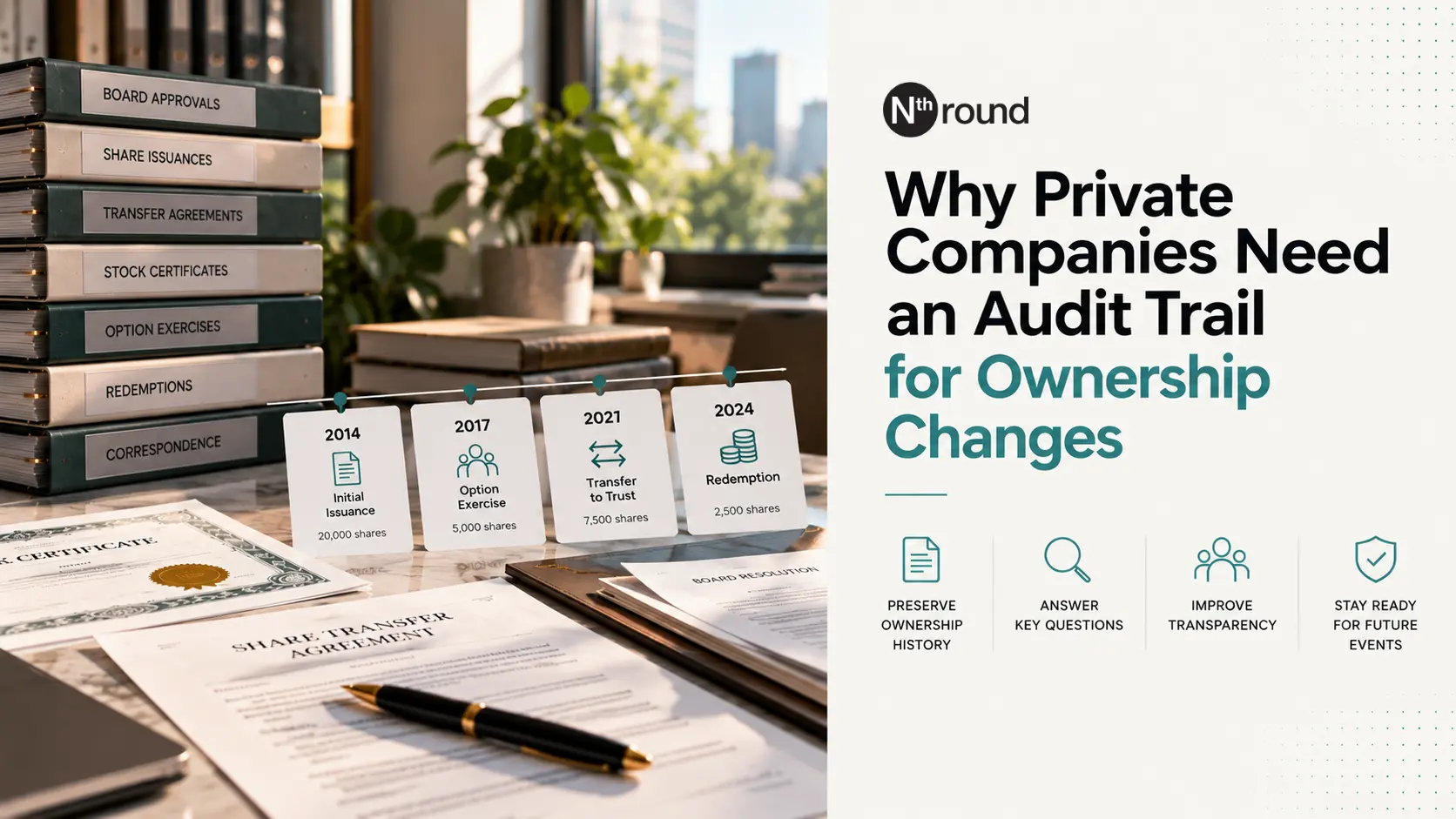
Jane Smith acquired 20,000 shares in 2014, acquired another 5,000 in 2017, transferred 7,500 to a trust in 2021, and sold 2,500 shares back to the company in 2024.

‍

Both arrive at the same answer today: 15,000 shares.

‍

Only one tells you why.

‍

Depending on the company and transaction, the history behind those changes may involve agreements, approvals, certificates, transaction records, shareholder information, and other supporting documentation.

‍

The point isn't to collect documents for the sake of collecting documents.

‍

It's to preserve enough context that the company can reconstruct what happened later.

‍

What ownership changes should you be able to trace?

‍

If an event changes who owns the company or how much they own, there should generally be a record of it.

‍

That can include:

  • Stock issuances
  • Share transfers
  • Option exercises
  • Conversions
  • Redemptions and repurchases
  • Cancellations
  • Certificate replacements
  • Transfers into trusts or other entities
  • Equity award activity
  • Corrections to ownership records

Not every event will have the same process or documentation.

‍

But they share something important: the ownership record looks different afterward than it did before.

‍

A good audit trail connects those two states.

‍

We've talked about this more broadly in our guide to private company shareholder recordkeeping. The current cap table matters, but so does the history and documentation that explain it.

‍

The current number isn't always enough

‍

Cap tables naturally emphasize the present.

‍

That's what they're supposed to do.

‍

You want to know how many shares are outstanding, who holds them, which classes exist, and what ownership looks like now. Our Ultimate Guide to Cap Table Management goes deeper into maintaining that current ownership picture.

‍

The trouble starts when someone asks a historical question.

‍

Why did this shareholder's balance change?

‍

When were these shares transferred?

‍

Was this certificate cancelled?

‍

What happened to this position after the shareholder died?

‍

Why does this agreement show a different number than today's cap table?

‍

Was this transaction ever completed?

‍

Now you're no longer asking the cap table to tell you where ownership stands.

‍

You're asking it to explain how ownership moved.

‍

Those are different jobs.

‍

Ownership changes rarely happen in one place

‍

This is where private-company ownership gets messy.

‍

Take a share transfer.

‍

On paper, it sounds simple:

‍

One shareholder transfers shares to another.

‍

Operationally, the transaction can touch several things.

‍

There may be a transfer agreement. An approval may be required. The cap table or stock ledger needs to change. An existing certificate may need to be cancelled. A new certificate may need to be issued. Shareholder information may need to be updated. The company may need to communicate with the parties involved.

‍

The transaction isn't really one action.

‍

It's a workflow.

‍

That's why we've argued that private-company ownership works better as a series of connected workflows. If one part of the process happens without the others, the company can end up with a transaction that appears complete in one system and unfinished in another.

‍

An audit trail helps preserve the connection between those steps.

‍

A transfer shouldn't disappear into the new balance

‍

Suppose Robert owns 50,000 shares.

‍

He transfers 10,000 to a family trust.

‍

After the transaction, your cap table might simply show:

‍

Robert: 40,000 shares
Robert Family Trust: 10,000 shares

‍

Perfectly reasonable.

‍

Five years later, though, someone may need to know where the trust's shares came from.

‍

If all you have is the current cap table, you know the answer today.

‍

You don't necessarily know the story.

‍

A useful historical record would make it possible to trace the trust's 10,000 shares back to the transfer, identify the parties involved, locate the relevant documentation, and understand what happened to any certificates or other records affected by it.

‍

This becomes particularly important for private companies with multigenerational or family ownership. Shares don't always stay with the person who originally acquired them.

‍

They move.

‍

The record needs to move with them.

‍

Stock certificates make the history especially important

‍

Certificates are a good example because the current document can make the previous one look irrelevant.

‍

It isn't.

‍

Imagine a shareholder holds a certificate for 30,000 shares.

‍

They transfer 10,000 shares.

‍

The original certificate is cancelled and a new certificate is issued for the remaining 20,000.

‍

Today's active certificate tells you the shareholder owns 20,000 shares.

‍

The cancelled certificate and transfer history help explain why.

‍

If the old certificate simply vanishes from the record, you've lost part of the chain.

‍

This is why managing stock certificates is more involved than generating a PDF and sending it to a shareholder. Issuance, assignment, transfer, cancellation, replacement, and preservation of history all matter.

‍

A cancelled certificate isn't necessarily useless paperwork.

‍

It's evidence of what existed before.

‍

Corrections should leave a trail too

‍

Nobody maintains perfect records forever.

‍

A name gets entered incorrectly.

‍

A transaction date is wrong.

‍

Someone discovers that a share amount was entered as 12,000 instead of 21,000.

‍

The obvious response is to fix it.

‍

And you should.

‍

But there is a difference between correcting a record and rewriting history.

‍

If an important ownership record changes, it can be useful to preserve what changed rather than silently replacing the previous information as though the error never existed.

‍

Otherwise, you may solve today's problem while creating tomorrow's mystery.

‍

Someone reviewing the history later sees a number that doesn't match an older document and has no idea why.

‍

The correction becomes another unexplained discrepancy.

‍

As we covered in What Happens When Your Cap Table and Legal Records Don't Match?, conflicting records are much easier to investigate when the company can reconstruct the events and corrections that produced the current position.

‍

An audit trail matters when people change too

‍

Private companies can last a long time.

‍

Longer than spreadsheets.

‍

Longer than software systems.

‍

And often longer than the tenure of the people administering ownership.

‍

The controller who handled a redemption in 2019 may have left.

‍

The outside attorney who worked on a transfer may have changed firms.

‍

The family member who understood an old ownership arrangement may no longer be involved in the business.

‍

The current team shouldn't need those people in the room to understand what happened.

‍

This is one of the quieter reasons an audit trail matters.

‍

It turns institutional memory into an institutional record.

‍

Instead of:

‍

"I think Susan handled that."

‍

You want:

‍

"Here's the transaction, here's what changed, and here's the supporting record."

‍

Much better.

‍

Audit trails become more valuable as ownership gets more complicated

‍

Shareholder count matters, but it isn't the whole story.

‍

A company with 40 shareholders can have a surprisingly complicated ownership history.

‍

One shareholder is an individual.

‍

Another holds shares through two trusts.

‍

Another inherited shares.

‍

Several employees have exercised options over the years.

‍

The company has completed multiple redemptions.

‍

A few shareholders have transferred portions of their positions between family entities.

‍

Now multiply those events across ten or twenty years.

‍

The difficulty isn't just knowing today's ownership.

‍

It's maintaining continuity between thousands of small decisions and transactions that produced it.

‍

This is where shareholder management starts becoming an operational responsibility rather than a periodic cap-table exercise.

‍

An audit trail doesn't mean saving everything forever

‍

There is a danger in talking about recordkeeping as though the answer is simply:

‍

Keep more stuff.

‍

That's not particularly helpful.

‍

A shared drive containing 14,000 files isn't automatically a good audit trail.

‍

Neither is an inbox full of transaction emails.

‍

The value comes from being able to connect the information.

‍

If a shareholder's position changed, can you identify the event?

‍

Can you see when it happened?

‍

Can you understand the before and after?

‍

Can you locate the relevant supporting records?

‍

Can another person follow that history without knowing which folder someone happened to use eight years ago?

‍

That's a much better test than the number of documents you've saved.

‍

And retention requirements vary. Companies should work with legal, tax, and accounting advisors to determine what records they are required to preserve and for how long.

‍

Audit trails matter during shareholder voting

‍

Voting is another place where historical ownership records can suddenly become operationally important.

‍

Before a shareholder casts a ballot, the company may need to determine who is eligible to participate and what voting power they have under the applicable rules and governing documents.

‍

That depends on the ownership record.

‍

If ownership has changed recently—or the company's records don't agree—something that looked like a simple voting exercise can become a much bigger administrative project.

‍

The ballot isn't necessarily the difficult part.

‍

Getting the ownership information behind the ballot right is.

‍

That's why governance, voting, and ownership administration shouldn't be treated as completely separate systems. The same ownership record often sits underneath all three.

‍

Audit trails matter during liquidity events too

‍

The same issue appears when shares move through a redemption, repurchase, or company-sponsored liquidity event.

‍

You need to know what someone owned before the transaction.

‍

What they sold.

‍

What remains afterward.

‍

And how that transaction should be reflected in the ownership record.

‍

If the company later runs another liquidity program, today's ending balance becomes tomorrow's starting point.

‍

History compounds.

‍

That's one reason we think the administrative infrastructure behind private-company ownership becomes more important over time, not less.

‍

Shareholders have long memories—and old documents

‍

Companies aren't the only ones keeping records.

‍

Shareholders may have certificates, agreements, tax documents, statements, emails, and other information they've collected over the years.

‍

Sometimes those records are decades old.

‍

If a shareholder comes to the company with a certificate showing 25,000 shares while the current record shows 15,000, somebody needs to explain the difference.

‍

Maybe 10,000 shares were transferred years ago.

‍

Fine.

‍

Can you show that?

‍

A good audit trail helps the company answer from its records rather than relying on somebody's recollection of a transaction that happened in 2016.

‍

Giving shareholders secure access to appropriate current information through a shareholder portal can help with the present.

‍

The audit trail explains the past.

‍

You need both.

‍

Software doesn't create a clean ownership history by itself

‍

Moving ownership administration into software helps.

‍

But there's no magic button labeled Fix 20 Years of Corporate History.

‍

If the underlying records are incomplete, putting them into a modern system doesn't make the missing pieces appear.

‍

And if your process still involves updating one system while forgetting three others, new software won't solve the process problem either.

‍

The value comes from connecting the work.

‍

The ownership record.

‍

The shareholder.

‍

The transaction.

‍

The documents.

‍

The certificate.

‍

The approval.

‍

The resulting change.

‍

Nth Round is built around that broader ownership operation, so companies can manage ownership information alongside the workflows and records that surround it rather than treating the cap table as an isolated spreadsheet.

‍

The goal isn't to create more administrative work.

‍

It's to stop having to reconstruct work you've already done.

‍

Could you reconstruct an ownership change from five years ago?

‍

That's probably the simplest test.

‍

Choose a transaction.

‍

Not last week's.

‍

Pick one from five years ago.

‍

Can you tell what ownership looked like before it happened?

‍

Can you identify what changed?

‍

Can you find the supporting documents?

‍

Can you see any certificates that were issued or cancelled?

‍

Can you identify the approvals associated with it, where applicable?

‍

Can you explain the ownership position after the transaction?

‍

And could somebody who wasn't there do the same thing?

‍

If the answer is no, the current cap table may still be accurate.

‍

But you're depending on a version of history you can't easily prove.

‍

Good ownership records preserve the path, not just the destination

‍

Private-company ownership is cumulative.

‍

Today's cap table is the result of every issuance, exercise, transfer, redemption, conversion, cancellation, and correction that came before it.

‍

Most days, you only need the current answer.

‍

Who owns what?

‍

Then one day, someone asks:

‍

Why?

‍

That's when the audit trail earns its keep.

‍

Not because every private company should operate as though an audit is arriving tomorrow.

‍

Because ownership changes.

‍

People change.

‍

Systems change.

‍

And five years from now, the person trying to understand today's transaction may have no idea who handled it.

‍

Give them something better than an old spreadsheet and a trail of emails.

‍

Give them the history.

‍

A shareholder owns 15,000 shares.

‍

That's useful information.

‍

But six years ago, they owned 25,000.

‍

What happened to the other 10,000?

‍

Maybe they sold some shares back to the company. Maybe they transferred them to a trust. Maybe part of the position moved to another family member. Maybe there was a correction somewhere along the way.

‍

If the only record you have is today's cap table, answering that question can turn into an afternoon of opening old spreadsheets, searching email, and asking around to see if anyone remembers.

‍

An ownership audit trail changes that.

‍

It preserves the history behind the current ownership record: what changed, when it changed, and what transaction or documentation sits behind that change.

‍

For private companies where ownership can stretch across decades, generations, entities, trusts, employees, and repeated transactions, that history isn't administrative clutter.

‍

It's part of the ownership record.

‍

What is an ownership audit trail?

‍

An ownership audit trail is the historical record of changes to a company's ownership and the information supporting those changes.

‍

Think about the difference between these two records:

‍

Current record:
Jane Smith owns 15,000 shares.

‍

Historical record:
Jane Smith acquired 20,000 shares in 2014, acquired another 5,000 in 2017, transferred 7,500 to a trust in 2021, and sold 2,500 shares back to the company in 2024.

‍

Both arrive at the same answer today: 15,000 shares.

‍

Only one tells you why.

‍

Depending on the company and transaction, the history behind those changes may involve agreements, approvals, certificates, transaction records, shareholder information, and other supporting documentation.

‍

The point isn't to collect documents for the sake of collecting documents.

‍

It's to preserve enough context that the company can reconstruct what happened later.

‍

What ownership changes should you be able to trace?

‍

If an event changes who owns the company or how much they own, there should generally be a record of it.

‍

That can include:

Not every event will have the same process or documentation.

‍

But they share something important: the ownership record looks different afterward than it did before.

‍

A good audit trail connects those two states.

‍

We've talked about this more broadly in our guide to private company shareholder recordkeeping. The current cap table matters, but so does the history and documentation that explain it.

‍

The current number isn't always enough

‍

Cap tables naturally emphasize the present.

‍

That's what they're supposed to do.

‍

You want to know how many shares are outstanding, who holds them, which classes exist, and what ownership looks like now. Our Ultimate Guide to Cap Table Management goes deeper into maintaining that current ownership picture.

‍

The trouble starts when someone asks a historical question.

‍

Why did this shareholder's balance change?

‍

When were these shares transferred?

‍

Was this certificate cancelled?

‍

What happened to this position after the shareholder died?

‍

Why does this agreement show a different number than today's cap table?

‍

Was this transaction ever completed?

‍

Now you're no longer asking the cap table to tell you where ownership stands.

‍

You're asking it to explain how ownership moved.

‍

Those are different jobs.

‍

Ownership changes rarely happen in one place

‍

This is where private-company ownership gets messy.

‍

Take a share transfer.

‍

On paper, it sounds simple:

‍

One shareholder transfers shares to another.

‍

Operationally, the transaction can touch several things.

‍

There may be a transfer agreement. An approval may be required. The cap table or stock ledger needs to change. An existing certificate may need to be cancelled. A new certificate may need to be issued. Shareholder information may need to be updated. The company may need to communicate with the parties involved.

‍

The transaction isn't really one action.

‍

It's a workflow.

‍

That's why we've argued that private-company ownership works better as a series of connected workflows. If one part of the process happens without the others, the company can end up with a transaction that appears complete in one system and unfinished in another.

‍

An audit trail helps preserve the connection between those steps.

‍

A transfer shouldn't disappear into the new balance

‍

Suppose Robert owns 50,000 shares.

‍

He transfers 10,000 to a family trust.

‍

After the transaction, your cap table might simply show:

‍

Robert: 40,000 shares
Robert Family Trust: 10,000 shares

‍

Perfectly reasonable.

‍

Five years later, though, someone may need to know where the trust's shares came from.

‍

If all you have is the current cap table, you know the answer today.

‍

You don't necessarily know the story.

‍

A useful historical record would make it possible to trace the trust's 10,000 shares back to the transfer, identify the parties involved, locate the relevant documentation, and understand what happened to any certificates or other records affected by it.

‍

This becomes particularly important for private companies with multigenerational or family ownership. Shares don't always stay with the person who originally acquired them.

‍

They move.

‍

The record needs to move with them.

‍

Stock certificates make the history especially important

‍

Certificates are a good example because the current document can make the previous one look irrelevant.

‍

It isn't.

‍

Imagine a shareholder holds a certificate for 30,000 shares.

‍

They transfer 10,000 shares.

‍

The original certificate is cancelled and a new certificate is issued for the remaining 20,000.

‍

Today's active certificate tells you the shareholder owns 20,000 shares.

‍

The cancelled certificate and transfer history help explain why.

‍

If the old certificate simply vanishes from the record, you've lost part of the chain.

‍

This is why managing stock certificates is more involved than generating a PDF and sending it to a shareholder. Issuance, assignment, transfer, cancellation, replacement, and preservation of history all matter.

‍

A cancelled certificate isn't necessarily useless paperwork.

‍

It's evidence of what existed before.

‍

Corrections should leave a trail too

‍

Nobody maintains perfect records forever.

‍

A name gets entered incorrectly.

‍

A transaction date is wrong.

‍

Someone discovers that a share amount was entered as 12,000 instead of 21,000.

‍

The obvious response is to fix it.

‍

And you should.

‍

But there is a difference between correcting a record and rewriting history.

‍

If an important ownership record changes, it can be useful to preserve what changed rather than silently replacing the previous information as though the error never existed.

‍

Otherwise, you may solve today's problem while creating tomorrow's mystery.

‍

Someone reviewing the history later sees a number that doesn't match an older document and has no idea why.

‍

The correction becomes another unexplained discrepancy.

‍

As we covered in What Happens When Your Cap Table and Legal Records Don't Match?, conflicting records are much easier to investigate when the company can reconstruct the events and corrections that produced the current position.

‍

An audit trail matters when people change too

‍

Private companies can last a long time.

‍

Longer than spreadsheets.

‍

Longer than software systems.

‍

And often longer than the tenure of the people administering ownership.

‍

The controller who handled a redemption in 2019 may have left.

‍

The outside attorney who worked on a transfer may have changed firms.

‍

The family member who understood an old ownership arrangement may no longer be involved in the business.

‍

The current team shouldn't need those people in the room to understand what happened.

‍

This is one of the quieter reasons an audit trail matters.

‍

It turns institutional memory into an institutional record.

‍

Instead of:

‍

"I think Susan handled that."

‍

You want:

‍

"Here's the transaction, here's what changed, and here's the supporting record."

‍

Much better.

‍

Audit trails become more valuable as ownership gets more complicated

‍

Shareholder count matters, but it isn't the whole story.

‍

A company with 40 shareholders can have a surprisingly complicated ownership history.

‍

One shareholder is an individual.

‍

Another holds shares through two trusts.

‍

Another inherited shares.

‍

Several employees have exercised options over the years.

‍

The company has completed multiple redemptions.

‍

A few shareholders have transferred portions of their positions between family entities.

‍

Now multiply those events across ten or twenty years.

‍

The difficulty isn't just knowing today's ownership.

‍

It's maintaining continuity between thousands of small decisions and transactions that produced it.

‍

This is where shareholder management starts becoming an operational responsibility rather than a periodic cap-table exercise.

‍

An audit trail doesn't mean saving everything forever

‍

There is a danger in talking about recordkeeping as though the answer is simply:

‍

Keep more stuff.

‍

That's not particularly helpful.

‍

A shared drive containing 14,000 files isn't automatically a good audit trail.

‍

Neither is an inbox full of transaction emails.

‍

The value comes from being able to connect the information.

‍

If a shareholder's position changed, can you identify the event?

‍

Can you see when it happened?

‍

Can you understand the before and after?

‍

Can you locate the relevant supporting records?

‍

Can another person follow that history without knowing which folder someone happened to use eight years ago?

‍

That's a much better test than the number of documents you've saved.

‍

And retention requirements vary. Companies should work with legal, tax, and accounting advisors to determine what records they are required to preserve and for how long.

‍

Audit trails matter during shareholder voting

‍

Voting is another place where historical ownership records can suddenly become operationally important.

‍

Before a shareholder casts a ballot, the company may need to determine who is eligible to participate and what voting power they have under the applicable rules and governing documents.

‍

That depends on the ownership record.

‍

If ownership has changed recently—or the company's records don't agree—something that looked like a simple voting exercise can become a much bigger administrative project.

‍

The ballot isn't necessarily the difficult part.

‍

Getting the ownership information behind the ballot right is.

‍

That's why governance, voting, and ownership administration shouldn't be treated as completely separate systems. The same ownership record often sits underneath all three.

‍

Audit trails matter during liquidity events too

‍

The same issue appears when shares move through a redemption, repurchase, or company-sponsored liquidity event.

‍

You need to know what someone owned before the transaction.

‍

What they sold.

‍

What remains afterward.

‍

And how that transaction should be reflected in the ownership record.

‍

If the company later runs another liquidity program, today's ending balance becomes tomorrow's starting point.

‍

History compounds.

‍

That's one reason we think the administrative infrastructure behind private-company ownership becomes more important over time, not less.

‍

Shareholders have long memories—and old documents

‍

Companies aren't the only ones keeping records.

‍

Shareholders may have certificates, agreements, tax documents, statements, emails, and other information they've collected over the years.

‍

Sometimes those records are decades old.

‍

If a shareholder comes to the company with a certificate showing 25,000 shares while the current record shows 15,000, somebody needs to explain the difference.

‍

Maybe 10,000 shares were transferred years ago.

‍

Fine.

‍

Can you show that?

‍

A good audit trail helps the company answer from its records rather than relying on somebody's recollection of a transaction that happened in 2016.

‍

Giving shareholders secure access to appropriate current information through a shareholder portal can help with the present.

‍

The audit trail explains the past.

‍

You need both.

‍

Software doesn't create a clean ownership history by itself

‍

Moving ownership administration into software helps.

‍

But there's no magic button labeled Fix 20 Years of Corporate History.

‍

If the underlying records are incomplete, putting them into a modern system doesn't make the missing pieces appear.

‍

And if your process still involves updating one system while forgetting three others, new software won't solve the process problem either.

‍

The value comes from connecting the work.

‍

The ownership record.

‍

The shareholder.

‍

The transaction.

‍

The documents.

‍

The certificate.

‍

The approval.

‍

The resulting change.

‍

Nth Round is built around that broader ownership operation, so companies can manage ownership information alongside the workflows and records that surround it rather than treating the cap table as an isolated spreadsheet.

‍

The goal isn't to create more administrative work.

‍

It's to stop having to reconstruct work you've already done.

‍

Could you reconstruct an ownership change from five years ago?

‍

That's probably the simplest test.

‍

Choose a transaction.

‍

Not last week's.

‍

Pick one from five years ago.

‍

Can you tell what ownership looked like before it happened?

‍

Can you identify what changed?

‍

Can you find the supporting documents?

‍

Can you see any certificates that were issued or cancelled?

‍

Can you identify the approvals associated with it, where applicable?

‍

Can you explain the ownership position after the transaction?

‍

And could somebody who wasn't there do the same thing?

‍

If the answer is no, the current cap table may still be accurate.

‍

But you're depending on a version of history you can't easily prove.

‍

Good ownership records preserve the path, not just the destination

‍

Private-company ownership is cumulative.

‍

Today's cap table is the result of every issuance, exercise, transfer, redemption, conversion, cancellation, and correction that came before it.

‍

Most days, you only need the current answer.

‍

Who owns what?

‍

Then one day, someone asks:

‍

Why?

‍

That's when the audit trail earns its keep.

‍

Not because every private company should operate as though an audit is arriving tomorrow.

‍

Because ownership changes.

‍

People change.

‍

Systems change.

‍

And five years from now, the person trying to understand today's transaction may have no idea who handled it.

‍

Give them something better than an old spreadsheet and a trail of emails.

‍

Give them the history.

‍

Frequently Asked Questions

‍

What is an audit trail for private-company ownership?

An ownership audit trail is the historical record of changes to a company's ownership. It helps show how a shareholder's current position was reached by preserving information about relevant issuances, transfers, exercises, redemptions, cancellations, corrections, and other ownership events.

‍

What's the difference between a cap table and an ownership audit trail?

A cap table primarily shows the company's capitalization and current ownership position. An audit trail provides historical context by showing the changes that led to that position. The two work together: one shows where ownership stands, while the other helps explain how it got there.

‍

What ownership changes should a private company track?

Depending on the company's structure and circumstances, relevant changes can include issuances, transfers, option exercises, conversions, redemptions, repurchases, cancellations, certificate changes, equity award activity, and corrections to ownership records. Companies should work with their professional advisors to determine their specific recordkeeping obligations.

‍

Should corrections to a cap table be tracked?

Maintaining a record of material corrections can make it easier to understand why current information differs from earlier records. Rather than silently overwriting history, companies may benefit from preserving enough context to understand what was corrected and why. The appropriate recordkeeping process should be determined with the company's legal and other professional advisors.

‍

Why does an ownership audit trail matter if the current cap table is accurate?

The current cap table answers what ownership looks like today. It may not explain why a shareholder owns a particular number of shares, what transactions changed their position, or why an older document shows something different. An audit trail makes those historical questions easier to answer without reconstructing years of activity from scratch.

‍