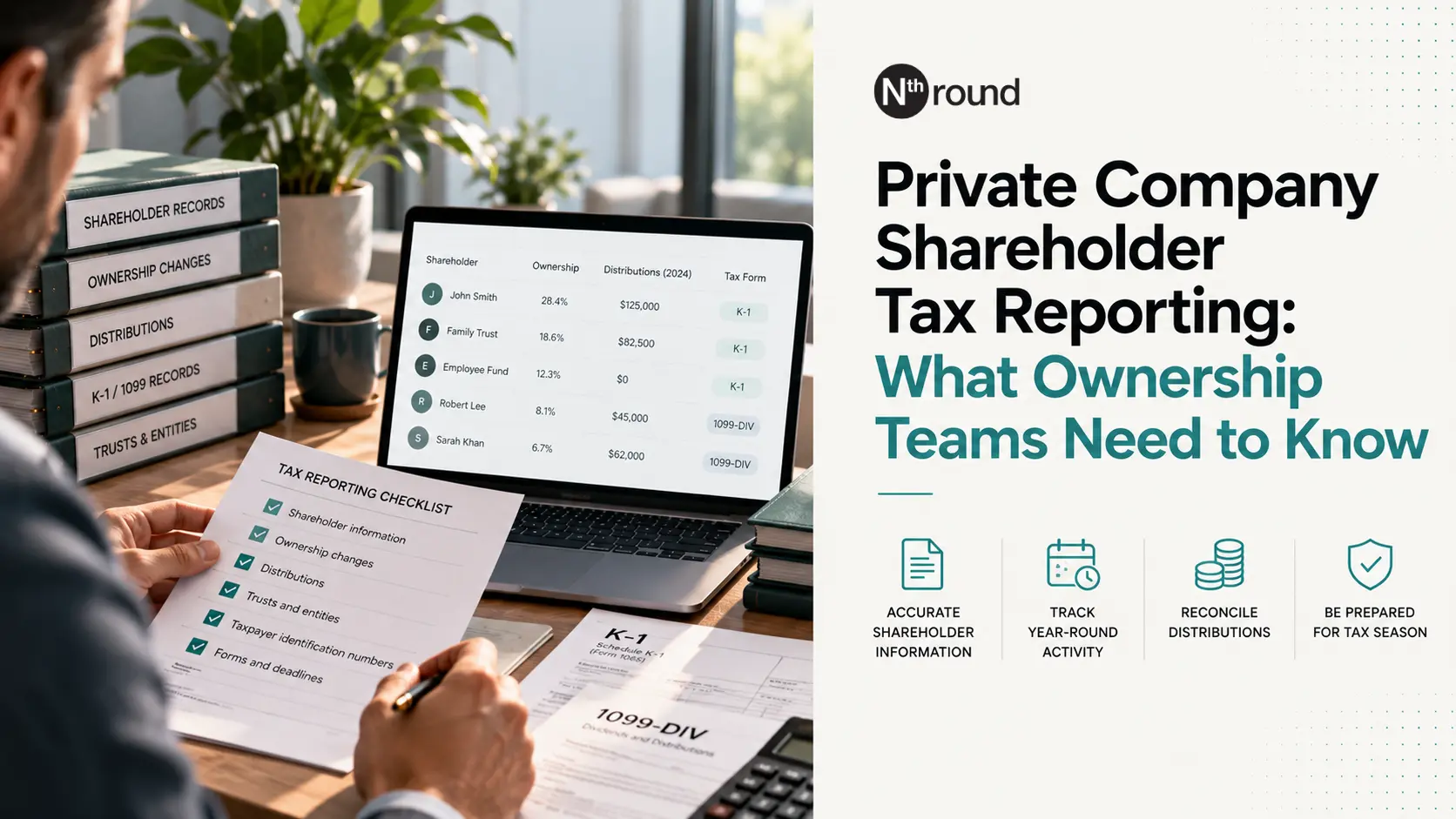
Tax forms may arrive at the end of the process. The information behind them has been accumulating all year.
Tax season has a way of turning small administrative problems into urgent ones.
A shareholder moved but never updated their address. Shares were transferred into a trust. A distribution was tracked in a separate spreadsheet. An ownership change happened halfway through the year. Someone needs a taxpayer identification number that isn't where everyone thought it was.
None of these problems started during tax season.
That's just when somebody finally needed the information.
For private companies, shareholder tax reporting depends on something much less seasonal: accurate ownership records, current shareholder information, and a reliable history of the transactions and distributions that happened during the year.
Your tax advisors may prepare the forms.
But they can only work with the information you give them.
What is shareholder tax reporting?
Shareholder tax reporting is a broad term for the information companies and other entities may need to report or provide to owners as a result of ownership, income, distributions, or other activity.
What that actually looks like depends heavily on the entity and the circumstances.
A C corporation that pays reportable dividends may have Form 1099-DIV obligations. The IRS generally requires Form 1099-DIV for people receiving at least $10 in dividends or other reportable distributions, subject to the form's specific rules and exceptions.
Partnerships generally use Schedule K-1 (Form 1065) to report each partner's share of income, deductions, credits, and other items. S corporations use Schedule K-1 (Form 1120-S) for each shareholder's share of relevant tax items.
Those are very different reporting situations.
That's why this isn't an article about choosing or preparing a particular tax form. That's work to handle with your tax professionals.
We're interested in what comes before it.
Because whichever form ultimately goes out, somebody first has to know who the owners are, what happened during the year, and whether the information attached to those owners is still correct.
Tax reporting starts with the ownership record
Consider a company with 75 shareholders.
If nobody's ownership changed during the year, administration may be relatively straightforward.
Private companies don't tend to stay that tidy.
A shareholder transfers shares to a trust.
Another sells shares back to the company.
An employee exercises options.
A longtime shareholder dies and an estate becomes involved.
New shares are issued.
A distribution is made.
Now the ownership record at December 31 doesn't necessarily tell you everything that happened during the preceding twelve months.
You need the history too.
That's why good shareholder recordkeeping matters well before tax reporting begins. The cap table tells you where ownership stands. The records behind it help explain how it got there.
Current shareholder information matters just as much
Ownership teams tend to focus, understandably, on the shares.
Tax reporting has a habit of reminding everyone that the information attached to the shareholder matters too.
Names.
Addresses.
Entity information.
Taxpayer identification information, where required.
Changes in how an interest is held.
Other information requested by the company's tax professionals.
Some of this information is sensitive. Some changes infrequently. Which makes it very easy to assume that whatever is already on file is still correct.
Until it isn't.
A shareholder who has been with the company for 15 years may have moved three times.
Shares once held personally may now sit in a trust.
A family member may have inherited an interest.
An entity's information may have changed.
The company may know about the change operationally without that change ever making its way to the record used for tax reporting.
That's the kind of disconnect that's much easier to resolve in October than when forms are being prepared.
A year-end cap table doesn't tell the whole story
This distinction matters.
Imagine a shareholder starts the year with 50,000 shares.
In July, the company redeems 20,000.
They finish the year with 30,000.
If you look only at the current cap table, you see 30,000.
Correct.
But depending on the reporting question, your tax professionals may also need to understand what happened during the year.
When did the redemption occur?
What documentation supports it?
Were any payments made?
How was the transaction characterized?
What did the shareholder own before and after it?
The current balance can't answer all of that.
An audit trail for ownership changes gives the company somewhere to go when today's ownership position isn't enough.
Tax reporting is one of the moments when that history can become useful very quickly.
Distributions create another layer of recordkeeping
For private companies that make distributions, there is another set of records to keep straight.
Who was entitled to receive the payment?
How much did each person receive?
When was it paid?
Did ownership change around the distribution date?
Was the payment successfully delivered?
How is the distribution treated for tax purposes?
That last question belongs with your tax advisors.
The others depend heavily on your administrative records.
This is where a process that looked perfectly manageable during the year can become surprisingly awkward.
The cap table lives in one place.
The distribution calculation lives in a spreadsheet.
Banking information lives somewhere else.
Shareholder tax information is in another file.
A transaction affecting ownership is sitting with legal.
Now somebody needs to bring everything together.
This is the broader problem we've described in our guide to private-company ownership workflows: digitizing individual steps doesn't necessarily mean the workflow itself is connected.
Tax reporting has a useful way of exposing those gaps.
Form 1099-DIV is one possible output
For companies that make reportable dividend distributions, Form 1099-DIV may be part of the process.
The IRS instructions say Form 1099-DIV is generally filed for each person receiving $10 or more in dividends or other distributions that fall within the form's reporting rules, as well as certain other circumstances described in the instructions.
But the form itself is the end product.
Before anyone gets there, the company may need accurate recipient information and a reliable record of the distributions made during the year.
That's where the operational work lives.
We go much deeper into the form itself in The Complete Guide to Form 1099-DIV for Private Companies.
The broader point here is simpler:
You don't want to start figuring out who received what when it's time to produce the form.
That record should already exist.
Schedule K-1 is a different reporting process
Schedule K-1 often gets lumped into the same general conversation about shareholder tax documents, but it serves a different purpose.
For partnerships, Schedule K-1 reports a partner's share of the partnership's income, deductions, credits, and other items. Partners generally report those items on their own tax returns, and partnership income can create tax liability whether or not the income was actually distributed.
S corporations also use Schedule K-1 to report each shareholder's share of income, deductions, credits, and other tax items. The IRS notes that S corporation shareholders generally include their share of income on their returns whether or not it was distributed.
That distinction matters because a distribution and taxable income are not necessarily the same thing.
It's also why ownership teams shouldn't try to make tax determinations based on the administrative record alone.
Your tax advisors determine how the applicable rules affect your company and its owners.
Your job operationally is to make sure they're not trying to do that work from stale or incomplete ownership information.
For more on the form, see our guide to understanding Schedule K-1.
Ownership changes during the year can matter
Suppose a private company has the same 100 shareholders on January 1 and December 31.
Easy enough.
Now suppose 15 ownership events happen during the year.
Shares are issued.
Options are exercised.
Positions are redeemed.
A shareholder transfers shares.
Another shareholder dies.
A trust enters the ownership structure.
The year-end shareholder list doesn't show the sequence.
That's why the underlying transaction history matters.
For example, IRS instructions for S corporations generally require a Schedule K-1 for each person who was a shareholder at any time during the tax year, not simply those appearing as shareholders at year-end.
The details of allocating tax items around ownership changes can get technical quickly. That's exactly where tax professionals belong.
But the professionals still need to know that the ownership change happened.
If an ownership transaction is buried in an email chain and never makes it into the company's reliable ownership history, you have an operational problem before you have a tax problem.
Tax reporting exposes disconnected systems
Picture the usual setup.
Legal has the transaction documents.
Finance has the cap table.
Someone in accounting has the distribution workbook.
Shareholder contact information is in another spreadsheet.
Tax information is stored somewhere more restricted.
The outside tax firm sends a request.
And then the scavenger hunt begins.
Nobody necessarily did anything wrong.
Each team kept the information it needed to do its part of the job.
The problem is that tax reporting needs several of those pieces at once.
This is why we don't think private-company equity administration stops at the cap table.
Ownership creates downstream work.
Distributions.
Communications.
Voting.
Documents.
Transactions.
Tax reporting.
The closer those activities remain to a reliable ownership record, the less time teams spend reconciling one version of the company against another.
Shareholders notice tax-reporting mistakes
A small internal recordkeeping issue feels different once it reaches a shareholder.
Their name is wrong.
The form goes to an old address.
The wrong entity is listed.
A document is missing.
Something doesn't match what they expected.
Now the shareholder is emailing the company.
The company is emailing its tax advisors.
Someone is checking the ownership record.
Someone else is looking for an old transfer document.
And an issue that could have been handled quietly months earlier becomes a January or March fire drill.
For partnership K-1s, the IRS specifically tells partners who believe their K-1 contains an error to notify the partnership and request a corrected Schedule K-1 rather than changing the K-1 themselves.
Accuracy matters on both sides of the relationship.
Shareholder self-service can help with the administrative side
Not every shareholder request should require an email to finance.
Where appropriate, shareholders can benefit from having a secure place to access the information and documents the company makes available to them.
That's one role of a shareholder portal.
It doesn't replace the company's tax advisors.
It doesn't tell a shareholder how to file their return.
And it certainly doesn't make a complicated tax situation simple.
What it can do is reduce some of the administrative friction around getting information to shareholders and giving them a reliable place to find it again.
Anyone who has resent the same document three times knows that's not nothing.
Tax information also needs to be handled like sensitive information
There's another side to all of this.
The information used for shareholder administration and tax reporting can be sensitive.
Personal information.
Tax identification information.
Addresses.
Ownership positions.
Banking details.
Documents.
That information shouldn't simply migrate into whichever spreadsheet is easiest to email around.
Access matters.
Permissions matter.
Security matters.
So does knowing where the authoritative information lives.
Nth Round's shareholder management platform is designed to help private companies keep shareholder information and ownership administration connected rather than scattering that work across spreadsheets, inboxes, and disconnected systems.
The goal isn't to turn the ownership team into the tax department.
It's to give the tax department and outside advisors better information to work from.
What should ownership teams do before tax season?
Don't wait for the first request from your tax firm.
Before reporting season begins, take a look at the records that will eventually feed the process.
Are shareholder names and contact details current?
Have changes involving trusts, estates, or entities been reflected appropriately?
Can you account for ownership changes during the year?
Are distribution records complete?
Can you reconcile those distributions back to the relevant shareholder information?
Do you know where the supporting transaction documents live?
Are you relying on one person to remember how something was handled?
And have you asked your tax advisors what information they'll need from you before deadlines start getting close?
That last question is worth doing early.
Your tax advisors know the company's filing requirements.
Your ownership team knows where the ownership information comes from.
Those two groups should meet before somebody is waiting on a form.
The best tax-season cleanup happens before tax season
There will always be last-minute questions.
Tax is tax.
But there is a big difference between answering a technical question in March and discovering in March that nobody updated a shareholder's information after a transfer nine months earlier.
One requires expertise.
The other requires archaeology.
Private companies can eliminate a surprising amount of the second kind.
Keep the ownership record current.
Preserve the history behind changes.
Keep shareholder information up to date.
Track distributions as they happen.
Connect transactions to their supporting records.
And involve your tax professionals early enough to understand what they'll need.
Because when tax reporting season arrives, the goal shouldn't be to rebuild the year.
The year should already be in the records.