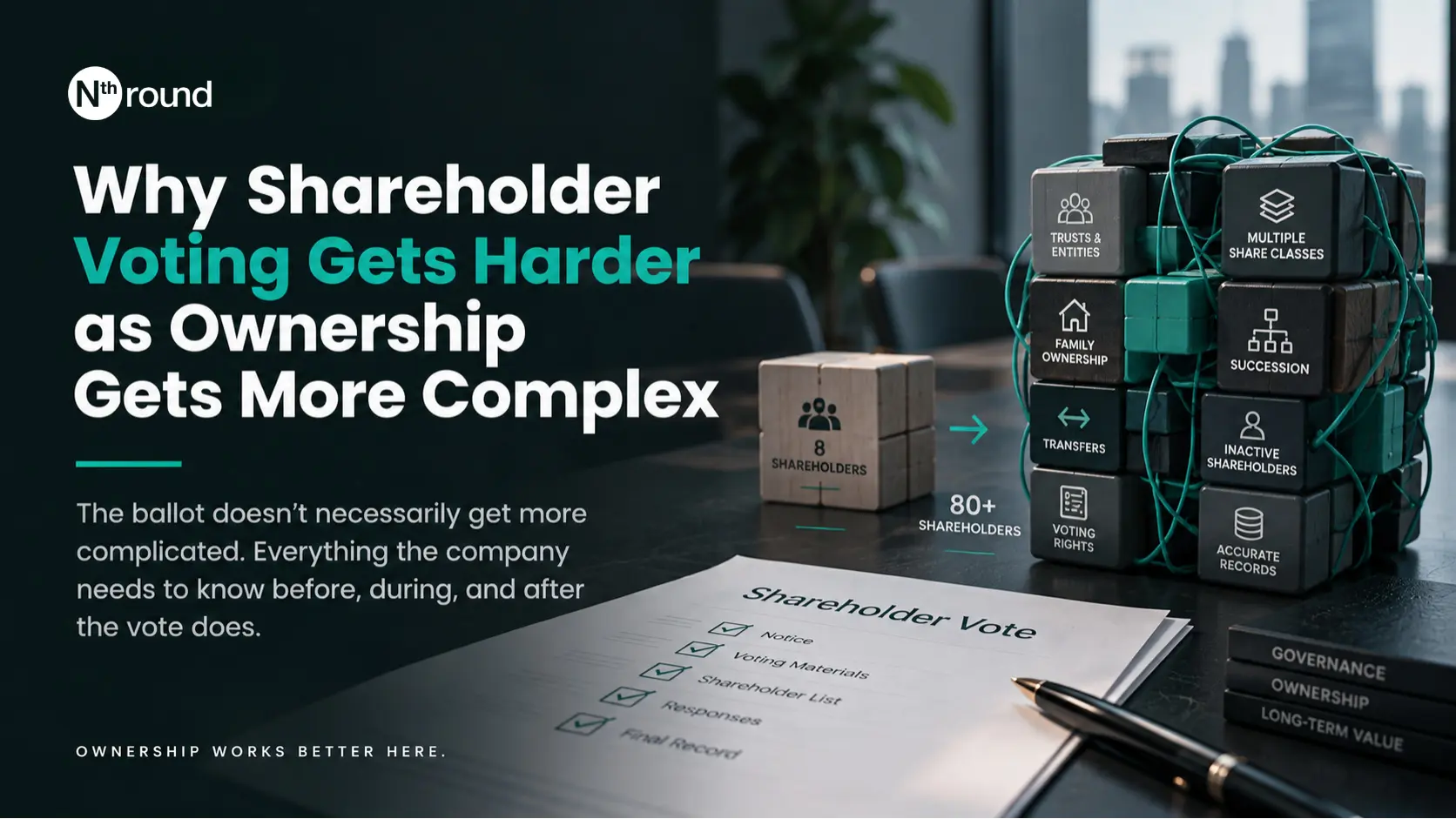
Voting with eight shareholders isn't particularly intimidating.
You probably know all eight of them. You know who owns what. If somebody hasn't responded, you know who to call. There may even be a decent chance they're all sitting around the same table.
Now make it 80 shareholders.
Some shares are held in trusts. A few shareholders inherited their positions. There are multiple classes of stock. Several owners haven't worked at the company in years. One email address bounced the last time you sent an update. Another shareholder recently transferred shares, but you're not sure whether every internal record reflects it yet.
The ballot hasn't become much more complicated.
The ownership behind it has.
That's why shareholder voting tends to get harder as private-company ownership grows: a vote forces the company to bring ownership records, shareholder information, voting rights, communication, participation, and governance history together at the same time.
If those pieces already work together, voting can be pretty uneventful.
If they don't, the vote is often when you find out.
Why does shareholder voting become more complicated as ownership grows?
Shareholder voting gets more complicated when the company has more ownership relationships, rights, records, and people to coordinate.
Headcount matters, but it's not the whole story.
A company with 100 shareholders who all hold the same class of stock and have current information may have a cleaner voting process than a company with 35 shareholders spread across trusts, family branches, multiple entities, and different classes of shares.
That's because the company doesn't just need a list of names.
It may need to know:
- Who is eligible to vote
- What each shareholder owns
- What voting rights attach to those holdings
- How much voting power each holder has
- Who is authorized to act for a trust or entity
- Where voting materials should be sent
- Who has responded
- Whether the required approval has been reached
- What needs to be preserved after the vote
That's a lot of information to bring together for something that ends with a fairly simple result: approved or not approved, elected or not elected.
Our Complete Guide to Shareholder Voting for Private Companies covers the full voting process. Here, we're looking specifically at what happens when the ownership underneath that process becomes harder to manage.
More shareholders create more places for records to drift
Private-company shareholder records don't usually become unreliable overnight.
They drift.
Someone moves and tells one person at the company but not another. A new trustee takes over. An employee leaves. Shares transfer between family members. An estate enters the picture. An old email address keeps hanging around because nobody had a reason to update it.
Until now.
A vote is coming.
Suddenly the company needs a clean list of eligible shareholders, current contact information, accurate ownership positions, and the rights associated with those positions.
And it needs them on a deadline.
This is why shareholder voting is so closely connected to cap table management. The ownership record isn't something you dust off after the voting materials have been prepared. It's part of what determines the voting population in the first place.
If you start a voting process by asking, “Which spreadsheet has the latest shareholder list?” you've already found the first problem.
Different owners can mean different voting rights
Another thing changes as ownership gets more complicated: assumptions become expensive.
It's easy to think of a shareholder vote as one person, one ballot.
Private-company ownership doesn't necessarily work that way.
Shareholders may hold different numbers of shares. Different classes can carry different rights. Certain matters may involve particular groups of shareholders. Trusts or entities can raise additional questions about who is authorized to act.
The specifics depend on the company's governing documents and applicable requirements, which is why companies should work with legal counsel to establish the voting rules for a particular event.
The administrative problem comes afterward.
Once the rules are established, can the company actually apply them to its ownership data?
Knowing that Class A and Class B need to be treated differently doesn't help much if someone still has to spend Friday afternoon reconciling three spreadsheets to determine who holds each class.
Trusts and entities add another question: who actually acts?
A shareholder record may say that shares are owned by a trust.
A trust isn't going to open an email and click a button.
Someone acts for it.
The same problem can arise with other entities holding shares. The company needs to understand not only the ownership position but also the appropriate person or authority associated with it.
That distinction can be easy to manage when everyone involved knows the history.
It becomes harder when ownership has accumulated over decades and the people administering today's vote weren't around when the shares were originally transferred.
This is one reason shareholder governance becomes more demanding as ownership gets more complex. The company is no longer managing a simple list of owners. It's managing the relationships, rights, and records surrounding those owners.
Ownership changes don't politely wait until after the vote
A clean diagram of a voting process usually assumes the ownership structure sits still while the vote happens.
Real companies are less considerate.
Shares get transferred. Employees exercise options. Estates are settled. Trusts change. Repurchases happen. Certificates are canceled and reissued.
Meanwhile, the company may be preparing a shareholder action.
That means the ownership record used for the vote needs to reflect whatever date and requirements apply to that particular event.
This isn't something a voting tool can decide for the company. Counsel and the company's governing framework determine the applicable rules.
But once those rules are known, the company still needs records accurate enough to apply them.
That's where voting stops being a standalone event and starts looking much more like the private-company ownership workflows we've written about before.
The vote is connected to what happened before it.
And whatever happens during the vote becomes part of the record used afterward.
The spreadsheet works until you're chasing votes
For a small shareholder base, a spreadsheet can feel perfectly adequate.
Name. Email. Shares. Voting power. Ballot sent. Response received.
Done.
Then the vote starts.
An email bounces.
Someone notices that a shareholder's voting power looks wrong.
A trust has a different contact than the one in the spreadsheet.
A shareholder says they already voted, but nobody can find the response.
Another replies directly to the reminder email with “YES” in all caps.
Someone on the team makes a corrected copy of the spreadsheet and forgets to tell everyone else.
Now there are two versions.
None of this means spreadsheets are bad.
It means the spreadsheet has become responsible for a job that involves more than rows and formulas.
We've looked specifically at the cost of running a proxy vote on spreadsheets and email. The real cost isn't just the time spent typing information into cells. It's the reconciliation, follow-up, version control, and uncertainty that appear once the voting process is underway.
The spreadsheet still calculates.
The process around it is what's struggling.
More shareholders means more communication - not necessarily better communication
Sending voting materials to 12 shareholders is one thing.
Sending them across a larger, more varied shareholder population is another.
Some shareholders know exactly what's happening because they're close to the business.
Others don't.
The CEO may have spent the last three months discussing a proposal with the board. A family shareholder who lives across the country may first hear about it when the voting notice lands in their inbox.
Those two people aren't starting with the same context.
The company has to bridge some of that gap.
Not by turning the voting packet into a novel. And not by involving every shareholder in management.
But owners need enough information to understand what they're being asked to do.
This becomes especially important when a company has shareholders who don't work in the business. We've seen the same issue in managing family shareholders who don't work in the business: people closest to the company naturally accumulate context that outside owners don't have.
Voting puts that difference under a deadline.
Email delivery becomes a surprisingly important problem
Before someone can vote, they need to receive the materials.
Again, obvious.
And again, easier said than done once the shareholder population gets larger.
Email addresses change. Messages bounce. Spam filters intervene. Someone's assistant receives company communications. An elderly shareholder still prefers paper. A family office has a different contact for administrative matters.
A vote is not a great time to discover that the shareholder information you've been carrying for five years is no longer current.
This is part of why shareholder communication problems are often infrastructure problems.
The email itself may be perfectly written.
It doesn't matter much if it went to an address nobody checks.
Getting the vote out is only half the job
Once the materials are distributed, administrators have a new problem.
Waiting.
Some shareholders respond immediately.
Some need a reminder.
Some need three.
Some have questions first.
Some open the email and forget about it.
Some are traveling.
Some will respond approximately eleven minutes before the deadline.
Anyone who has administered a shareholder process knows the last group exists.
As the shareholder base grows, follow-up becomes its own workflow.
Who hasn't responded?
Who received a reminder?
Who has a question outstanding?
Did someone submit a replacement response?
Are there shareholders who need a different form of outreach?
Without a clear system, the administrator starts building one manually while the clock is already running.
Voting exposes problems that were already there
This is the part worth remembering.
The vote didn't create the ownership problems.
It didn't create the old email address.
It didn't create uncertainty around who acts for a trust.
It didn't create the duplicate shareholder lists.
It didn't create the missing ownership history.
It didn't create different versions of the same document sitting in different folders.
The vote just forced the company to deal with all of them at once.
That's why shareholder voting is such a useful stress test for governance.
During ordinary periods, disconnected records can coexist without causing much trouble. Finance has its spreadsheet. Legal has its documents. Someone else has the shareholder contact list. Everybody gets by.
Then shareholders need to make a decision.
Suddenly those systems have to agree.
Family businesses feel this complexity differently
A growing family business can accumulate shareholder complexity without adding a single outside investor.
One generation becomes two.
Two becomes three.
Shares move through gifts, trusts, estates, and succession plans. One branch of the family stays active in the company while another doesn't. Some shareholders know the CEO as a colleague. Others know the CEO as a cousin they see twice a year.
Then everyone needs to vote.
There is already enough potential for disagreement in that situation. The administrative process shouldn't add more.
A shareholder shouldn't have to wonder whether they received the same information as everyone else. The company shouldn't be debating voting power halfway through the process. And family members shouldn't need to chase an employee for documents that should already be available to them.
We've written about the broader relationship between shareholder administration and stronger family governance.
Good administration won't resolve a family disagreement.
It can at least make sure the disagreement is about the actual decision rather than who received what email.
More complicated ownership makes self-service more valuable
As the shareholder population grows, companies tend to answer the same questions repeatedly.
Where are the voting materials?
Can you resend the notice?
Where can I find the relevant agreement?
What do I own?
Where is the document you sent last week?
For one shareholder, that's a quick email.
For 75 shareholders, it's an afternoon.
A shareholder portal gives owners a secure place to access information and documents relevant to their ownership instead of making the company's administrative team the retrieval system for every request.
That doesn't mean every voting question should be answered by a portal.
People will still call. Some questions deserve a conversation.
The point is simply that finding a document shouldn't require one.
Tabulation gets more sensitive as the ownership structure gets more complicated
At the end of the process, somebody needs to calculate the result.
This is where all the earlier work catches up.
The company needs the correct eligible population, the appropriate voting power, the responses received, and the approval standard for the matter.
If those pieces are reliable, tabulation can be straightforward.
If they're not, the company is now trying to resolve ownership questions at the exact moment it needs a final answer.
That's backwards.
The best time to figure out voting power isn't while you're counting votes.
The result isn't the end of the process
Suppose the proposal passes.
Great.
Six months later, can someone reconstruct what happened?
Who was eligible?
What voting power did they have?
What materials were provided?
Who responded?
How was the result determined?
Where are the relevant records?
This is where a voting event reconnects to the broader governance system.
Our Complete Guide to Private Company Governance makes the same point from the other direction: governance isn't only about making decisions. The company also needs enough of a record that those decisions can be understood later.
A final percentage on a spreadsheet tells you the outcome.
It doesn't necessarily tell you the story behind it.
What changes when voting is connected to the ownership record?
This is where technology can actually help.
Not because electronic voting is inherently exciting.
Most shareholders probably don't care what software processed their vote. They care that the process works.
The bigger operational change happens when the voting event doesn't have to be assembled from disconnected systems.
The company already has its shareholder and ownership information. The eligible population can be established from those records. Voting power can be associated with the relevant holdings. Materials can be distributed. Participation can be tracked. The outcome can remain connected to the governance history.
Nth Round's proxy voting software is designed around that relationship between the shareholder, the ownership record, and the voting event.
The useful part isn't turning a paper ballot into a button.
It's not having to rebuild the ownership context around the vote every time.
A more complex shareholder base doesn't have to mean a chaotic vote
There is no point pretending that a company with hundreds of shareholders, multiple classes, trusts, entities, and decades of ownership history will have the same voting process as a company with six founders.
It won't.
But complexity and chaos aren't the same thing.
A complicated ownership structure can still support a straightforward voting process when the underlying records are current, shareholder information is organized, voting rights can be applied correctly, communication has somewhere reliable to live, and the final event leaves behind a useful record.
That's the real challenge as ownership grows.
Not making the ballot simpler.
Making sure everything around it still works.