Equity Operations

1099-DIV vs. Schedule K-1: What Private Companies and Shareholders Should Know

Zohaib Khalid

I

October 15, 2026

Both can land in a private-company owner's inbox at tax time. They report very different things.

‍A 1099-DIV and a Schedule K-1 can both show up in conversations about private-company ownership. They are not interchangeable.

‍

That sounds obvious if you spend your days working in tax.

‍

Plenty of shareholders don't.

‍

They know they own part of a private company. Money may have shown up in their bank account during the year. Then tax season arrives and they receive a document—or start wondering when they're going to receive one.

‍

“Am I getting a 1099?”

‍

“Should I be waiting for a K-1?”

‍

“Why did I get income reported when I didn't receive that amount in cash?”

‍

Those questions often make their way back to finance.

‍

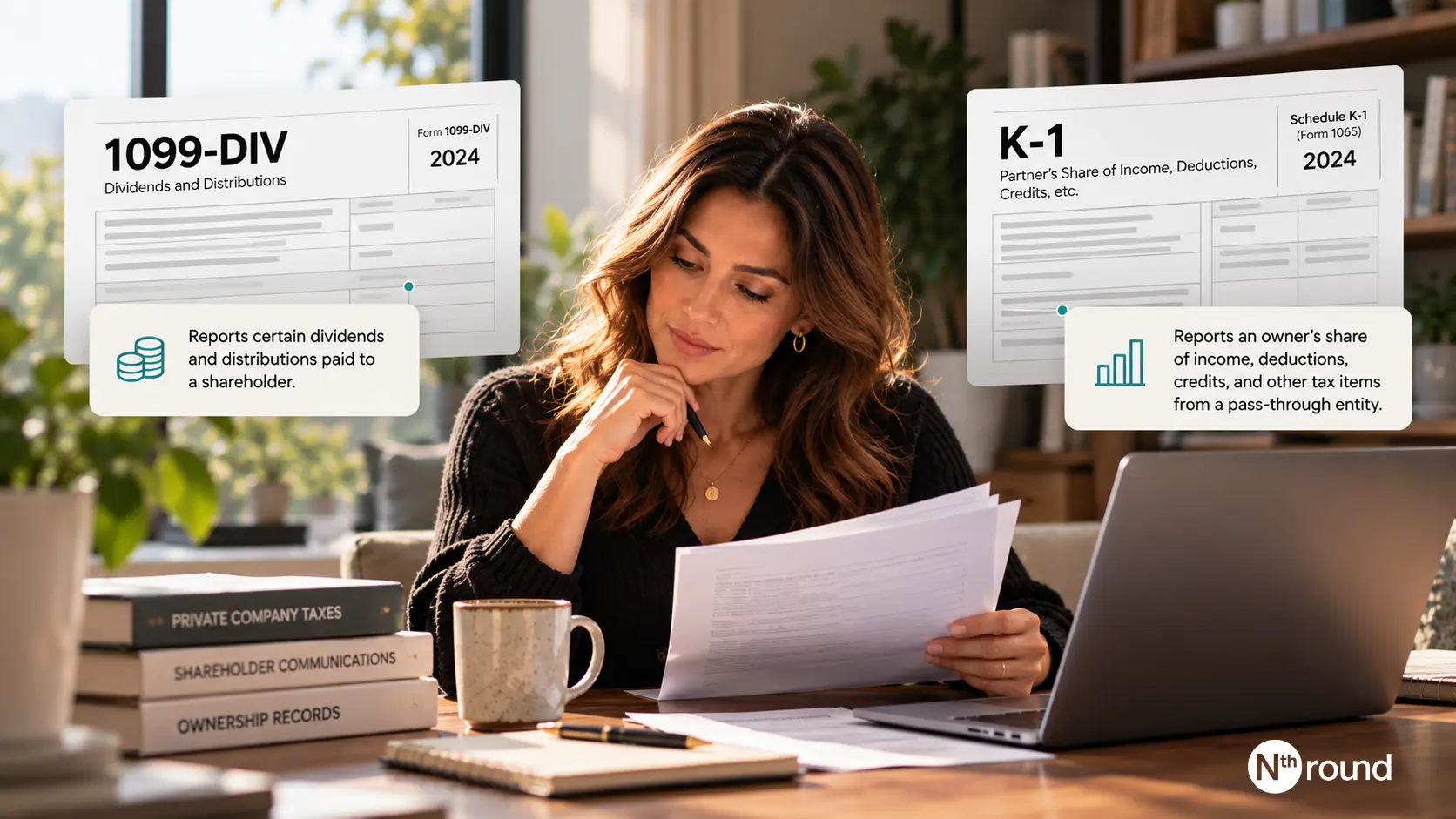
The short version is that Form 1099-DIV generally reports certain dividends and distributions, while Schedule K-1 reports an owner's share of income, deductions, credits, and other tax items from a pass-through entity such as a partnership or S corporation. The form a private-company owner receives depends on the entity's tax treatment and what happened during the year. IRS

‍

The tax rules belong with your tax professionals.

‍

But there is an operational side to this that private companies can't hand off quite so easily.

‍

Someone still needs to know who the owners are, what changed during the year, whether distributions were made, and whether the information attached to each owner is correct.

‍

That's the part we're interested in.

‍

What is the difference between a 1099-DIV and a Schedule K-1?

‍

The easiest distinction is to look at what each document is reporting.

‍

Form 1099-DIV reports certain dividends and distributions paid to a recipient. Under current IRS instructions, it generally applies when $10 or more in dividends or certain other distributions are paid, along with several other specified situations. IRS

‍

Schedule K-1 reports an owner's share of tax items from a pass-through entity. Partnerships use Schedule K-1 (Form 1065) to report each partner's share of income, deductions, credits, and other items. S corporations use Schedule K-1 (Form 1120-S) for each shareholder's share. IRS

‍

That distinction matters.

‍

A 1099-DIV is fundamentally about reportable distributions.

‍

A K-1 is fundamentally about the owner's share of the entity's tax activity.

‍

And that leads to one of the most common sources of confusion for private-company owners:

‍

Cash received and taxable income are not necessarily the same thing.

‍

A K-1 doesn't necessarily mean you received that amount in cash

‍

This is where shareholders who aren't accustomed to pass-through entities can get surprised.

‍

A partner can be responsible for tax on their share of partnership income whether or not that income was actually distributed to them. The same general principle applies to an S corporation shareholder's share of S corporation income. IRS

‍

So imagine an owner receives a K-1 showing income.

‍

Their first reaction might be:

‍

“I didn't get paid that much.”

‍

That doesn't necessarily mean anything is wrong.

‍

The K-1 isn't simply a receipt for cash that hit the shareholder's bank account.

‍

It's reporting tax information allocated to that owner.

‍

This is why shareholder communication matters.

‍

A company can prepare everything correctly and still create confusion if owners don't understand what they're receiving or why.

‍

And no, an investor portal isn't going to make the Internal Revenue Code suddenly feel intuitive.

‍

But giving shareholders a consistent place to access documents and company information is considerably better than making them search through an inbox for an attachment sent three months ago.

‍

A 1099-DIV is about distributions, but not every payment is automatically a dividend

‍

For private companies, another easy mistake is assuming:

‍

We paid shareholders money, therefore it's a dividend, therefore it's a 1099-DIV.

‍

Tax doesn't tend to reward that kind of shortcut.

‍

Form 1099-DIV covers dividends and certain other distributions. Current IRS instructions generally require it for a person paid at least $10 in dividends and other covered distributions, and for certain other circumstances such as backup withholding or qualifying liquidation payments. IRS

‍

How a particular payment should be characterized can depend on facts well beyond the payment itself.

‍

That's a tax question.

‍

Your CPA or tax advisor should answer it.

‍

What the company can control operationally is whether it has a reliable record of what was actually paid.

‍

Who received the payment?

‍

How much?

‍

When?

‍

What ownership information was used?

‍

Did anything change during the relevant period?

‍

Can you reconcile the payment record back to the shareholder record?

‍

If answering those questions requires opening six spreadsheets, the tax form isn't really the problem.

‍

Can an S corporation shareholder receive both a K-1 and a 1099-DIV?

‍

Potentially, yes.

‍

This is an important wrinkle because “1099-DIV versus K-1” makes the two sound more mutually exclusive than they always are.

‍

An S corporation uses Schedule K-1 to report each shareholder's share of the corporation's income, deductions, credits, and other items. The IRS's shareholder instructions also note that Schedule K-1 does not show actual dividend distributions made to the shareholder and that qualifying dividend distributions are instead reported on Form 1099-DIV. IRS

‍

So the right question isn't always:

‍

“Which one do I get?”

‍

Sometimes it's:

‍

“What does each document represent?”

‍

That's an important distinction for companies communicating with shareholders.

‍

A shareholder may look at two tax documents and assume something has been reported twice.

‍

The documents may actually be reporting different things.

‍

Again: that's where the company's tax professionals should handle the tax explanation.

‍

But the ownership team should at least know enough about the process to route the question to the right place rather than treating every shareholder tax document as basically the same thing.

‍

Entity structure changes the answer

‍

This is why there's no useful universal answer to:

‍

“What tax form do private-company shareholders get?”

‍

“Private company” describes a company's ownership and market status. It doesn't tell you how the entity is taxed.

‍

A private company might be a C corporation.

‍

It might be an S corporation.

‍

It might be an LLC taxed as a partnership.

‍

Other structures and tax elections can complicate things further.

‍

Those differences affect tax reporting.

‍

A partnership generally furnishes Schedule K-1 to its partners. An S corporation generally prepares a Schedule K-1 for each person who was a shareholder at any point during the tax year. IRS

‍

A company making reportable dividends or distributions may have Form 1099-DIV reporting obligations. IRS

‍

So before trying to answer a shareholder's form question, start with the company's actual entity and tax treatment.

‍

Not what somebody remembers from the last company they worked for.

‍

The paperwork is different. The underlying data problem looks familiar.

‍

This is the part that matters most to an ownership team.

‍

Whether the eventual output is a 1099-DIV, a Schedule K-1, or something else your tax professionals determine is required, the process depends on accurate information.

‍

Who is the owner?

‍

What entity or individual holds the interest?

‍

Is their identifying information current?

‍

Did ownership change during the year?

‍

Were distributions made?

‍

Are those distributions accurately recorded?

‍

Are there transactions your tax professionals need to know about?

‍

This is why we think shareholder tax reporting starts well before anyone generates a tax document.

‍

The form is the output.

‍

The records are the inputs.

‍

Ownership changes make K-1 administration more interesting

‍

Consider an S corporation.

‍

One shareholder owns shares on January 1.

‍

They transfer those shares during the year.

‍

By December 31, they're no longer on the cap table.

‍

If somebody looks only at the year-end shareholder list, that former shareholder can disappear from view.

‍

But the IRS instructions generally require an S corporation to prepare a Schedule K-1 for each person who was a shareholder at any time during the tax year. IRS

‍

Now the ownership history matters.

‍

When did the shareholder hold the shares?

‍

When did the ownership change?

‍

What transaction caused it?

‍

Who held the shares afterward?

‍

The allocation rules themselves can become technical and belong with the company's tax advisors.

‍

Operationally, though, you need to be able to tell them what happened.

‍

This is exactly why an audit trail for ownership changes matters.

‍

The December cap table gives you December.

‍

Your tax professionals may need the year.

‍

Distributions need their own history too

‍

Now look at the 1099-DIV side.

‍

Suppose the company made four distributions during the year.

‍

Ownership changed between the second and third.

‍

Someone transferred shares into a trust.

‍

Another shareholder participated in a redemption.

‍

A shareholder's address changed.

‍

The company added several new owners.

‍

The distribution history needs to make sense against the ownership history.

‍

You shouldn't be trying to recreate that relationship after the year is over.

‍

If a distribution was made in March, the company should already know who received it and how much.

‍

If another happened in September, that should be recorded too.

‍

Tax season shouldn't be the first time somebody puts the four distribution spreadsheets next to the cap table and asks:

‍

“Do these actually agree?”

‍

Sometimes they won't.

‍

Better to find out before the reporting deadline.

‍

A shareholder's name is not enough information

‍

Tax documents have an irritating habit of requiring more than “Bob owns 20,000 shares.”

‍

The company may need identifying information, addresses, entity details, and other records requested by its tax professionals.

‍

And private-company ownership evolves.

‍

Bob moves.

‍

Bob transfers shares into a trust.

‍

Bob dies and his estate becomes involved.

‍

Bob's shares eventually move to three family members.

‍

The original ownership entry may have been perfectly correct.

‍

It just stopped being current.

‍

That's why we recommend reviewing shareholder information before tax season, rather than waiting until a tax professional asks for something that's been missing for nine months.

‍

The work is boring.

‍

That's a feature.

‍

Boring in October is considerably better than urgent in March.

‍

Shareholders mostly care about getting the right document

‍

Companies tend to experience tax reporting as a process.

‍

Shareholders experience it as an envelope, an email, or a PDF they were waiting for.

‍

Their questions are more practical.

‍

Where is my document?

‍

Why does this amount look different from the cash I received?

‍

Why is the form under my trust's name?

‍

Why did my sibling get something different?

‍

Why does the company still have my old address?

‍

Is this a corrected version?

‍

Who do I call if something looks wrong?

‍

You don't need your finance team giving individual tax advice.

‍

In fact, they shouldn't.

‍

But the company should have a process for getting the right documents to the right people, making those documents reasonably accessible, and routing substantive tax questions to the appropriate professionals.

‍

That's ownership administration too.

‍

A portal won't explain your K-1. It can stop you from emailing it four times.

‍

There's a tendency to make software sound magical.

‍

It isn't.

‍

A shareholder portal won't tell an owner how to report a complicated K-1.

‍

It won't decide whether a distribution belongs on Form 1099-DIV.

‍

And it won't replace a CPA.

‍

What it can do is give shareholders a secure place to access documents and information the company makes available to them.

‍

That sounds modest.

‍

Anyone who has dealt with:

‍

“Can you resend my tax document?”

‍

followed three weeks later by:

‍

“Sorry, can you send that again?”

‍

may appreciate the modesty.

‍

Tax reporting gets harder when ownership information lives everywhere

‍

This is the common thread through both forms.

‍

The tax rules are different.

‍

The administrative mess often looks remarkably similar.

‍

The cap table is with finance.

‍

Shareholder contact information is in a CRM.

‍

Tax information is in a restricted spreadsheet.

‍

Distribution records are in another workbook.

‍

Ownership documents are with legal.

‍

The tax firm has last year's file.

‍

Someone has a newer version attached to an email.

‍

And now everybody needs to agree.

‍

That's why good shareholder recordkeeping matters beyond the cap table.

‍

The goal isn't to put every piece of tax work into one system.

‍

It's to make sure the ownership information underlying that work is reliable, current, and traceable.

‍

Tax documents contain sensitive information

‍

There is also a security question hiding underneath all of this.

‍

Tax documents and the information used to prepare them can contain sensitive personal and financial information.

‍

They shouldn't be treated like ordinary company attachments.

‍

Who can access shareholder tax information?

‍

Where is it stored?

‍

How is it shared?

‍

What happens when someone leaves the company?

‍

Are shareholders receiving documents through an appropriate channel?

‍

Does the company know which version is current?

‍

These questions aren't as interesting as debating tax rules.

‍

They're much more likely to be within the ownership team's control.

‍

Nth Round's shareholder management platform helps private companies keep shareholder information connected to the ownership record and the administrative workflows around it, rather than relying on an expanding collection of spreadsheets, inboxes, and shared folders.

‍

The goal isn't to turn Nth Round into tax software.

‍

It isn't.

‍

The goal is to make the ownership side of tax reporting less chaotic.

‍

So, 1099-DIV or K-1?

‍

If you're a shareholder asking that question about your own situation, the safest answer is:

‍

It depends on the entity, its tax treatment, what happened during the year, and your individual circumstances. Ask the company or your tax professional which reporting applies to you.

‍

If you're the company, there's another question worth asking:

‍

Do we have the information our tax professionals need to get the answer right?

‍

That's where the ownership team comes in.

‍

Know who your owners are.

‍

Keep their information current.

‍

Record ownership changes when they happen.

‍

Maintain the history behind distributions.

‍

Keep the underlying documents organized.

‍

And give your tax professionals a clean set of records to work from.

‍

Because a 1099-DIV and a K-1 are very different documents.

‍

But both become considerably harder to deal with when the ownership records behind them are a mess.

‍

‍A 1099-DIV and a Schedule K-1 can both show up in conversations about private-company ownership. They are not interchangeable.

‍

That sounds obvious if you spend your days working in tax.

‍

Plenty of shareholders don't.

‍

They know they own part of a private company. Money may have shown up in their bank account during the year. Then tax season arrives and they receive a document—or start wondering when they're going to receive one.

‍

“Am I getting a 1099?”

‍

“Should I be waiting for a K-1?”

‍

“Why did I get income reported when I didn't receive that amount in cash?”

‍

Those questions often make their way back to finance.

‍

The short version is that Form 1099-DIV generally reports certain dividends and distributions, while Schedule K-1 reports an owner's share of income, deductions, credits, and other tax items from a pass-through entity such as a partnership or S corporation. The form a private-company owner receives depends on the entity's tax treatment and what happened during the year. IRS

‍

The tax rules belong with your tax professionals.

‍

But there is an operational side to this that private companies can't hand off quite so easily.

‍

Someone still needs to know who the owners are, what changed during the year, whether distributions were made, and whether the information attached to each owner is correct.

‍

That's the part we're interested in.

‍

What is the difference between a 1099-DIV and a Schedule K-1?

‍

The easiest distinction is to look at what each document is reporting.

‍

Form 1099-DIV reports certain dividends and distributions paid to a recipient. Under current IRS instructions, it generally applies when $10 or more in dividends or certain other distributions are paid, along with several other specified situations. IRS

‍

Schedule K-1 reports an owner's share of tax items from a pass-through entity. Partnerships use Schedule K-1 (Form 1065) to report each partner's share of income, deductions, credits, and other items. S corporations use Schedule K-1 (Form 1120-S) for each shareholder's share. IRS

‍

That distinction matters.

‍

A 1099-DIV is fundamentally about reportable distributions.

‍

A K-1 is fundamentally about the owner's share of the entity's tax activity.

‍

And that leads to one of the most common sources of confusion for private-company owners:

‍

Cash received and taxable income are not necessarily the same thing.

‍

A K-1 doesn't necessarily mean you received that amount in cash

‍

This is where shareholders who aren't accustomed to pass-through entities can get surprised.

‍

A partner can be responsible for tax on their share of partnership income whether or not that income was actually distributed to them. The same general principle applies to an S corporation shareholder's share of S corporation income. IRS

‍

So imagine an owner receives a K-1 showing income.

‍

Their first reaction might be:

‍

“I didn't get paid that much.”

‍

That doesn't necessarily mean anything is wrong.

‍

The K-1 isn't simply a receipt for cash that hit the shareholder's bank account.

‍

It's reporting tax information allocated to that owner.

‍

This is why shareholder communication matters.

‍

A company can prepare everything correctly and still create confusion if owners don't understand what they're receiving or why.

‍

And no, an investor portal isn't going to make the Internal Revenue Code suddenly feel intuitive.

‍

But giving shareholders a consistent place to access documents and company information is considerably better than making them search through an inbox for an attachment sent three months ago.

‍

A 1099-DIV is about distributions, but not every payment is automatically a dividend

‍

For private companies, another easy mistake is assuming:

‍

We paid shareholders money, therefore it's a dividend, therefore it's a 1099-DIV.

‍

Tax doesn't tend to reward that kind of shortcut.

‍

Form 1099-DIV covers dividends and certain other distributions. Current IRS instructions generally require it for a person paid at least $10 in dividends and other covered distributions, and for certain other circumstances such as backup withholding or qualifying liquidation payments. IRS

‍

How a particular payment should be characterized can depend on facts well beyond the payment itself.

‍

That's a tax question.

‍

Your CPA or tax advisor should answer it.

‍

What the company can control operationally is whether it has a reliable record of what was actually paid.

‍

Who received the payment?

‍

How much?

‍

When?

‍

What ownership information was used?

‍

Did anything change during the relevant period?

‍

Can you reconcile the payment record back to the shareholder record?

‍

If answering those questions requires opening six spreadsheets, the tax form isn't really the problem.

‍

Can an S corporation shareholder receive both a K-1 and a 1099-DIV?

‍

Potentially, yes.

‍

This is an important wrinkle because “1099-DIV versus K-1” makes the two sound more mutually exclusive than they always are.

‍

An S corporation uses Schedule K-1 to report each shareholder's share of the corporation's income, deductions, credits, and other items. The IRS's shareholder instructions also note that Schedule K-1 does not show actual dividend distributions made to the shareholder and that qualifying dividend distributions are instead reported on Form 1099-DIV. IRS

‍

So the right question isn't always:

‍

“Which one do I get?”

‍

Sometimes it's:

‍

“What does each document represent?”

‍

That's an important distinction for companies communicating with shareholders.

‍

A shareholder may look at two tax documents and assume something has been reported twice.

‍

The documents may actually be reporting different things.

‍

Again: that's where the company's tax professionals should handle the tax explanation.

‍

But the ownership team should at least know enough about the process to route the question to the right place rather than treating every shareholder tax document as basically the same thing.

‍

Entity structure changes the answer

‍

This is why there's no useful universal answer to:

‍

“What tax form do private-company shareholders get?”

‍

“Private company” describes a company's ownership and market status. It doesn't tell you how the entity is taxed.

‍

A private company might be a C corporation.

‍

It might be an S corporation.

‍

It might be an LLC taxed as a partnership.

‍

Other structures and tax elections can complicate things further.

‍

Those differences affect tax reporting.

‍

A partnership generally furnishes Schedule K-1 to its partners. An S corporation generally prepares a Schedule K-1 for each person who was a shareholder at any point during the tax year. IRS

‍

A company making reportable dividends or distributions may have Form 1099-DIV reporting obligations. IRS

‍

So before trying to answer a shareholder's form question, start with the company's actual entity and tax treatment.

‍

Not what somebody remembers from the last company they worked for.

‍

The paperwork is different. The underlying data problem looks familiar.

‍

This is the part that matters most to an ownership team.

‍

Whether the eventual output is a 1099-DIV, a Schedule K-1, or something else your tax professionals determine is required, the process depends on accurate information.

‍

Who is the owner?

‍

What entity or individual holds the interest?

‍

Is their identifying information current?

‍

Did ownership change during the year?

‍

Were distributions made?

‍

Are those distributions accurately recorded?

‍

Are there transactions your tax professionals need to know about?

‍

This is why we think shareholder tax reporting starts well before anyone generates a tax document.

‍

The form is the output.

‍

The records are the inputs.

‍

Ownership changes make K-1 administration more interesting

‍

Consider an S corporation.

‍

One shareholder owns shares on January 1.

‍

They transfer those shares during the year.

‍

By December 31, they're no longer on the cap table.

‍

If somebody looks only at the year-end shareholder list, that former shareholder can disappear from view.

‍

But the IRS instructions generally require an S corporation to prepare a Schedule K-1 for each person who was a shareholder at any time during the tax year. IRS

‍

Now the ownership history matters.

‍

When did the shareholder hold the shares?

‍

When did the ownership change?

‍

What transaction caused it?

‍

Who held the shares afterward?

‍

The allocation rules themselves can become technical and belong with the company's tax advisors.

‍

Operationally, though, you need to be able to tell them what happened.

‍

This is exactly why an audit trail for ownership changes matters.

‍

The December cap table gives you December.

‍

Your tax professionals may need the year.

‍

Distributions need their own history too

‍

Now look at the 1099-DIV side.

‍

Suppose the company made four distributions during the year.

‍

Ownership changed between the second and third.

‍

Someone transferred shares into a trust.

‍

Another shareholder participated in a redemption.

‍

A shareholder's address changed.

‍

The company added several new owners.

‍

The distribution history needs to make sense against the ownership history.

‍

You shouldn't be trying to recreate that relationship after the year is over.

‍

If a distribution was made in March, the company should already know who received it and how much.

‍

If another happened in September, that should be recorded too.

‍

Tax season shouldn't be the first time somebody puts the four distribution spreadsheets next to the cap table and asks:

‍

“Do these actually agree?”

‍

Sometimes they won't.

‍

Better to find out before the reporting deadline.

‍

A shareholder's name is not enough information

‍

Tax documents have an irritating habit of requiring more than “Bob owns 20,000 shares.”

‍

The company may need identifying information, addresses, entity details, and other records requested by its tax professionals.

‍

And private-company ownership evolves.

‍

Bob moves.

‍

Bob transfers shares into a trust.

‍

Bob dies and his estate becomes involved.

‍

Bob's shares eventually move to three family members.

‍

The original ownership entry may have been perfectly correct.

‍

It just stopped being current.

‍

That's why we recommend reviewing shareholder information before tax season, rather than waiting until a tax professional asks for something that's been missing for nine months.

‍

The work is boring.

‍

That's a feature.

‍

Boring in October is considerably better than urgent in March.

‍

Shareholders mostly care about getting the right document

‍

Companies tend to experience tax reporting as a process.

‍

Shareholders experience it as an envelope, an email, or a PDF they were waiting for.

‍

Their questions are more practical.

‍

Where is my document?

‍

Why does this amount look different from the cash I received?

‍

Why is the form under my trust's name?

‍

Why did my sibling get something different?

‍

Why does the company still have my old address?

‍

Is this a corrected version?

‍

Who do I call if something looks wrong?

‍

You don't need your finance team giving individual tax advice.

‍

In fact, they shouldn't.

‍

But the company should have a process for getting the right documents to the right people, making those documents reasonably accessible, and routing substantive tax questions to the appropriate professionals.

‍

That's ownership administration too.

‍

A portal won't explain your K-1. It can stop you from emailing it four times.

‍

There's a tendency to make software sound magical.

‍

It isn't.

‍

A shareholder portal won't tell an owner how to report a complicated K-1.

‍

It won't decide whether a distribution belongs on Form 1099-DIV.

‍

And it won't replace a CPA.

‍

What it can do is give shareholders a secure place to access documents and information the company makes available to them.

‍

That sounds modest.

‍

Anyone who has dealt with:

‍

“Can you resend my tax document?”

‍

followed three weeks later by:

‍

“Sorry, can you send that again?”

‍

may appreciate the modesty.

‍

Tax reporting gets harder when ownership information lives everywhere

‍

This is the common thread through both forms.

‍

The tax rules are different.

‍

The administrative mess often looks remarkably similar.

‍

The cap table is with finance.

‍

Shareholder contact information is in a CRM.

‍

Tax information is in a restricted spreadsheet.

‍

Distribution records are in another workbook.

‍

Ownership documents are with legal.

‍

The tax firm has last year's file.

‍

Someone has a newer version attached to an email.

‍

And now everybody needs to agree.

‍

That's why good shareholder recordkeeping matters beyond the cap table.

‍

The goal isn't to put every piece of tax work into one system.

‍

It's to make sure the ownership information underlying that work is reliable, current, and traceable.

‍

Tax documents contain sensitive information

‍

There is also a security question hiding underneath all of this.

‍

Tax documents and the information used to prepare them can contain sensitive personal and financial information.

‍

They shouldn't be treated like ordinary company attachments.

‍

Who can access shareholder tax information?

‍

Where is it stored?

‍

How is it shared?

‍

What happens when someone leaves the company?

‍

Are shareholders receiving documents through an appropriate channel?

‍

Does the company know which version is current?

‍

These questions aren't as interesting as debating tax rules.

‍

They're much more likely to be within the ownership team's control.

‍

Nth Round's shareholder management platform helps private companies keep shareholder information connected to the ownership record and the administrative workflows around it, rather than relying on an expanding collection of spreadsheets, inboxes, and shared folders.

‍

The goal isn't to turn Nth Round into tax software.

‍

It isn't.

‍

The goal is to make the ownership side of tax reporting less chaotic.

‍

So, 1099-DIV or K-1?

‍

If you're a shareholder asking that question about your own situation, the safest answer is:

‍

It depends on the entity, its tax treatment, what happened during the year, and your individual circumstances. Ask the company or your tax professional which reporting applies to you.

‍

If you're the company, there's another question worth asking:

‍

Do we have the information our tax professionals need to get the answer right?

‍

That's where the ownership team comes in.

‍

Know who your owners are.

‍

Keep their information current.

‍

Record ownership changes when they happen.

‍

Maintain the history behind distributions.

‍

Keep the underlying documents organized.

‍

And give your tax professionals a clean set of records to work from.

‍

Because a 1099-DIV and a K-1 are very different documents.

‍

But both become considerably harder to deal with when the ownership records behind them are a mess.

‍

Frequently Asked Questions

‍

What's the main difference between Form 1099-DIV and Schedule K-1?

Form 1099-DIV generally reports certain dividends and distributions paid to a recipient. Schedule K-1 reports an owner's share of income, deductions, credits, and other tax items from a pass-through entity such as a partnership or S corporation. IRS

‍

Can an S corporation shareholder receive both a K-1 and a 1099-DIV?

Yes, depending on the circumstances. An S corporation uses Schedule K-1 to report a shareholder's share of tax items. IRS shareholder instructions also note that actual qualifying dividend distributions are not shown on the K-1 and may instead be reported on Form 1099-DIV. IRS

‍

Does a K-1 mean the shareholder received that amount in cash?

Not necessarily. Partners and S corporation shareholders can generally be liable for tax on their share of entity income whether or not that income was distributed to them. IRS

‍

Does every private-company shareholder receive a K-1?

No. The tax form an owner receives depends on the company's entity type, tax treatment, and the owner's circumstances. Partnerships and S corporations use Schedules K-1 for their owners, while other structures may have different reporting requirements. IRS

‍

When is Form 1099-DIV generally required?

Current IRS instructions generally require Form 1099-DIV for each person paid at least $10 in covered dividends or other distributions, as well as certain other circumstances such as backup withholding and liquidation payments of $600 or more. Specific exceptions and requirements apply.

‍