Tax season is a bad time to discover that a shareholder moved two years ago.
It's also a bad time to discover that shares were transferred into a trust, a shareholder died, the distribution records don't quite match the ownership records, or the person who knows where everything lives left the company last summer.
None of those are really tax problems.
They're ownership administration problems that become tax problems when someone needs accurate information on a deadline.
For private companies, getting ready for shareholder tax reporting starts with something fairly ordinary: knowing who your shareholders are, what they own, what changed during the year, and whether the information you have about them is still current.
Your tax advisors can tell you what information and forms your company is required to report.
Your ownership records need to give them something reliable to work from.
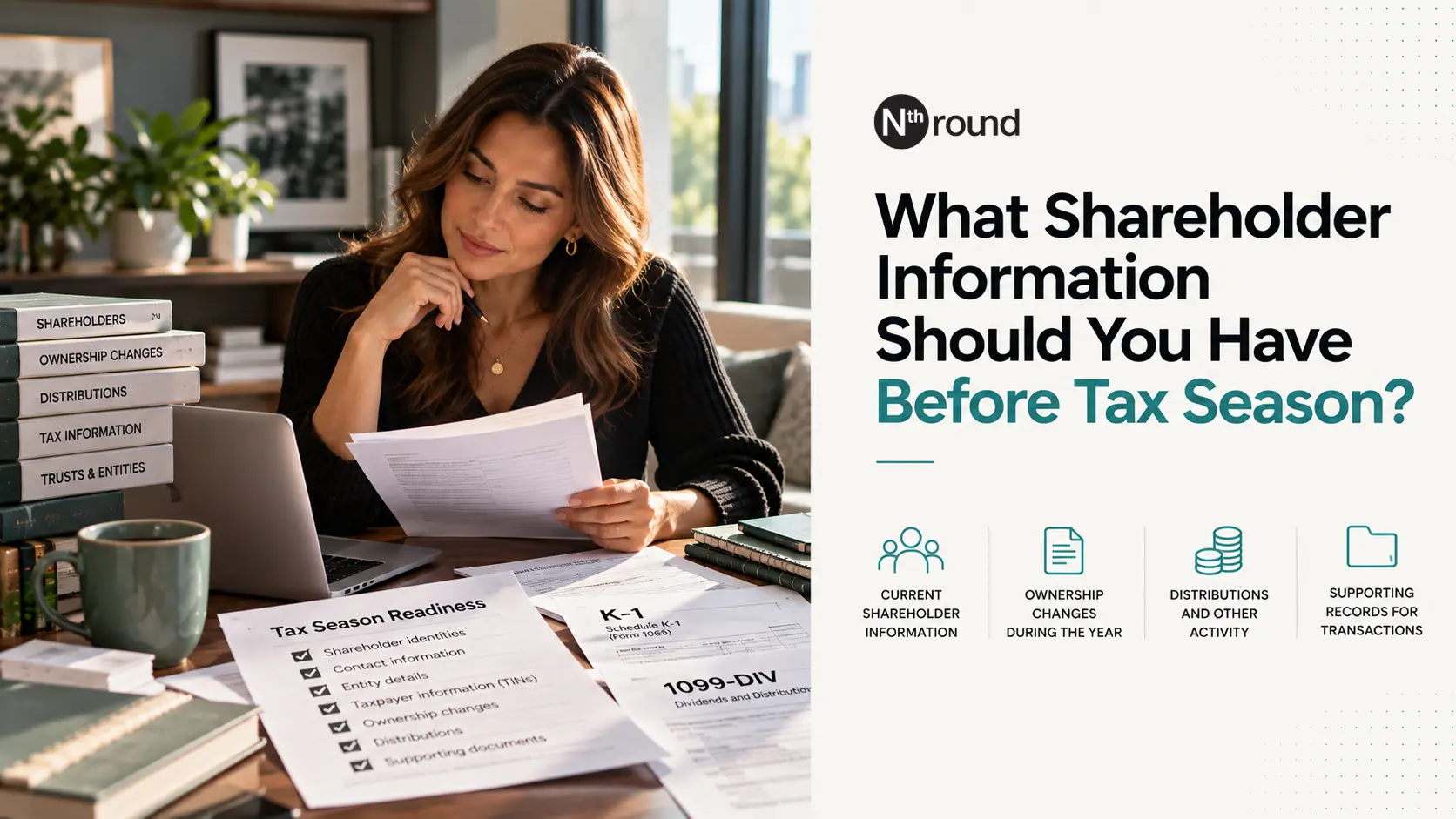
What shareholder information should you have before tax season?
The exact information required will depend on your entity type, tax classification, ownership structure, and the reporting involved.
But from an ownership-administration standpoint, there are several things worth getting in order before anyone starts asking for tax forms.
You should be able to identify your current shareholders, understand relevant ownership changes during the year, locate the shareholder and entity information you've collected, reconcile distributions and other relevant activity, and find the records supporting significant transactions.
That sounds obvious.
The trouble is that private-company ownership rarely stays still long enough for the information to remain correct on its own.
Start with the shareholder's actual identity
This sounds almost too basic to mention.
Who owns the shares?
But over time, even that question can become less straightforward.
Maybe the shares were originally issued to John Smith.
Then John transferred them into the Smith Family Trust.
Or some shares remain with John while others sit in the trust.
Or the shareholder record lists a family entity using an abbreviated name while another system uses its full legal name.
When tax reporting begins, those little inconsistencies become something somebody has to resolve.
Your records should make it clear who or what actually holds the ownership interest.
For an individual, that starts with an accurate name.
For a trust, partnership, LLC, corporation, estate, or other entity, it means accurately identifying the holder reflected in the company's ownership records.
This is one reason shareholder recordkeeping goes beyond maintaining share balances. The information attached to those balances matters too.
Make sure contact information isn't five years old
Private-company shareholders have a habit of staying shareholders for a long time.
Their addresses don't necessarily cooperate.
People move.
Email addresses change.
Employees become former employees and stop using their company email address.
Family members relocate.
A shareholder who hasn't contacted the company in years may still have perfectly good ownership - and perfectly stale contact information.
Tax season is not when you want to find that out.
Before reporting begins, make sure the contact information you're relying on is reasonably current.
That can include mailing addresses, email addresses, and other contact details your company maintains for shareholder administration.
The point isn't simply getting a tax document delivered.
Accurate contact information also matters for routine shareholder communications, voting materials, distributions, transaction notices, and the other work that comes with managing a private shareholder base.
Bad data tends not to stay in one lane.
Know whether the shareholder is an individual or an entity
A shareholder name alone may not tell you enough.
Private-company ownership often includes a mix of:
- Individuals
- Trusts
- Family entities
- LLCs
- Partnerships
- Corporations
- Estates
- Other investment vehicles
That mix tends to get more complicated as a company gets older.
Founders create estate plans.
Families move shares between generations.
Trusts become shareholders.
Employees exercise equity.
Entities are formed to hold investments.
An ownership structure that looked simple ten years ago can become a small forest of people and legal entities.
Your records should make those distinctions clear rather than forcing someone to infer them from the shareholder's name.
Have the appropriate tax information on file
Depending on the reporting involved, your company or its tax professionals may need taxpayer information for shareholders or other recipients.
Exactly what information you need to collect, how it should be collected, and how it should be used are questions to work through with your tax advisors.
Operationally, the important part is simpler:
Don't wait until reporting season to discover that required information is missing.
If your tax team needs information from 150 shareholders, January is an expensive time to begin figuring out which 37 records are incomplete.
And because taxpayer information is sensitive, this shouldn't become an exercise in passing spreadsheets and attachments around the company.
Collect what you need.
Know where it lives.
Control who can access it.
Don't just check who owns shares today
A year-end shareholder list is useful.
It isn't always the whole story.
Suppose a shareholder owned 25,000 shares at the beginning of the year.
In May, they transferred 10,000 into a trust.
In September, the company redeemed another 5,000.
At year-end, the shareholder owns 10,000 shares.
If you only look at today's cap table, that's the number you see.
But the year contained two ownership events that may matter to the company's tax and accounting professionals.
This is where the history behind the cap table becomes important.
As we covered in Why Private Companies Need an Audit Trail for Ownership Changes, an audit trail gives you more than the ending balance. It gives you the path that produced it.
Your tax advisors determine the tax treatment.
Your records should make sure the underlying events aren't a surprise.
Review ownership changes from the entire year
Before tax season, take a pass through the ownership events that occurred during the year.
Not because every event necessarily creates the same reporting obligation.
Because you want your tax professionals to have a complete picture before they determine what matters.
Depending on the company, the year's activity might include issuances, transfers, exercises, conversions, redemptions, repurchases, cancellations, or changes involving trusts and estates.
This is where good cap table management earns its keep.
If those events were recorded when they happened, reviewing the year is manageable.
If they weren't, you're rebuilding twelve months of ownership activity from documents and email.
Not ideal.
Get your distribution records straight
Distributions deserve their own review.
If the company made payments to shareholders during the year, can you answer some basic questions without assembling a committee?
Who received them?
How much?
When?
What ownership information was used to calculate them?
Were any payments returned or unsuccessful?
Did ownership change during the relevant period?
Does the distribution record reconcile with the company's other records?
The tax characterization of those payments belongs with qualified tax professionals.
But the underlying payment history belongs with the company.
For companies with recurring distributions, this becomes even more important because small discrepancies compound.
One wrong shareholder record in the first distribution can become the starting point for the next one.
By year-end, everyone is very confident in a number that has been wrong since February.
Banking information may need attention too
Tax reporting and shareholder payments aren't the same thing, but the records surrounding them often overlap operationally.
If your company pays distributions electronically, outdated banking information creates its own problems.
A shareholder closes an account.
An entity changes banks.
Someone sends updated instructions to one person at the company, but the master record never changes.
The next payment goes out using the old information.
This is another reason shareholder administration works better when information is maintained as part of an ongoing process rather than reconstructed around individual events.
And banking information deserves the same thought around security and access as tax information.
A spreadsheet attachment titled FINAL SHAREHOLDER BANK INFO.xlsx probably shouldn't be your long-term strategy.
Pay attention to trusts, estates, and ownership transitions
These are the records most likely to produce a sentence beginning:
"It's a little complicated."
A shareholder dies.
Shares move into an estate.
A trust becomes involved.
A family transfer occurs.
The company's ownership record changes - or is supposed to.
Meanwhile, tax reporting continues.
These situations are exactly where you don't want the administrative record making assumptions about the legal or tax treatment.
Work with the appropriate advisors.
But make sure the company's records clearly reflect the information and documentation it has received and the ownership changes that were actually completed.
If a transfer has occurred, you should be able to trace it.
If it hasn't, don't make the cap table tell a story that the underlying records don't support.
We looked at that problem directly in What Happens When Your Cap Table and Legal Records Don't Match?.
Check that names and ownership records agree across systems
Here's a useful pre-tax-season exercise.
Pick ten shareholders at random.
Look them up everywhere their information lives.
The cap table.
Your shareholder database.
The distribution workbook.
Whatever system accounting uses.
The document repository.
Your communications list.
Do the names match?
Do the addresses match?
Does the entity type match?
Does the ownership position make sense?
Does one system still list an individual while another lists their trust?
This is where the problem with disconnected systems becomes very concrete.
Each spreadsheet may be internally accurate.
Together, they can disagree.
And when tax reporting requires information from several of them, someone has to decide which version to trust.
Know where the supporting documents live
You probably won't need every ownership document to prepare every tax form.
That's not the point.
The point is being able to find the relevant records when something doesn't make sense.
If a shareholder's ownership changed in June, can you find the transaction that explains it?
If shares moved into a trust, can you locate the records supporting the change?
If the company redeemed shares, can you find the agreement and resulting ownership update?
If a shareholder questions the information they're receiving, can you reconstruct what happened?
Tax season tends to produce questions.
Good records make those questions less dramatic.
The broader principle behind private-company ownership workflows is that the transaction, documentation, ownership update, and resulting history shouldn't become four unrelated pieces of work.
Decide who owns the cleanup
One of the easiest ways for shareholder information to remain outdated is for everybody to assume somebody else owns it.
Legal thinks finance has it.
Finance thinks accounting has it.
Accounting assumes the tax firm will ask if something is missing.
The tax firm assumes the company has already reconciled its shareholder records.
Then January arrives.
Private companies don't all need the same organizational structure, but somebody should know who is responsible for maintaining the shareholder information that feeds the process.
And that responsibility shouldn't begin when the tax calendar says it does.
Ask your tax advisors what they need before they need it
This may be the least sophisticated advice in the article.
It's also among the most useful.
Ask.
What shareholder information will you need from us?
What ownership activity should we flag?
What distribution information will you need?
How do you want the data delivered?
When do you need it?
Are there records we should collect or validate now?
Don't wait until your tax advisors send their standard request list to discover that three pieces of information will take a month to assemble.
The shareholder tax reporting process works better when the ownership team and tax team aren't meeting for the first time at the finish line.
Give shareholders a chance to keep their information current
Companies can do a better job maintaining shareholder information.
Shareholders also need a practical way to tell the company when something changes.
If updating an address requires knowing exactly who in finance to email, the information is going to get stale.
If a shareholder sends a change and it disappears into someone's inbox, you haven't really solved the problem either.
A shareholder portal can give shareholders a consistent place to access the information and documents the company makes available to them, while reducing some of the routine back-and-forth around shareholder administration.
It doesn't remove the need for review or professional advice.
It gives the relationship somewhere better to live than an email chain.
Sensitive shareholder information deserves better than a shared spreadsheet
There's a reason some of this information is difficult to centralize.
It's sensitive.
Taxpayer information.
Banking details.
Personal contact information.
Ownership information.
Documents.
You don't want everybody at the company to have access just because everybody happens to have access to the shared drive.
Permissions matter.
So does having a clear source of truth.
Nth Round's shareholder management platform helps private companies keep shareholder information connected to the ownership record and the workflows surrounding it, with controlled access to sensitive information.
That's the operational problem we're trying to solve.
Not preparing someone's tax return.
Making sure the information behind the process isn't scattered across six places when somebody needs it.
Do the boring work before it becomes urgent work
Most of the preparation we've described isn't glamorous.
Confirm an address.
Review a shareholder name.
Reconcile a distribution.
Check a trust record.
Find a transaction document.
Update an ownership change.
Ask the tax team what they'll need.
Nobody is putting that on the company highlight reel.
But private-company ownership is full of work like this.
And when it's done consistently, tax season looks a lot less like an archaeological dig.
So don't start with the forms.
Start with the records.
Make sure you know who your shareholders are.
Make sure you know what they own.
Make sure you know what changed.
Make sure you can account for what they were paid.
And make sure the people preparing the tax reporting aren't discovering your ownership history at the same time they're trying to report it.
The best time to clean up shareholder information is when nobody urgently needs it.