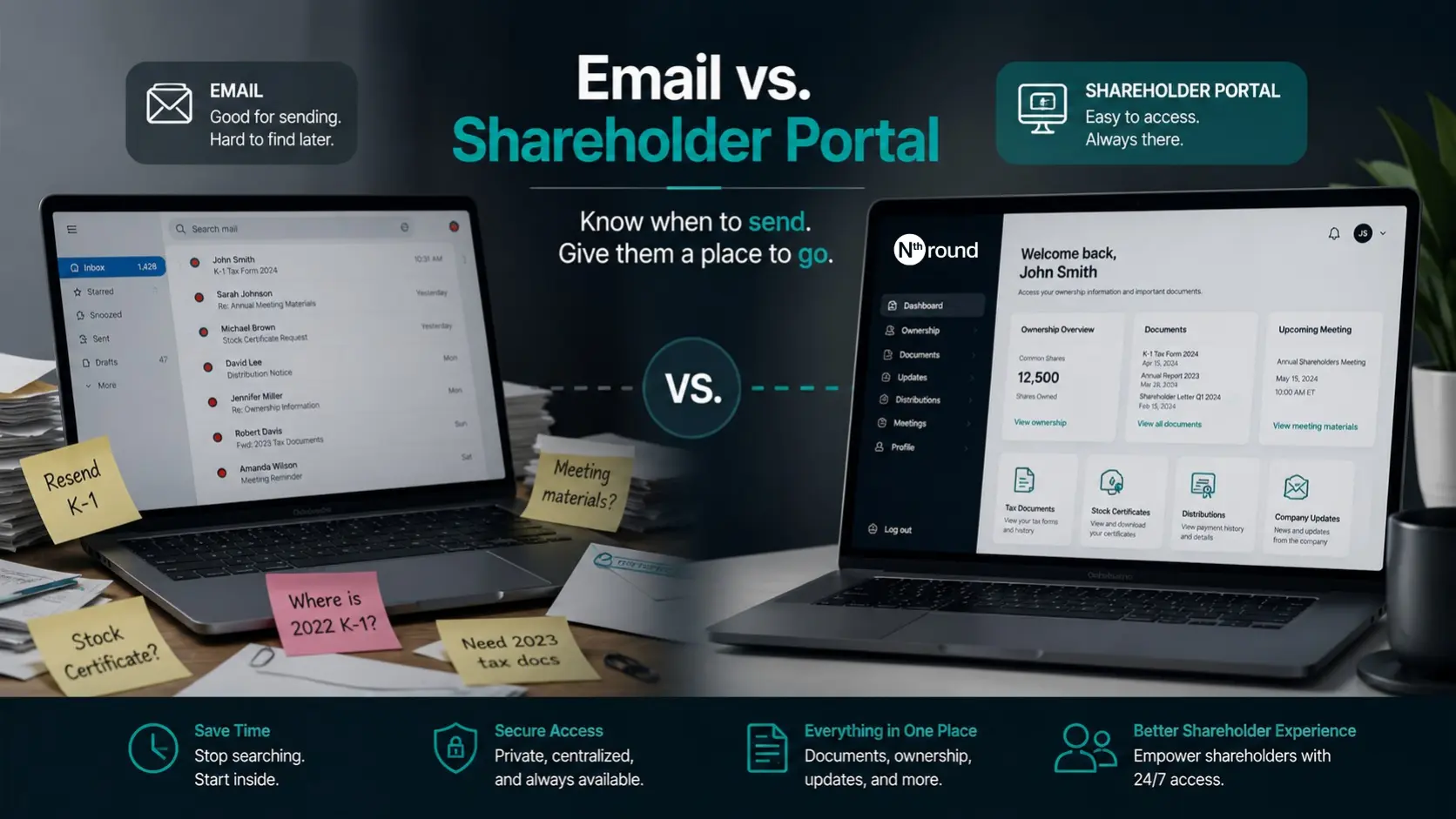
Email works.
That probably sounds like an odd way to start an article about shareholder portals, but it’s worth saying.
If you need to tell shareholders that the annual meeting is next month, send an email.
If a distribution is going out Friday, email them.
If the CEO wants to explain why the company had a difficult quarter, an email may be exactly the right place to start.
Nobody needs software to solve the problem of sending a message.
The problems tend to show up later.
Six months after you emailed the tax documents, someone can’t find theirs.
Three years after sending a stock certificate, a shareholder asks for another copy.
A new trustee needs documents that were originally sent to someone else.
An investor wants last year’s meeting materials.
And somewhere inside the company, a person who has absolutely nothing to do with the shareholder’s inability to search Outlook is now searching Outlook for them.
That’s where email starts doing a job it wasn’t built for.
Email is great at “here’s something you should know”
That job matters.
Shareholder communication often needs to be immediate.
There’s a vote coming up.
A document is ready.
The board approved a distribution.
The company has an announcement.
Something changed and owners should know about it.
Email is hard to beat for that.
People already check it. There is nothing new to learn. You don’t need shareholders to remember another URL just to read a message from management.
And some conversations should never be reduced to software anyway.
If the business had a rough year, the answer probably isn’t to quietly upload the financial statements and wait.
Explain what happened.
If a long-time family shareholder has a serious concern, talk to them.
If there is a sensitive transaction underway, communication may require considerably more judgment than deciding which “Send” button to click.
A shareholder portal does not make any of that unnecessary.
Where email struggles is with what happens after the message.
Six months later is where things get annoying
Consider the annual shareholder meeting.
You email the materials.
The meeting happens.
Everybody moves on.
Eighteen months later, a shareholder wants to see those materials again.
Where do they look?
Maybe the email is still there.
Maybe they remember what the subject line said.
Maybe the attachments are easy to find.
Or maybe they email someone at the company.
Now apply that to:
tax documents,
stock certificates,
distribution notices,
shareholder agreements,
ownership information,
company updates,
and whatever else has accumulated over ten or twenty years.
The inbox becomes a very strange filing cabinet.
Everything is technically in there.
Finding it is another matter.
This is the distinction we made in our Complete Guide to Shareholder Communication for Private Companies:
Sending information and giving shareholders ongoing access to information are different jobs.
Email handles the first one beautifully.
A shareholder portal is built more for the second.
Tax season is where the inbox really earns its scars
If you want to see this problem in concentrated form, wait until tax documents go out.
The company sends them.
Then:
“Can you resend mine?”
“My CPA says they need the previous year too.”
“I don’t use that email anymore.”
“I can’t open the attachment.”
“I found 2025. I need 2024.”
“Can you copy my accountant?”
None of these requests is absurd. Most of us have lost an important attachment at some point.
But they create a predictable annual ritual for the people administering shareholders.
Find document.
Check shareholder.
Check year.
Send document.
Repeat.
The portal changes that fairly mundane interaction.
The shareholder logs in and retrieves the document.
If they still can’t find it, fine. Help them.
But the company no longer has to be the only search function available.
We’ve looked more closely at that particular use case in our article on managing K-1 distributions through a shareholder portal.
A stock certificate shouldn’t become an archaeological project
Stock certificates have the same problem, except the time between requests can be much longer.
A shareholder received a certificate six years ago.
Now their adviser wants it.
They have no idea where the email went.
Inside the company, somebody remembers that certificates used to be stored in one folder but were moved during a system migration, except the older ones might still be somewhere else, and there may also be scanned copies attached to the original transaction files.
This is usually the point where “it’s digital” stops sounding like much of an accomplishment.
A PDF is digital.
That doesn’t mean it’s easy to administer.
If a shareholder can securely see the certificate attached to their ownership record, the question becomes much simpler.
We’ve covered the mechanics behind certificates in our Complete Guide to Stock Certificates for Private Companies. The communication point is straightforward: if a shareholder has already been given a document they may need again, it helps if there is somewhere sensible for it to live.
Email also does a poor impression of a shareholder database
Here’s another familiar one.
A shareholder changes their email address.
They email someone at the company:
Please use my new address going forward.
The person replies:
Got it.
Has the shareholder record actually changed?
Maybe.
Maybe they updated the spreadsheet.
Maybe they forwarded the email to the person who does.
Maybe everyone assumes someone else did it.
Six months later, the annual shareholder letter goes to the old address.
This isn’t really an email problem.
It’s a recordkeeping problem that happened to arrive through email.
The same thing happens with mailing addresses, banking information, trustees, family representatives and other details that change over time.
A message tells you something changed.
The shareholder record needs to remember it changed.
Those are not the same thing.
Then there’s access
This is probably the biggest practical difference between an inbox and a shareholder portal.
Email is organized around messages.
A portal can be organized around the shareholder.
That matters when different people should see different things.
Your CFO may need the full ownership picture.
A shareholder does not.
A trustee may need access related to a particular trust.
A family member may own shares personally and through another entity.
An outside investor may have information available to them that does not apply to everyone else.
Trying to manage all of that through email eventually turns into increasingly careful recipient lists and a low-level fear that somebody is going to attach the wrong file.
A portal can give each person an appropriate view.
Not everything.
What belongs to them.
That is a much more useful model for private-company ownership.
So should companies stop emailing documents?
No.
This is where the “versus” in Email vs. Shareholder Portal becomes a little misleading.
You often want both.
Suppose tax documents are ready.
Email:
Your 2026 tax document is now available.
Portal:
Here is the secure place where you can retrieve it.
Or a shareholder meeting is approaching.
Email gets their attention.
The portal holds the materials.
Or a distribution goes out.
The company communicates the event directly.
The shareholder can later return to the relevant information without searching for the original message.
That combination makes sense because each tool is doing something it’s good at.
Email says: Pay attention.
The portal says: Here’s where this lives.
You don’t have to choose one religion.
When does email stop being enough?
There isn’t a magic number of shareholders.
It usually has more to do with how much work is happening around them.
You start noticing things.
The same documents get resent again and again.
Tax season creates a small support desk.
Shareholder information is spread across inboxes, spreadsheets and folders.
Nobody is completely sure whether the contact list is current.
Different owners need different documents.
Meeting materials go out by email, voting happens somewhere else and the final record lives in another folder.
The person who manages shareholders has an impressive amount of company history stored in their head.
That last one is usually more serious than it looks.
If Jane knows where every old shareholder document lives, Jane is invaluable.
If the company cannot find those documents without Jane, you don’t really have a system. You have Jane.
And Jane deserves a vacation.
Family businesses feel this sooner than they expect
The founder may not need a portal.
They may be the only shareholder.
Then the children become owners.
One works in the company. Two don’t.
Then shares move into trusts.
Then the grandchildren arrive.
Now ownership is spread across people who live in different places, have different levels of involvement in the business and do not all need the same information.
The old communication model may still be:
Call Dad.
That worked because Dad knew everything.
Two generations later, there may not be one person who can play that role.
This is where communication starts needing structure.
Not because the family should become more corporate.
Because the family got bigger.
We’ve written about what happens when communication starts failing in family-owned businesses, particularly when shareholders outside the company have less context than the people running it.
A portal doesn’t solve the family dynamics.
It can at least make sure nobody needs to call an uncle to get last year’s tax form.
A portal does not magically make shareholders engaged
Another thing worth getting out of the way.
Some shareholders will ignore your emails.
Then they will ignore your portal notifications.
That is human nature.
Somebody will forget their password.
Somebody will insist they never received the invite.
Someone who has emailed the same employee for ten years will keep emailing them because, as far as that shareholder is concerned, the existing system works perfectly well.
Software does not eliminate any of this.
Nor does a portal make weak communication strong.
If management avoids difficult conversations, the portal will not have them on management’s behalf.
If shareholders do not understand why distributions changed, uploading a spreadsheet will not create understanding.
If trust is poor, software is not going to manufacture it.
This is why we keep coming back to the same distinction:
The portal supports the shareholder relationship. It is not the shareholder relationship.
Where the portal earns its place
The best case for a portal is usually not dramatic.
It’s a bunch of little things that stop happening.
Someone no longer has to resend every tax form.
Certificates don’t need to be found one at a time.
Shareholders have a consistent place to look for company materials.
The ownership information they see can connect to the same record the company maintains internally.
When a shareholder’s position changes, the portal doesn’t need to become another standalone database somebody manually reconciles.
That last point matters.
A portal that contains a manually recreated version of the cap table may look modern while quietly creating another administrative job.
If the company’s cap table says one thing and the portal says something else, shareholders will not care which system was responsible.
They will care that the numbers do not match.
What about confidential information?
Email has another weakness that tends to become obvious only after someone almost sends something to the wrong person.
Private companies routinely handle information that should not be distributed casually.
Ownership details.
Tax forms.
Financial information.
Legal documents.
Banking information.
Materials intended for a particular class or group of shareholders.
A secure portal can give companies more control over what is available to whom.
That doesn’t remove the need for good judgment or appropriate security practices.
It does mean the company isn’t relying entirely on somebody typing the right address into the “To” field every time sensitive information goes out.
Anyone who has ever stared at an email for an extra ten seconds before clicking Send because they were checking the recipient list understands the appeal.
What should stay in email?
Plenty.
Use email when you want to get somebody’s attention.
Company updates.
A message from leadership.
Meeting reminders.
Notifications that a document is ready.
Requests for action.
Direct answers to questions.
Conversations that actually benefit from being conversations.
I would not try to move every interaction behind a login.
That makes communication worse, not better.
If the CEO wants shareholders to understand why the company is making a major investment, write the email.
Tell the story.
Give people context.
Then put any relevant supporting materials somewhere they can find again later.
What belongs in the portal?
The things shareholders may reasonably need to come back to.
Depending on the company, that might mean:
ownership information,
stock certificates,
tax documents,
distribution records,
meeting materials,
company reports,
governance documents,
or information tied to other ownership events.
Not everything belongs there.
And not every shareholder necessarily gets access to the same things.
The useful question is:
Will someone need this again after today's email has disappeared beneath another 4,000 messages?
If yes, give some thought to where it should live.
Email vs. shareholder portal isn't really the decision
The decision is whether your shareholder communication process still works.
If email, spreadsheets and shared folders are doing the job without creating much administrative burden, good.
You do not earn extra governance points for buying software you do not need.
But if the same shareholder questions keep coming back, important records are spread everywhere, people cannot reliably find what they have already received, and your team is spending more time administering information than communicating it, adding structure starts to make sense.
A portal is one piece of that structure.
The goal is not fewer emails at all costs.
The goal is fewer pointless emails.
There is a difference.
How Nth Round approaches it
Nth Round’s Shareholder Portal is designed to work alongside the ownership records companies already maintain in the platform.
Shareholders can securely access information relevant to their ownership, including documents, stock certificates, company materials and information connected to equity events.
Administrators manage that within the broader ownership environment rather than maintaining a completely separate shareholder-facing record.
Email still has a job.
Tell shareholders when something matters.
Give them context.
Ask for action when you need it.
The portal gives the underlying information somewhere to live after they close the message.
That’s really the relationship between the two.
Email starts the conversation. A shareholder portal keeps the conversation from becoming an archive hunt six months later.
Explore Nth Round’s Shareholder Portal.