Equity Operations

The Cost of Waiting: Why Family Businesses Can’t Afford to Delay Shareholder Modernization

Nth Round

I

October 10, 2025

For most family businesses, shareholder systems fail gradually, then suddenly. The families who waited too long have a lot to say about the cost.

Every family business eventually reaches a crossroads. Systems that once worked begin to strain under new complexity, ownership transitions bring unexpected confusion, and critical tasks pile up until someone finally says, “We should have fixed this years ago.”

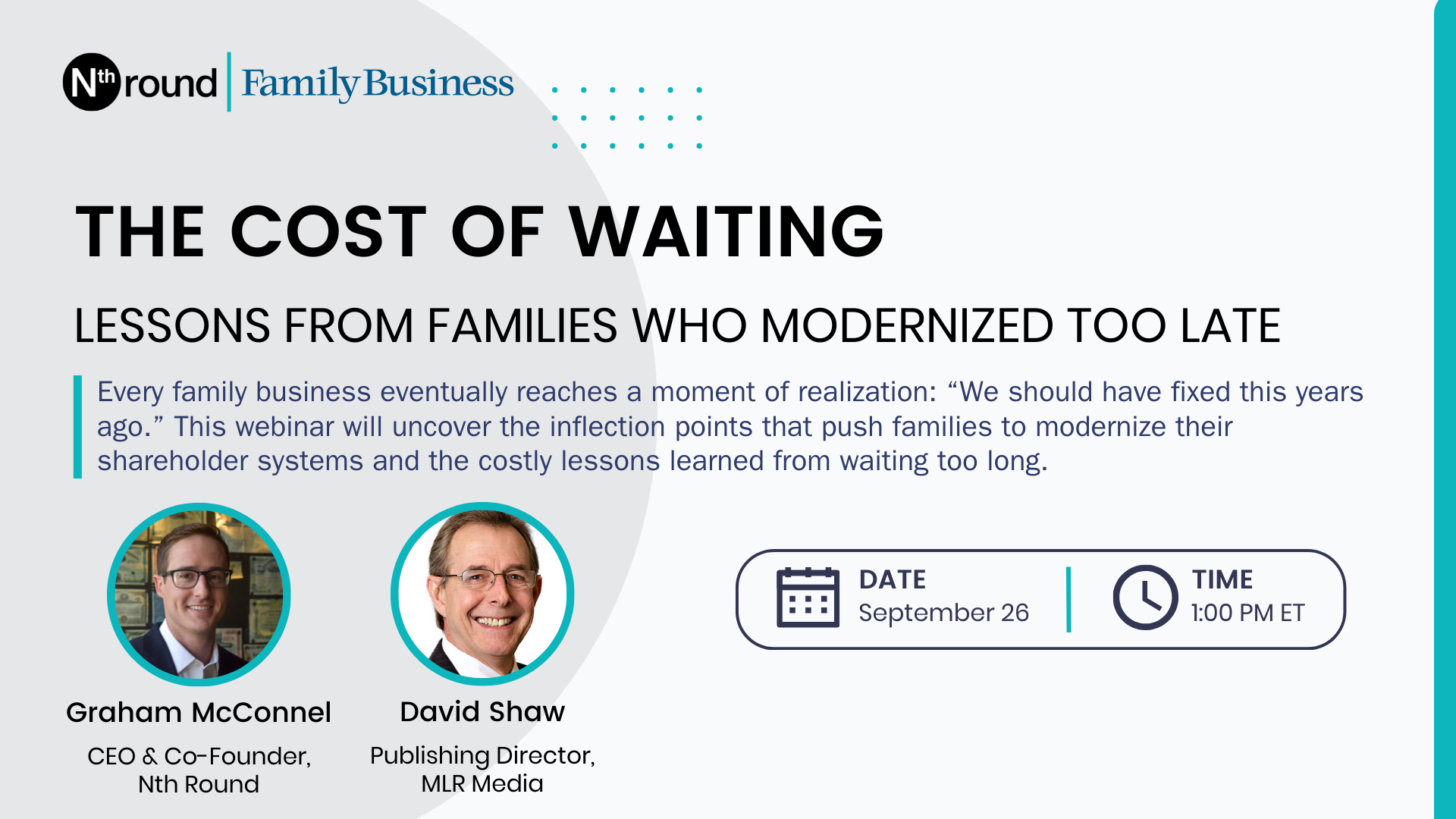
That sentiment framed the discussion in The Cost of Waiting: Lessons from Families Who Modernized Too Late, a recent webinar hosted by Nth Round CEO, Graham McConnell. With the support of Family Business Magazine’s David Shaw, they explored the moments that push families to modernize their shareholder systems, and, more importantly, the hidden costs of waiting too long.

Recognizing the Breaking Point

How do you know when your governance systems are holding you back?

The warning signs are usually clear in hindsight. Late nights before dividend payments. A single administrator juggling every shareholder request. Spreadsheets that seem to multiply before tax season.

These pressure points often expose deeper issues:

  • Overreliance on individuals
  • Fragmented data
  • Outdated communication processes.

It’s easy to tolerate these inefficiencies because they seem manageable…until they’re not.

Key equity-related events like proxy voting, K-1 distributions, and ownership transitions tend to magnify underlying weaknesses at the worst possible times.

These are the moments when the cost of waiting becomes real.

From Reaction to Prevention

So, what does it take to move from a reactive response to a preventive one?

For many family enterprises, that starts with a mindset change. First, modernization isn’t about replacing people or tradition. The goal is about preserving both through better systems.

During the webinar, Graham encouraged families to “stress-test” their processes. Could someone else step in tomorrow and run your shareholder workflows without chaos? If not, that’s a signal. He outlined practical steps like auditing spreadsheets, documenting communication protocols, and creating consistency in how ownership information is shared.

The objective is operational efficiency. Resilience even. And leaders who invest in scalable systems are better positioned to navigate transitions, growth, and even generational change without disruption.

Real Lessons from Real Families

It’s not Beauty and the Beast, but it’s a tale as old as time: Private companies navigating the journey from outdated processes to modern governance.

Take one family-run enterprise, for example. Operating for more than a century, they relied on paper certificates and a single legal officer to manage shareholder communications. Every proxy season felt like an all-hands emergency. But after deciding, “there has to be a better way,” they transitioned to a digital platform. They not only reduced the administrative burden but also improved shareholder engagement across generations.

Another family discovered how easily critical transactions could fall through the cracks when buybacks and dividend distributions were managed through scattered email threads. By consolidating their workflows, they gained real-time visibility and regained control of their timeline.

These examples reinforced a shared truth: modernization is less about technology and more about stewardship. Families that act early protect both their legacy and their future.

Moving Forward with Confidence

You don’t need a full audit to know it’s time to modernize. You just need to ask yourself if your current systems would survive a major event. A transition, perhaps, or an audit.Tax season!

For families who have been operating with the same tools and processes for decades, that reflection can be uncomfortable. But it’s also empowering. Because once you recognize the cost of waiting, you can begin investing in systems that grow with your business instead of against it.

Watch the Replay

If you missed the live session, you can watch the full webinar replay to hear Graham and David discuss these insights in more depth.

For most family businesses, the push to modernize shareholder systems doesn't come from a strategic planning session. It comes after the K-1s went out late, after the proxy vote nearly fell apart, after a shareholder called frustrated and nobody had a clean answer. This post covers what families learned from waiting — and why the cost is always higher than it looks.

The warning signs of an outdated shareholder system — late nights before dividend payments, a single administrator handling every shareholder request, spreadsheets that multiply before tax season — are usually clear in hindsight.

Key equity events like proxy voting, K-1 distributions, and ownership transitions magnify underlying weaknesses at the worst possible times.

Modernization isn't about replacing people or tradition. It's about preserving both through systems that survive the next transition.

The families that modernized earliest stress-tested their processes and acted before the breaking point — not after.

Every family business eventually reaches a crossroads. Systems that once worked begin to strain under new complexity, ownership transitions bring unexpected confusion, and critical tasks pile up until someone finally says, “We should have fixed this years ago.”

That sentiment framed the discussion in The Cost of Waiting: Lessons from Families Who Modernized Too Late, a recent webinar hosted by Nth Round CEO, Graham McConnell. With the support of Family Business Magazine’s David Shaw, they explored the moments that push families to modernize their shareholder systems, and, more importantly, the hidden costs of waiting too long.

Recognizing the Breaking Point

How do you know when your governance systems are holding you back?

The warning signs are usually clear in hindsight. Late nights before dividend payments. A single administrator juggling every shareholder request. Spreadsheets that seem to multiply before tax season.

These pressure points often expose deeper issues:

It’s easy to tolerate these inefficiencies because they seem manageable…until they’re not.

Key equity-related events like proxy voting, K-1 distributions, and ownership transitions tend to magnify underlying weaknesses at the worst possible times.

These are the moments when the cost of waiting becomes real.

From Reaction to Prevention

So, what does it take to move from a reactive response to a preventive one?

For many family enterprises, that starts with a mindset change. First, modernization isn’t about replacing people or tradition. The goal is about preserving both through better systems.

During the webinar, Graham encouraged families to “stress-test” their processes. Could someone else step in tomorrow and run your shareholder workflows without chaos? If not, that’s a signal. He outlined practical steps like auditing spreadsheets, documenting communication protocols, and creating consistency in how ownership information is shared.

The objective is operational efficiency. Resilience even. And leaders who invest in scalable systems are better positioned to navigate transitions, growth, and even generational change without disruption.

Real Lessons from Real Families

It’s not Beauty and the Beast, but it’s a tale as old as time: Private companies navigating the journey from outdated processes to modern governance.

Take one family-run enterprise, for example. Operating for more than a century, they relied on paper certificates and a single legal officer to manage shareholder communications. Every proxy season felt like an all-hands emergency. But after deciding, “there has to be a better way,” they transitioned to a digital platform. They not only reduced the administrative burden but also improved shareholder engagement across generations.

Another family discovered how easily critical transactions could fall through the cracks when buybacks and dividend distributions were managed through scattered email threads. By consolidating their workflows, they gained real-time visibility and regained control of their timeline.

These examples reinforced a shared truth: modernization is less about technology and more about stewardship. Families that act early protect both their legacy and their future.

Moving Forward with Confidence

You don’t need a full audit to know it’s time to modernize. You just need to ask yourself if your current systems would survive a major event. A transition, perhaps, or an audit.Tax season!

For families who have been operating with the same tools and processes for decades, that reflection can be uncomfortable. But it’s also empowering. Because once you recognize the cost of waiting, you can begin investing in systems that grow with your business instead of against it.

Watch the Replay

If you missed the live session, you can watch the full webinar replay to hear Graham and David discuss these insights in more depth.

What are the warning signs that your equity administration system needs modernization?

The most common warning signs include spending significant time manually pulling ownership data before transactions or board meetings, discovering discrepancies between your records and what shareholders expect, and losing institutional knowledge when key staff leave. If your system requires manual updates after every transaction, that’s a structural vulnerability, not a process problem.

Why do private companies wait so long to modernize their equity administration systems?

The most common reason is that the current system works well enough between events. The pain is episodic — it surfaces during K-1 season, a proxy vote, or a liquidity window — and recedes when the event passes. This episodic experience makes the case for modernization feel abstract until the next deadline arrives.

What’s the difference between fixing equity administration reactively and building a proactive system?

Reactive fixes address the symptom in front of you — a missed K-1, a record discrepancy, a shareholder inquiry. Proactive systems address the structural causes so the same problems don’t recur each cycle. The difference isn’t just operational efficiency; it’s whether your ownership records are a liability or an asset going into the next transaction event.

How long does it typically take to implement a modern equity administration platform?

Implementation timelines depend on the complexity of your ownership structure and the quality of your existing records. Companies with clean, digitized records typically go live in weeks. Companies migrating from fragmented spreadsheets and paper certificates may need a few months for data cleanup before the platform can function as intended.