Most private companies don’t wake up one morning and decide they need a shareholder portal.
It usually happens more slowly than that.
Someone asks finance for an old K-1. No problem.
A shareholder wants another copy of their stock certificate. Easy enough.
Then somebody’s CPA needs a document from three years ago. A family trust gets a new trustee. An email address starts bouncing. A shareholder insists they never received the meeting materials that everyone else got.
None of these things is a crisis.
That’s why companies can keep handling them manually for years.
There’s usually one person who knows how it all works anyway. They know which spreadsheet is current, which folder has the certificates, where the 2022 tax forms ended up and which shareholder stopped using the email address everybody still has on file.
Until that person is on vacation.
Or leaves.
Or tax season hits and the inbox fills up with variations of the same request.
That’s roughly the point where a shareholder portal starts becoming interesting.
Not because a portal is exciting.
Because looking for the same document for the fourth time isn’t.
So what is a shareholder portal, really?
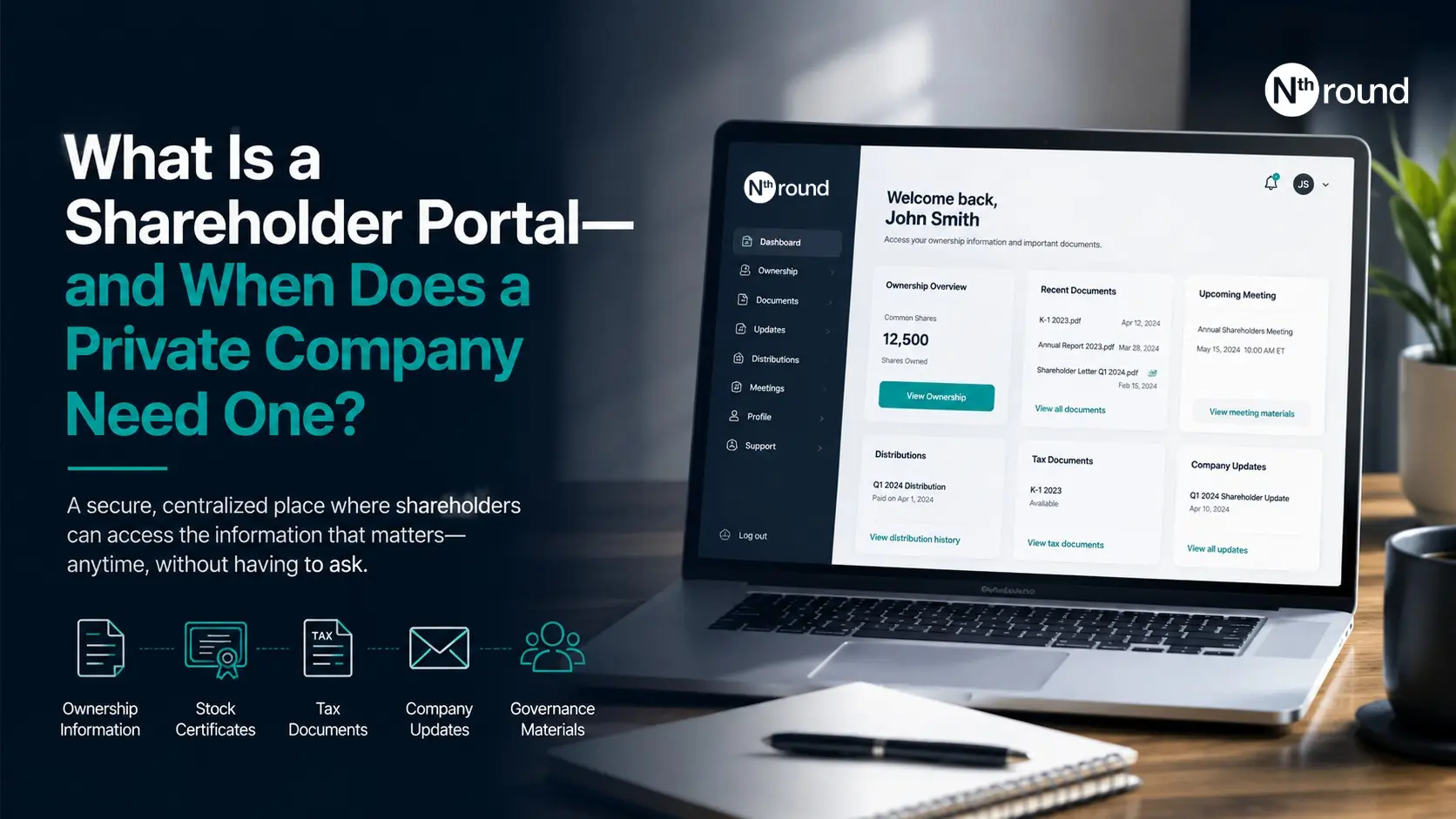
It’s a secure place where shareholders can go to find information the company has made available to them.
That’s the useful definition.
A shareholder might log in and see their ownership information, stock certificates, tax documents, company updates, distribution information, meeting materials or documents tied to another ownership event.
The point isn’t that the documents are online. Your company probably already has plenty of documents online.
The point is that the shareholder knows where to go.
That sounds almost too simple to justify software, until you think about how many private-company processes rely on the opposite arrangement:
Email us and we’ll find it for you.
That works surprisingly well when there are six owners.
It gets less charming at sixty.
In our Complete Guide to Shareholder Communication for Private Companies, we draw a line between communication and access that matters here.
You can send something successfully and still make it hard to find later.
Those are two different problems.
Think about it from the shareholder’s side
Say you invested in a private company in 2019.
You don’t work there.
You get a few updates each year. There have been some distributions. Every spring, a tax document shows up.
Now your accountant asks for your 2022 form.
You search your inbox.
You try the company name. Too broad.
“K-1.” Still a mess.
You try the year.
You find an email about the K-1 but not the attachment you need.
At that point, most normal people stop searching and email somebody at the company.
“Can you resend this?”
Perfectly reasonable.
The annoying part is what happens on the other end.
Someone stops what they’re doing, finds the right file, checks the year, checks the shareholder, sends it, and maybe gets another email asking for the previous year too.
Five minutes.
Who cares?
Except this is not the only shareholder, and tax season is not the only time it happens.
That’s where the work hides. Not in one giant painful task. In twenty tiny ones.
Tax documents are where a lot of companies notice it first
Tax season has a way of exposing weak shareholder administration.
The forms go out and the requests come back.
“Can you resend mine?”
“My accountant needs it.”
“I changed email addresses.”
“Do you have 2021 too?”
“Can you send it to my CPA?”
Nobody is doing anything wrong here. People lose documents. People forget passwords. People change accountants.
The strange part is building a process that assumes they won’t.
If shareholders can securely retrieve the right document themselves, that is one less reason somebody inside the company has to become tech support for an attachment they already sent once.
For companies dealing with Schedule K-1s, we’ve written more specifically about managing K-1 distributions through a shareholder portal.
And the same basic problem shows up elsewhere.
Stock certificates are another good example
A shareholder receives a certificate.
Three years later, they need it.
If the process is:
“Hang on, I think it’s in the certificates folder”
you have a digital-storage system, perhaps, but not much of a shareholder-access system.
A portal gives the certificate somewhere to live from the shareholder’s point of view.
That becomes more useful when the certificate is connected to the company’s actual ownership records rather than sitting as an isolated PDF.
If the shares later transfer, or a certificate is cancelled and another is issued, the history matters.
We cover the certificate mechanics in our Complete Guide to Stock Certificates for Private Companies.
Here, the more important idea is that documents are easier to trust when they stay connected to the thing they’re documenting.
This is also why a shared drive isn’t quite the same thing
A shared folder is useful.
A shareholder portal has to answer a harder question:
Who gets to see what?
Your CFO may need the whole ownership picture.
A shareholder should not.
A trustee may need access to information tied to one trust. Another family member may hold shares personally. An outside investor may need one set of materials and an employee-owner another.
That is where “just put it in Drive” starts getting awkward.
Permissions matter.
So does the source of the information.
If your cap table says one thing and the shareholder-facing portal says another because someone forgot to update both, you haven’t solved much. You’ve just created a nicer-looking reconciliation problem.
The shareholder view should come from ownership information the company actually trusts.
That’s why the connection to the cap table matters.
A portal will not fix bad communication
This deserves more attention than it usually gets.
If shareholders don’t trust management, a login page won’t fix that.
If the company had a bad year and management refuses to explain what happened, uploading the financials to a portal doesn’t count as transparency.
If a family is already fighting about distributions, putting the distribution history online may give everybody cleaner data to argue about. It won’t resolve the argument.
Sometimes you still need to pick up the phone.
Sometimes the CEO needs to write the letter.
Sometimes a shareholder deserves a real explanation rather than a notification.
The portal handles the boring part around those interactions.
And frankly, that’s enough.
Software does not need to solve the human relationship to be useful. It can just stop everybody wasting time hunting down attachments.
When does a portal actually become worth it?
I wouldn’t use shareholder count as the rule.
Twenty shareholders can be easy.
Twenty shareholders can also be chaos.
Look at the work instead.
Do people regularly ask you to resend things?
Does tax season create a predictable pile of support requests?
Are certificates, tax forms, meeting materials and ownership records sitting in different places?
Do you have shareholders outside the business who have no obvious place to see their information?
Does one employee know where everything is?
That last one is usually worth thinking about.
Every company loves the person who knows how everything works.
Nobody loves discovering that the system was actually that person.
You also start feeling the need more as ownership spreads.
The founder gives shares to the children.
One child works in the company. Two don’t.
Shares move into trusts.
There are grandchildren now.
An investor comes in.
An employee retires but keeps their shares.
Suddenly “the shareholders” are not one tidy group of people who all know each other and all need the same thing.
The ownership may still fit neatly on a cap table.
The administration around those owners does not necessarily stay neat.
We’ve written more about that in How Shareholder Portals Simplify Complex Ownership Structures.
Then there’s the question nobody asks during the demo
Will people actually use it?
Some won’t, at least at first.
Someone will forget their password.
Someone will still email Susan because they’ve been emailing Susan since 2014.
Somebody will say they never got the invite.
A shareholder who has received paper documents for thirty years may not be thrilled that the process changed.
Fine.
That’s normal.
The way you get people to use a portal is not by explaining how innovative it is.
Put something useful in it.
Tax documents.
Certificates.
Ownership information.
Materials they genuinely need.
Keep it current.
And when somebody asks for a document that’s already there, help them find it there instead of quietly rebuilding the old process around the new software.
We’ve got a separate piece on best practices for using a shareholder portal that goes further into adoption and setup.
Email still belongs in the picture
A portal doesn’t mean you stop emailing shareholders.
That would be strange.
If there’s a vote, tell them.
If meeting materials are ready, tell them.
If the company has something important to say, say it.
The portal gives the information a home after the message goes out.
That’s the useful split:
Email gets their attention.
The portal gives them somewhere to go.
Next week, we’ll go deeper on that in Email vs. Shareholder Portal because the two are usually treated as competitors when they’re actually useful for different jobs.
What should you look for in a shareholder portal?
Start with whatever your team is tired of doing manually.
If the problem is tax-document requests, test that workflow.
If shareholders constantly ask what they own, look closely at how ownership information appears.
If you manage complicated family or trust ownership, test permissions.
If stock certificates matter, see what happens when one is issued, cancelled, or replaced.
And ask what happens when the ownership changes.
That’s a useful question because ownership always changes eventually.
A shareholder transfers shares.
A trust becomes the holder.
Someone dies.
An employee buys in.
A certificate gets replaced.
If you now have to update the shareholder portal separately from the cap table and everything else, you have created another database somebody needs to remember.
Maybe that is still an improvement over what you had.
But understand what you are buying.
Shareholder portal or investor portal?
People use both terms, sometimes for nearly identical products.
I wouldn’t get hung up on it.
An investor portal often leans more toward the investment relationship: capital calls, distributions, fund reporting, performance, investment documents.
A shareholder portal usually sits closer to the company’s own ownership record and the ongoing relationship with its shareholders.
There’s overlap.
Look at what the system actually does.
Can it show people the right ownership information?
Can you control access?
Does it connect with the records you maintain internally?
Can it handle the documents and ownership events that are currently creating work?
Will your shareholders be able to use it without calling you every time?
The label is secondary.
We’ve also written about finding the right investor portal for companies comparing different approaches.
The best portal eventually becomes boring
That’s probably the goal.
A shareholder needs a certificate.
They log in.
There it is.
Their accountant asks for last year’s tax form.
They get it.
The company sends an update and supporting materials are where shareholders expect them to be.
Nothing dramatic happens.
Nobody posts in Slack asking who has the 2021 version.
Nobody spends twenty minutes searching for K1_FINAL_v2_USE_THIS_ONE.pdf.
Nobody needs to remember that the cancelled certificate is in a different folder from the current one.
Boring is good here.
This is ownership administration, not entertainment.
Where Nth Round fits
Nth Round’s Shareholder Portal sits with the ownership records companies already manage in the platform.
That’s important because a portal should not become another version of the cap table somebody has to keep current manually.
Shareholders can securely access information relevant to their ownership, including documents, stock certificates, company materials and information tied to equity events.
Administrators manage that alongside the broader ownership record.
That is really the point.
The shareholder should not care how many spreadsheets, folders, emails, and people used to sit behind the answer.
They just need to know where to go.
And your team should not have to stop what they’re doing every time somebody needs a document they already received.
Your shareholders may still call you.
They probably will.
It would just be nice if they weren’t calling because they can’t find their K-1.
Explore Nth Round’s Shareholder Portal.